Purple Was the Colour to Wear!


IMG_4498

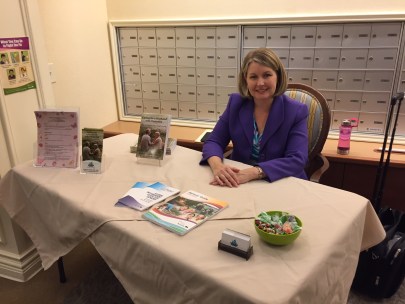
I am so glad I wore my purple suit to the Forget-Me-Not Fair at River Ridge Retirement Residence! When I arrived, there was purple everywhere! It was a very enjoyable event and was a successful fundraiser for the Alzheimer Society of Manitoba. My table was set up at River Ridge Retirement Residence near the “Post Office” and I had many people come by to ask questions about my book, other products and services.

There were about 7-8 other vendors onsite as well. I added their information to my website, “The Grey Pages – Winnipeg.” The other vendors I saw there were Wright 1 Care Inc., Friendly Caregiver Seniors Care, S.M.I.L.E. Fitness, Silvert’s Adaptive Clothing and Footwear, and Comfort Keepers. There were a couple of others I didn’t get around to connecting with.

The fundraiser included selling a potted pansy which got the purchaser’s name into a raffle.IMG_4538

When it came to my turn, I spoke to about 60 people. It was a full house. Some even watched from the upper balcony! My topic was Dementia Caregiving and I used a power point presentation format. I referred to my book, “Caring for a Husband with Dementia: The Ultimate Survival Guide.” and educated the audience on dementia, caregiving, signs and symptoms of dementia, and what you can do. I also referred to my mobile app for iPhone and iPad called, “Dementia Caregiver Solutions” as well as my other services such as counselling and consulting. The audience was very attentive and some questions were asked about Lewy Body dementia and Frontotemporal dementia. A few were concerned about their own memory problems. Some current and former caregivers were there as well.

After I went back to my table, I answered many questions about memory concerns, family issues and how to get a diagnosis. My candies were a hit and all the jellies went very quickly (note to self-bring more jellies next time!).  I sold four copies of my book after the presentation.
IMG_4536 (1)

The other speaker was Elizabeth Murray, another Winnipeg author, who wrote a book called, “Holding on to Mamie. My Mother, Dementia and Me.” We swapped books. I am looking forward to reading her book as well.

I am very grateful to Leslie Fiorino, Director of Health and Wellness for inviting me to speak at the River Ridge Forget-Me-Not Fair. I am also grateful for all the new connections I have made. I look forward to more speaking engagements and providing education and support on all things related to aging and growing older.

Thanks for reading!

For more information on me, my products and services, please go to www.AngelaGGentile.com.

Have a great day!

Angela G. Gentile, MSW, RSW


How to Improve Memory Skills

ID-100349509

Photo credit: satit_srihin, freedigitalphotos.net

I work in Geriatric Mental Health. I see all kinds of people in my practice, and surprisingly I am rarely asked questions about preventative health measures when it comes to maintaining and improving brain health. One day I was asked by a man in his 80s, “How can I improve my short-term memory?”

I brought this question about brain health back to my team (which includes a psychiatrist, and an occupational therapist/clinician). Here is the latest advice that we are recommending. I didn’t want to keep it all to myself, so here it is:

1. Keep your body healthy. Your brain is an organ just like any other. Feed it nutritious foods (see the Mediterranean Diet for example), keep stress levels down, don’t smoke, limit alcohol, keep active (at least 30 minutes of exercise a day) and get an adequate amount of rest. Consider when you do something good for your body, you are doing it for your brain health, too.

2. Try practicing “mindfulness,” a nonjudgmental and present moment awareness way of being in the world. When you keep your mind focused on what your body is doing, it offers a sense of peace and relaxation. It connects the body to the mind. Instead of daydreaming while you wash the dishes, notice the feel of the warm water on your hands. The smell of the soap. The noise the dishes make. Google search “mindfulness” and see what the latest research is showing.

3. Try a “mindful” awareness practice like Tai Chi or Yoga. These exercises combine both exercise and mindfulness and are easily adapted to suit almost everyone.

4. Do novel things. Your mind needs to be challenged. Learning and doing new things is like exercising a muscle. If you want your muscles to grow, you need to add more resistance or weights. Similarly, your brain needs to be challenged in order to grow. Learn a new language. Take music lessons. Learn how to tango. Go back to school. Try something new.

5. Try a brain games and brain training programs like “Luminosity.” Do crossword puzzles or try Sudoku. “BrainyApps” and “Elevate” are applications you can get for your smartphone or tablet. Do a Google search on “brain training” or “brain games” and find something suited for you. For fun, try playing “Words With Friends,” a mobile app version of Scrabble.

I would add a few more things: Having a variety of social connections (all ages) and healthy relationships is very important. Taking care of ourselves helps us focus on what we need to do to keep healthy. Focusing on the health and well-being of others helps us feel good about the world and each other. Caregivers need to be mindful to ensure they take care of themselves, too, so they don’t burn out. Managing our chronic illnesses like diabetes and high blood pressure help reduce our likelihood of having a stroke.

No matter what your age, keeping active and living a healthy purposeful life helps us keep engaged and thriving.

Angela G. Gentile, M.S.W., R.S.W.

Disclaimer: This information is not intended to replace the advice of your health care professional. Always consult your doctor before starting a new exercise regime.

________________________________________________________________

Angela G. Gentile, M.S.W., R.S.W. is a clinician and older adult specialist who has more than 25 years of experience working with older adults and their families in a variety of capacities. She is currently employed as a Geriatric Mental Health Clinician and enjoys writing, traveling, photography and exploring what it means to age well. She is a realistic optimist who lives in Winnipeg, Manitoba with her husband and two children.

Exploring Meditation, Spirituality and Mindfulness: Satisfying the Curious

ID-10063447

Girl Doing Yoga by ponsuwan

My curiosity has led me to learn more about meditation and the benefits of it. I have read in many books and articles the benefits of this ancient practice. One of my goals for 2016 is to learn more about meditation and how to do it. Anyone can do it at any age.

I invited a teacher (Uday, originally from India) into my home on 11 Feb 2016 and he presented his beliefs of “Self-Realization and Meditation” to my family (four of us) and one of my daughter’s friends. He was at our home for two-and-a-half hours and we learned a lot. At the end we did a 20-minute meditation. It certainly stimulated a lot of thoughts, debate and conversation.

We all had a very different experience. His teachings relate to self-realization with an emphasis on the spirit or soul. He had us think about many things. He encourages us to be human “beings”, versus human “doings.” He praises the benefits of meditation and offers his teachings as a community service to those who are interested.

I’d like to share with you some of what I learned that night and some of the thoughts from others who were at the session.

We are all made up of a body, mind and spirit. Some of us don’t believe in the “spirit” part or haven’t yet made it that far in our spiritual growth journey. I believe some of us may never believe it or get to that spiritual part in our lives. One’s upbringing, beliefs, age, or stage in life will influence and determine what level of spirituality is attained, if any. When I was young, I remember exploring organized religion. I learned about God, Jesus and faith. As I matured, and became more educated, I became more aware of my mortality. I became very conscious of my finite time on earth and started realizing my true purpose and what I really wanted in this lifetime. I called this a “spiritual awakening” and opened my eyes to what is beyond the material desires in life. I started seeing and appreciating the beauty in nature, the miracle of life and all that was good in the world.

To appreciate the concept of “spirit” or “soul,” we explored the question, “Who am I?” Uday says we are not just a body, or a mind. We are more than that. He talked about death. How are we different from animals and other living plants when we die? When we die, our body and mind and all our parts are still physically there, but “we” are gone. He asked us to think about “What is gone?” He taught us that the life force, or spirit energy is the true essence of our being. Amanda, my daughter Simone’s 17-year-old friend said she thought it was interesting to learn “you are not your body, you are your soul who is occupying your body.” My 20-year-old son Lorenzo said he feels he is all the parts put together – “body, mind, consciousness, etc.” He finds the concept of spirit hard to grasp. My mother said my grandmother didn’t believe that we had a spirit, either.

Our teacher also pointed out how humans are different from most other living entities. For example, when animals die we can still use them. We can use plants while they are living, and after they are picked. We eat the cow, we use the leather, we use the wood from the tree, we use the fruit from the plants. For people, there is no use for our bodies once we have died. They are vessels that carry our spirit from the day we are born, until the day we die. That’s the only purpose for our bodies. My son pointed out that our pet dog Rocky is not useful to us after he is gone, so there are some exceptions when it comes to pets.

What is  human life? Our teacher explained that the Life Force is oxygen. Without oxygen we will die. We breathe it in and it is needed for our body to function. He also discussed that in order for life to be possible, there is a perfect balance of the five great elements: fire, earth, water, air, ether. If it was too hot or cold, we’d die. If there wasn’t enough water, we’d die. If there was too much water, we’d drown. He said that for some, Life Force is God. I know some call it the Divine and others call it Source. For others it is Universe. Life energy is whatever you want to call it.

Life is a puzzle. Each life experience has it’s purpose, whether good, bad or indifferent. These are like pieces of a puzzle. It all fits perfectly. Each day, each moment, it’s all part of the bigger picture. We learn how to accept all parts of the puzzle, for without all the pieces, our picture would not be complete.
ID-100230273

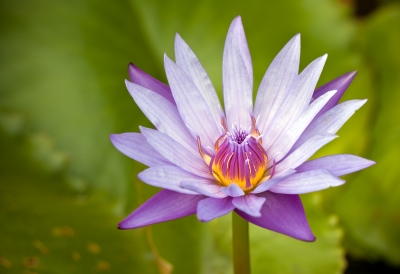
Purple Lotus by Panpote

The Lotus – A great analogy for life’s beauty amidst struggles and pain is The Lotus – from sludge, mud and slime, comes a beautiful flower. There is beauty in life no matter how difficult it gets.

Meditation clears the mind.  For me, an analogy for meditating is like having a cluttered or dirty path in front of me, and I am sweeping away the debris and clutter. This is how I see it clearing my mind or my internal being. Our teacher said it’s when the consciousness, subconscious and unconsciousness meet. Amanda found this concept interesting as well. Meditation brings consciousness to the subconscious act of breathing. He said 20 minutes a day is all that is needed. He said if we all meditated for 20 minutes a day for a week, we would all have a different experience. If a thought comes, acknowledge it, then gently turn your attention back to your breathing. For me, I liked to say to myself, “breathing in…breathing out…” He had me light a candle in and we were all asked to look at it. He instructed us to take a deep breath in, hold it for a couple seconds, then breath out and hold it for a couple seconds. Many of us closed our eyes. This eventually becomes more of a habit. The more we meditate, the happier we become. In fact, our teacher said something that really impressed my daughter Simone. He said he was the happiest person he knows! Regular meditation practices helps him control his thoughts and desires of the senses. Simone was also impressed by the fact that he “never gets sick because he can control his body.” Another thing he shared with us is that he weighs the same as he did when he got married over 40 years ago! He ended by saying that meditation experiences will be different for each and every one of us. It’s a very personal experience. Uday said meditating on a regular basis can change you and change your life. It took him about 6 months of practicing meditation on a regular daily basis and it completely changed who he is. It also cured him of his migraines. He still meditates one hour a day.

 

IMG_0162

Waterfalls in Alberta by Angela G. Gentile


Our teacher told us to make sure we enjoy what nature has to give us. Go outside. Enjoy the trees, the sky, the earth. He explained that we call our world Mother Earth, because she carries us. I would like to add travel to beautiful places if you are able. We can enjoy different parts of the world and the beauty that is on this earth.

We talked about our fears. He explained how a lot of our fears are learned. My son Lorenzo also added how many of our fears are innate, and they have been necessary for our evolution and are basic survival instincts. For example, we are born with two innate fears – the fear of loud noises and the fear of falling. Other fears developed naturally in order to ensure our survival. Some of these fears have been carried with us from a long time ago, and are no longer necessary for our survival. Still, other fears are learned and we also develop irrational fears. For further reading, check out this article called, Are We Born to Be Afraid? from Psychology Today.

Dreams are meant to be self-interpreted. Our teacher told us to throw away your dream interpretation books. He says we have to interpret our dreams for ourselves. When we have disturbing dreams, it usually means we are experiencing some mental stress. The more bizarre and disturbing our dreams, the more distressed we are. We all dream, but we don’t all remember our dreams all the time. Here’s an article from PsychCentral That explains How to Analyze Your Dreams (And Why It’s Important).

Lorenzo liked the focus on “being aware of and having more control of your thoughts, something everyone could benefit from.” I remembered I knew about the practice of mindfulness and shared a related meditation with him. This one had no religious or other afiliations. No reference to spirit or soul. He thought this was a more realistic approach to being aware of your thoughts and breathing, and it was nice having a guide talking you through it. If you’d like to check it out, Mindfulness Meditation – Guided 10 Minutes by TheHonestGuys.

My husband Cupp states that “calming the body and mind for 20 minutes a day is a beneficial addition to your daily routine. It’s ‘internal hygiene.’ Things like exercise and brushing your teeth is hygiene for the body. Meditation is like internal hygiene starting in the mind and eventually benefiting the rest of the body. The ability to reach a higher level of consciousness may come in time.”

Our teacher was very enthusiastic about sharing his knowledge and beliefs. At times some of what he was telling us was hard to believe. For example, he said meditation has been clinically proven to cure people of cancer. He also said that there was one yogi who was able to go into a vacuum chamber, was pronounced dead by doctors, then emerged three days later, alive. He claims there are ways that very advanced meditation practitioners can control their subconscious actions such as heartbeat. I’d be open to hearing more about the validity of his claims. Incidentally, my son did a Google search and found an article about a study that debunks this belief – Can Yogis Stop Their Heart?

Every one of us is at different stages of spiritual evolution and we need to be mindful of this. I appreciated the opportunity to learn more about spirit and soul, and meditation, and how the two relate based on the concept of self-realization. I am enjoying my curiosity and openness regarding this subject. Going inward takes a higher level of thinking and consciousness, something most of us find difficult to do. My son and daughter daughter do not buy into the “spirit or soul” idea quite yet. I believe for some this can take years of life experiences in order to fully appreciate the concept. Some are at the self-realization stage already, others are on their way. Some are at the very beginning of their journey. It’s hard for some people to even imagine we have a spirit as it is such an abstract concept. We can’t measure it in the scientific sense. We can’t see it either. For now, we just have to believe.

Namaste,*

Angela G. Gentile, MSW RSW
Specialist in Aging
www.AngelaGGentile.com

*Namaste is an ancient Sanskrit greeting still in everyday use in India and especially on the trail in the Nepal Himalaya. Translated roughly, it means “I bow to the God within you”, or “The Spirit within me salutes the Spirit in you” – a knowing that we are all made from the same One Divine Consciousness. (Urban Dictionary)

For further exploration:

The Spiritual Research Foundation: http://www.spiritualresearchfoundation.org/

How to chant Aum with Yogi Shanti Desai. Watch on Youtube: https://www.youtube.com/watch?v=cudh7lXZw70

Chanting vs. Meditation. An article from the Spiritual Science Research Foundation. http://www.spiritualresearchfoundation.org/spiritual-practice/steps-of-spiritual-practice/chanting/chanting-japa-meditation

How Spiritually Intelligent Are You? Take this quiz and find out. http://www.beliefnet.com/section/quiz/index.asp?sectionID=200&surveyID=90

Self-Compassion by K. Neff – A book review


51lMvyzaYcL._SX331_BO1,204,203,200_


In Kristin Neff’s (Ph.D.) self-help book, “Self-Compassion“, she does a great job of explaining the benefits of a healthy level of self-compassion and self-appreciation. She is heavy on the Buddhist philosophy, recognizing that the human experience involves pain and we are all imperfect. Although she says self-esteem and self-compassion go well together, I appreciate how she makes comparisons and explains the differences between the two. She refers to loads of research, including her own, combined with her own personal stories and anecdotes to drive the messages home in a simple-to-understand way.

I appreciate her easy-to-read and personal style of writing. As a social worker, I can see applying these concepts to not only work I do with others, but also to myself. Her exercises provide practical and easy ways to explore self-compassion in a non-threatening way. The “self-compassion mantra” is especially helpful. “Taking care of the caregiver” exercise gives the caregiver many ideas of ways to meet his/her own needs and enhance quality of life (ex. get a massage, take a walk in nature, go dancing). Many other exercises provide tools and examples of how to explore the subject in a personal way.

Overall, this book makes me think about self-compassion, self-care and how we are not really “taught” how to take care of ourselves. It leaves me with more questions and has ignited my interest and curiosity in the subject.

Angela G. Gentile, MSW, RSW
Author/Specialist in Aging
www.AngelaGGentile.com

New Book, App Promotion and Women’s Group Announced

Angela has been very busy these days and she wanted to make sure all her subscribers don’t miss out on the news. Here are some of the projects she’s been working on.

New Book

agentileebook091015v2


Her new book, A Book About Burnout: One Social Worker’s Tale of Survival is now available on Amazon.com. It’s an eBook for Kindle and it’s a personal memoir plus tips on how to recognize and survive job burnout and compassion fatigue.


FREE APP PROMOTION

Ce1xkPeBp3iH43Lal6Zrbb6b4b0hlJtyNtTo1sIRUbs


The mobile app, Dementia Caregiver Solutions for iOS 8 and up, is being offered for FREE from September 13 – 26, 2015 in recognition of World Alzheimer’s Day (September 21, 2015). Tell your friends.


NEW WOMEN’S Group

11226047_10153042578306128_1169184377110265414_n

Aging Well for Women Group on Facebook

A new members-only, CLOSED, Facebook group has been started, Aging Well for Women Group. Angela’s community Facebook page, Aging Well for Women has reached millions of people and she is excited to announce a more personalized and private experience for women. Request to join!

For more information: www.AngelaGGentile.com


Are Social Work Counselling Therapy Services Covered?

contract-reimburse1-266x300ato-tax-refund

Angela G. Gentile, MSW RSW

“Are your services covered?”

I get this question asked many times. If you are in Manitoba and would like to claim the expenses for my Social Work services, please take note of the following options:

1. Group Health Insurance Plans (Check to see if your plan covers “Social Worker”)

  • Chambers of Commerce Group Insurance Plan has included social work coverage since 2014. You pay me for the service, then I give you a receipt which will include my name, credentials, and my social worker registration number. You submit to Chambers of Commerce Group Insurance Plan for reimbursement (Johnston Group). 
  • Empire Life – I am a registered provider
  • Great West Life may provide some coverage for the services of a social worker. See Comprehensive Healthcare Plans.
  • Green Shield Canada (GSC) – I am a registered provider
  • Manitoba Blue Cross – I am a registered provider. Check out the Counselling Services information for EAP and IAP. The website states, “Counselling services are available to those who have Employee Assistance Program (EAP) or Individual Assistance Program (IAP) coverage with Manitoba Blue Cross. If you are unsure of your coverage, visit your mybluecross online account to confirm.”
  • Manitoba Public Insurance (MPI) – I am a registered provider. This service is covered under the “Fatality Claims – Grief Counselling” provision.
  • Manulife – Some plans cover social workers, so check your plan. If your plan does include social worker, then you pay for the service, get a receipt with the social worker’s name, credentials, and registration number and submit to Manulife for reimbursement.
  • Sun Life Financial Health Insurance and coverage – I am registered with the Sun Life Lumino Health Network
  • SSQ Insurance – I am a registered provider

2. Indigenous Services Canada – First Nations and Inuit Health Branch Mental Health Counselling Services

  • First Nations Inuit Health Branch – Non-Insured Health Benefit (NIHB) Mental Health Counselling Services and the Indian Residential Schools Resolution Health Support Programs (IRS RHSP) – I am a registered to provide services (free of charge) to those who qualify. This therapy is provided by funding through Indigenous Services Canada.

3. Manitoba Government Employees Health Spending Account

If you have a Health Spending Account through Manitoba Blue Cross, please see the following from the government website:

“A Health Spending Account can be easily compared to a bank account. The Province
of Manitoba deposits a pre-determined amount of benefit dollars into your account.
These benefit dollars can be used to top-off existing benefit maximums, or to pay for
any medical expenses you incur which meet the requirements for the medical expense
credit as defined by Canada Revenue Agency, for anyone for whom you claim a tax
deduction in accordance with the Income Tax Act (Canada).”

4. Medical Expenses on Income Tax Through Canadian Revenue Agency (CRA)

You may be able to claim the therapy on the CRA Income Tax Form, Line 330 – Medical Expenses for Self, Spouse or Common-Law Partner, and your Dependent Children.  Social workers are on their list of approved qualified medical practitioners for almost all provinces.

Therapy is listed as an eligible medical expense by the CRA. The following is from their website:

“Therapy – the salary and wages paid for the therapy given to a person who is eligible for the disability tax credit (DTC). The person giving the therapy must not be your spouse or common-law partner and must be 18 years of age or older when the amounts are paid.

The therapy has to be prescribed and supervised by one of the following practitioners:

  • a psychologist, a medical doctor, or a nurse practitioner (for expenses incurred after September 7, 2017) for a mental impairment
  • an occupational therapist, a medical doctor, or a nurse practitioner (for expenses incurred after September 7, 2017) for a physical impairment

For more information about the DTC, see Guide RC4064, Disability-Related Information.”

Contact Numbers:

Canada Revenue Agency (for Manitoba): 1-800-267-6999.

Manitoba Blue Cross(204) 775-0151

Clarify your eligibility for coverage prior to our first session. If you need any help finding out if you have coverage, please let me know.

References:

Manitoba Blue Cross Frequently Asked Questions: https://www.mb.bluecross.ca/faq

Medical Expenses (2020), Canada Revenue Agency

Social Work Services and Third Party Payments – Canadian Association of Social Workers

How to Boost Your Energy

iStock_000007339043Large DENTES

Photo credit: iStock_000007339043Large DENTES


I have been putting a lot of thought into Life Coaching concepts and I’d like to share my beliefs on the root cause of many peoples’ problems when it comes to feeling depleted or drained.

I often use analogies or metaphors in my work, so here is my take on how we can understand why so many of us say we are “tired” or “have no energy” and what we can do about it.

There are three main concepts when it comes to personal energy:

1. Eliminate the clog

If you have clogged arteries, the blood doesn’t flow. The same is true for clogged drains or pipes. When the blood doesn’t flow or the water doesn’t drain, we may end up with some major catastrophe. Sometimes we need to unclog the pipes. If there is too much accumulation of debris (unwanted waste), we will end up with a blockage. If we imagine that debris is our emotional stress, physical clutter, or other unwanted things we want out of our life, this is what can block our energy flow.

  • Make a list of these unwanted items/situations. Work on eliminating one item at a time to help unclog the energy flow. It’s not easy and sometimes it takes another person to help us with this. This will help the energy flow better.

2. Close the drains and fix the leaks

Imagine trying to fill up a sink with water. In my bathroom, I have one of those stubborn metal levers that you pull on to close the drain. If the drain doesn’t close properly, down the sink goes the water. I try to fill the sink with water as it’s going down the drain. Or imagine you have a big pool, and it springs a leak. You have to keep adding water to the pool until you get the leak fixed.  This is an analogy to trying to boost yourself up with positive and helpful energy, and as fast as you are adding it to your energy pool, it’s going down the drain or leaking out. It’s important to get those stoppers and leaks fixed so that you can reserve that precious energy for when you really need it.

  • Reflect on what your energy drains are. Fix them or eliminate them altogether. When these drains are corrected, the energy you have will be allocated in a positive direction.

3. Keep the positive energy flowing and utilized in the most efficient way possible

I know for myself, I get a boost of mental and physical energy when I exercise. It gets my blood pumping and keeps the positive energy flowing. I have better energy flow when I feel happy, when I am productive and when I have exciting plans (travel, projects, etc.). I feel energized after a great nights’ sleep. Plus, I feel more energy after drinking one of my favourite caffeinated beverages. 🙂

  • Explore where your supply of positive energy comes from. Make sure you get a sufficient dose on a regular basis so that you have enough energy to handle whatever may come your way. Life isn’t always easy, so we need lots of energy in storage to handle those difficult times. This will ensure we have the energy to “get back up again.”

Please share your experiences and thoughts on the subject of energy drains and energy boosts.

Angela G. Gentile, MSW RSW, Specialist in Aging
www.AngelaGGentile.com