“Caring for a Husband with Dementia” Book Now Available In Winnipeg Libraries

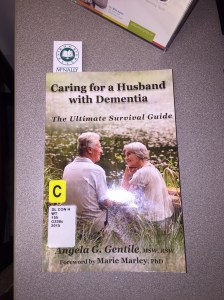
IMG_1977

As seen at J.W. Crane Memorial Library at Deer Lodge Centre

I am pleased to announce that the book, Caring for a Husband with Dementia: The Ultimate Survival Guide (2015) is now available in the Winnipeg Public Library* as well as J. W. Crane Memorial Library (Deer Lodge Centre, 2109 Portage Avenue, Winnipeg).

(*As of 05 Oct 2015, the book was on order for three Winnipeg libraries: Henderson Library, Louis Riel Library and Millenium Library. Request your copy now!).

Angela G. Gentile, MSW, RSW


Don’t Let a Hearing Impairment Stop You From Getting Help

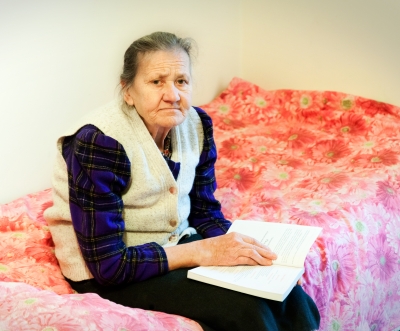
81GgA8NyrcL._SL256_

This woman is wearing a Pocketalker and she can hear better!

Don’t let hearing impairment stop you from seeking help!

For counselling or consulting with those who are hearing impaired, I use a “Pocketalker” by Williams Sound with hygienic covers for the earphones (or you can use your own earbuds or earphones). This device can be used with existing hearing aids.

Pocketalker ULws_pkt_d1_ehTRA System

Improve your hearing – improve your life with the new Pocketalker Ultra from Williams Sound! The Pocketalker Ultra amplifies sounds closest to the listener while reducing background noise. The Pocketalker Ultra features a lightweight, ergonomic design for portability and ease of use. Finger tip adjustable volume control allows you to quickly adjust to your listening environment – whether your hearing loss is low frequency or high frequency sounds. The listening accessories jack accommodates for a variety of earphone and headphone options. Use the Pocketalker Ultra with an optional neckloop (NKL 001) to amplify a telecoil-equipped hearing aid.

To purchase a Pocketalker, check out the Williams Sound website.

If you or someone you know has special needs, please let me know and I will accommodate as best as I can.

Angela G. Gentile, MSW, RSW
Specialist in Aging
http://www.AngelaGGentile.com

Image credits:

  • Lady in wheelchair: https://images-na.ssl-images-amazon.com/images/I/81GgA8NyrcL._SL256_.jpg
  • Pocketalker: http://www.williamssound.com/catalog/pkt-d1-eh

Today’s Woman: Life Balance Secrets (Book Review)

IMG_2235

When you read “Today’s Woman: Life Balance Secrets” (2014) by Miriam Castilla, it is like having your own motivational life coach right by your side. Self-awareness, life strategies, and self-care are essential to achieving life balance, satisfaction and fulfilment. Castilla gives you a wide variety of tips on how to do it.

Castilla, an entrepreneur and finance advisor, gets you thinking positive starting at chapter one as she has you determine what your definition of success is. She gives you a step-by-step method to help you visualize what it would feel like to be very successful.  She explains her definition goes like this — “Success is doing all you love and loving all you do.” She helps you come up with your own.

Castilla, uses the “Pinwheel Principle” as an analogy to demonstrate your need for a balanced life in order to be efficient. She describes the ideal “life pinwheel” to be balanced in these four areas: Body, Mind, Self, Others. She states keeping these areas in balance helps you take a holistic approach to having a well-balanced, amazingly satisfied and fulfilling life.

Castilla also gets you thinking about your five core values and your three central ones. Momentum is gained as you define goals in chapter seven. Part three was most helpful to me, in that I was able to hone in on all those practical tips that help me focus on my goals.

Throughout the book, Castilla injects her personal stories to help us understand how the strategies apply. She helps you think about concepts in a different way. For example, in terms of a bucket list, she tells you that she “fills up her bucket” versus strokes things off the bucket list. As another example, she advises you to not be so hard on yourself for being efficient at what you do.

I particularly enjoyed the section called, “Run Away to the Circus” and the need to have a “crazy sh#t friend!” As part of the “Feed Your Soul” teachings, she tells you about all her adventures and it is very amusing and thought-provoking.

Any professional woman will find this book comforting and motivating. “Today’s Woman: Life Balance Secrets” is a delightful, inspiring read.

Buy Now on Amazon:

Today’s Woman – Life Balance Secrets: Practical Tips & Tricks for Overcoming Stress, Guilt and Overwhelm

Angela G. Gentile, MSW, RSW

http://www.AngelaGGentile.com

New Book, App Promotion and Women’s Group Announced

Angela has been very busy these days and she wanted to make sure all her subscribers don’t miss out on the news. Here are some of the projects she’s been working on.

New Book

agentileebook091015v2


Her new book, A Book About Burnout: One Social Worker’s Tale of Survival is now available on Amazon.com. It’s an eBook for Kindle and it’s a personal memoir plus tips on how to recognize and survive job burnout and compassion fatigue.


FREE APP PROMOTION

Ce1xkPeBp3iH43Lal6Zrbb6b4b0hlJtyNtTo1sIRUbs


The mobile app, Dementia Caregiver Solutions for iOS 8 and up, is being offered for FREE from September 13 – 26, 2015 in recognition of World Alzheimer’s Day (September 21, 2015). Tell your friends.


NEW WOMEN’S Group

11226047_10153042578306128_1169184377110265414_n

Aging Well for Women Group on Facebook

A new members-only, CLOSED, Facebook group has been started, Aging Well for Women Group. Angela’s community Facebook page, Aging Well for Women has reached millions of people and she is excited to announce a more personalized and private experience for women. Request to join!

For more information: www.AngelaGGentile.com


Are Social Work Counselling Therapy Services Covered?

contract-reimburse1-266x300ato-tax-refund

Angela G. Gentile, MSW RSW

“Are your services covered?”

I get this question asked many times. If you are in Manitoba and would like to claim the expenses for my Social Work services, please take note of the following options:

1. Group Health Insurance Plans (Check to see if your plan covers “Social Worker”)

  • Chambers of Commerce Group Insurance Plan has included social work coverage since 2014. You pay me for the service, then I give you a receipt which will include my name, credentials, and my social worker registration number. You submit to Chambers of Commerce Group Insurance Plan for reimbursement (Johnston Group). 
  • Empire Life – I am a registered provider
  • Great West Life may provide some coverage for the services of a social worker. See Comprehensive Healthcare Plans.
  • Green Shield Canada (GSC) – I am a registered provider
  • Manitoba Blue Cross – I am a registered provider. Check out the Counselling Services information for EAP and IAP. The website states, “Counselling services are available to those who have Employee Assistance Program (EAP) or Individual Assistance Program (IAP) coverage with Manitoba Blue Cross. If you are unsure of your coverage, visit your mybluecross online account to confirm.”
  • Manitoba Public Insurance (MPI) – I am a registered provider. This service is covered under the “Fatality Claims – Grief Counselling” provision.
  • Manulife – Some plans cover social workers, so check your plan. If your plan does include social worker, then you pay for the service, get a receipt with the social worker’s name, credentials, and registration number and submit to Manulife for reimbursement.
  • Sun Life Financial Health Insurance and coverage – I am registered with the Sun Life Lumino Health Network
  • SSQ Insurance – I am a registered provider

2. Indigenous Services Canada – First Nations and Inuit Health Branch Mental Health Counselling Services

  • First Nations Inuit Health Branch – Non-Insured Health Benefit (NIHB) Mental Health Counselling Services and the Indian Residential Schools Resolution Health Support Programs (IRS RHSP) – I am a registered to provide services (free of charge) to those who qualify. This therapy is provided by funding through Indigenous Services Canada.

3. Manitoba Government Employees Health Spending Account

If you have a Health Spending Account through Manitoba Blue Cross, please see the following from the government website:

“A Health Spending Account can be easily compared to a bank account. The Province
of Manitoba deposits a pre-determined amount of benefit dollars into your account.
These benefit dollars can be used to top-off existing benefit maximums, or to pay for
any medical expenses you incur which meet the requirements for the medical expense
credit as defined by Canada Revenue Agency, for anyone for whom you claim a tax
deduction in accordance with the Income Tax Act (Canada).”

4. Medical Expenses on Income Tax Through Canadian Revenue Agency (CRA)

You may be able to claim the therapy on the CRA Income Tax Form, Line 330 – Medical Expenses for Self, Spouse or Common-Law Partner, and your Dependent Children.  Social workers are on their list of approved qualified medical practitioners for almost all provinces.

Therapy is listed as an eligible medical expense by the CRA. The following is from their website:

“Therapy – the salary and wages paid for the therapy given to a person who is eligible for the disability tax credit (DTC). The person giving the therapy must not be your spouse or common-law partner and must be 18 years of age or older when the amounts are paid.

The therapy has to be prescribed and supervised by one of the following practitioners:

  • a psychologist, a medical doctor, or a nurse practitioner (for expenses incurred after September 7, 2017) for a mental impairment
  • an occupational therapist, a medical doctor, or a nurse practitioner (for expenses incurred after September 7, 2017) for a physical impairment

For more information about the DTC, see Guide RC4064, Disability-Related Information.”

Contact Numbers:

Canada Revenue Agency (for Manitoba): 1-800-267-6999.

Manitoba Blue Cross(204) 775-0151

Clarify your eligibility for coverage prior to our first session. If you need any help finding out if you have coverage, please let me know.

References:

Manitoba Blue Cross Frequently Asked Questions: https://www.mb.bluecross.ca/faq

Medical Expenses (2020), Canada Revenue Agency

Social Work Services and Third Party Payments – Canadian Association of Social Workers

How to Boost Your Energy

iStock_000007339043Large DENTES

Photo credit: iStock_000007339043Large DENTES


I have been putting a lot of thought into Life Coaching concepts and I’d like to share my beliefs on the root cause of many peoples’ problems when it comes to feeling depleted or drained.

I often use analogies or metaphors in my work, so here is my take on how we can understand why so many of us say we are “tired” or “have no energy” and what we can do about it.

There are three main concepts when it comes to personal energy:

1. Eliminate the clog

If you have clogged arteries, the blood doesn’t flow. The same is true for clogged drains or pipes. When the blood doesn’t flow or the water doesn’t drain, we may end up with some major catastrophe. Sometimes we need to unclog the pipes. If there is too much accumulation of debris (unwanted waste), we will end up with a blockage. If we imagine that debris is our emotional stress, physical clutter, or other unwanted things we want out of our life, this is what can block our energy flow.

  • Make a list of these unwanted items/situations. Work on eliminating one item at a time to help unclog the energy flow. It’s not easy and sometimes it takes another person to help us with this. This will help the energy flow better.

2. Close the drains and fix the leaks

Imagine trying to fill up a sink with water. In my bathroom, I have one of those stubborn metal levers that you pull on to close the drain. If the drain doesn’t close properly, down the sink goes the water. I try to fill the sink with water as it’s going down the drain. Or imagine you have a big pool, and it springs a leak. You have to keep adding water to the pool until you get the leak fixed.  This is an analogy to trying to boost yourself up with positive and helpful energy, and as fast as you are adding it to your energy pool, it’s going down the drain or leaking out. It’s important to get those stoppers and leaks fixed so that you can reserve that precious energy for when you really need it.

  • Reflect on what your energy drains are. Fix them or eliminate them altogether. When these drains are corrected, the energy you have will be allocated in a positive direction.

3. Keep the positive energy flowing and utilized in the most efficient way possible

I know for myself, I get a boost of mental and physical energy when I exercise. It gets my blood pumping and keeps the positive energy flowing. I have better energy flow when I feel happy, when I am productive and when I have exciting plans (travel, projects, etc.). I feel energized after a great nights’ sleep. Plus, I feel more energy after drinking one of my favourite caffeinated beverages. 🙂

  • Explore where your supply of positive energy comes from. Make sure you get a sufficient dose on a regular basis so that you have enough energy to handle whatever may come your way. Life isn’t always easy, so we need lots of energy in storage to handle those difficult times. This will ensure we have the energy to “get back up again.”

Please share your experiences and thoughts on the subject of energy drains and energy boosts.

Angela G. Gentile, MSW RSW, Specialist in Aging
www.AngelaGGentile.com

Aging with Grace is All About Acceptance and Attitude

Aging with grace logo

Aging with Grace Defined Survey Results


What does “Aging with grace” mean to you?

To help me get a sense of what this term really means, I surveyed 24 people of all ages (most aged 50-69) and asked them to define “Aging with grace.” I enjoyed reading through the responses and I’d like to thank everyone who participated. I’d like to share with you what I learned, and I will also include my own thoughts on the subject.

“Grace is a quality that many aspire to, but I think in the context of today’s society, what defines grace is somewhat elusive.” – Survey respondent, 49 or under

For the most part, aging with grace is one’s ability to accept growing older and all the changes that come with it. We could almost change the term to, “Aging with Acceptance.” Aging (or the passing of the years) brings many changes to our appearance and abilities (physically, mentally); it also brings changes to the world and our lives. Aging with grace means we are able to accept, adapt and accommodate these changes.

The attitude we carry into our later years will also influence our ability to age with grace.

People who are aging gracefully…

  • accept aging
  • are happy
  • are confident
  • are wise
  • live a healthy and active lifestyle

Regarding “healthy” lifestyle — as we age, our risk for developing age-related illnesses and diseases increases. I think it is important that even if we develop health conditions, we take care of ourselves and try to recover quickly or learn how to live well with chronic illness. I know many people who are aging with grace despite chronic illnesses. It all comes down to attitude.  For example, does arthritis become who you are or is it just something you need to live with and manage?

“Grace is an inside job with outside effects.” – Survey respondent, 49 or under

If we are able to practice self-love as we age, by “nurturing our bodies and minds,” (Survey respondent, 50-69) we tend to be happier and more at peace. It helps us improve our confidence, and live a life that is in line with our true and authentic selves. As we become more compassionate about ourselves we will become more compassionate about others. We can continue to be “gracious to others, and make people feel good”, no matter what their age (Survey respondent, 50-69).

“Aging with grace means aging with confidence, valuing the experience, knowledge and wisdom that comes with age, and rising above a youth-oriented culture.  – Survey respondent, 50-69

Harnessing the wisdom and personal power that comes with age helps us age with confidence. There is great significance in the realization of the value of knowledge and experience gained from years lived. Only then are we able to choose to live a life designed and driven by our own personal values. We realize that we are responsible for our own lives and decisions are made with the wisdom that comes with age and the personal power that we embrace and celebrate.

“Allowing the power and wisdom of aging to be apparent in one’s presence –      including the ability to break stereotypes of aging.” – Survey respondent, 50-69

Being present in the moment in the here-and-now, while focusing on the good things in our life will help us live and age with gratitude. Practicing mindfulness will help us age with grace.

The ability to re-frame our challenges and limitations can help improve our outlook and overall attitude. Being resilient in the face of adversity will also help us a great deal.

Living a conscious life, knowing that we have a finite time here on earth, enables us to focus on living a life that honours our individual values and goals.

I can also tell you what aging with grace IS NOT. It is not about complaining – such as “moaning upon standing” or “whining about wearing reading glasses.” Aging with grace is “void of anger, regrets and baggage from the past.”

The more we learn to accept aging as a normal lifelong process, make peace with it (not war), the happier and more confident we will be.

I’ll leave you with this: Only one person over 70 answered the survey, and gave me something to laugh about. When asked, “How would you define aging with grace?” the answer was:

“I don’t know anyone named Grace, but, I am aging.”

The survey will remain open for a few more weeks, so if you’d like to give me your definition of Aging with Grace, please go to this survey and answer three quick questions. Thanks!

Have your say – please comment below. I’d love to hear from you.

Angela G. Gentile

purple-swirl-separator-hi

Angela G. Gentile, MSW, RSW is a clinical social worker who specializes in aging. She has helped hundreds of people who are struggling with the challenges aging can bring. Angela is passionate about challenging ageist myths and stereotypes and exploring what it means to age well. She considers herself a realistic optimist but she still can’t tell her left from her right. Find out more at http://www.angelaggentile.com.

Read a Sample Chapter of “Caring for a Husband with Dementia”

20140605_122948

Getting a Diagnosis

“The process of figuring out what is causing dementia is often not that simple.” – Angela G. Gentile

In case you are interested, I am offering a sample chapter of my book, Caring for a Husband with Dementia: The Ultimate Survival Guide. The sample I chose is Chapter 2, Getting a Diagnosis. It is six pages in the book (11-16) and it is a good representation of how most of the chapters are written. It ends with some questions to answer regarding what was covered in the chapter.

I hope this sample will give you a feel for the the way the book is written. I also hope it will give you some information on “Getting a Diagnosis.” (The photo shown here is mine, by the way.)

Read the sample chapter.

Have a great day!

Angela G. Gentile

Men Concerned About Developing Dementia Want Their Partners to Read This Book

IMG_1407

“Caring for a Husband With Dementia: The Ultimate Survival Guide” has been out for almost two months now. I have been to a few events since my book launch. On Saturday, May 9, 2015, Coles – Kildonan Place (Winnipeg) hosted a book signing event for me. This is my second time doing an event like this, and I couldn’t find any “How To” on the subject. I’ve been learning as I go.

BUY THE BOOK – Caring for a Husband with Dementia

I suited up; packed up my signing pen, rack cards, business cards and candy dish and headed over to Coles with a positive mindset. I was looking forward to the event, hoping to connect with lots of people. Since I only sold one book at my first event (and the author sharing a table with me that day sold two books) I hoped to sell one or two books at my second event.

What I find most memorable from the event are the people who stoped by to chat. I appreciate when people open up and tell me their stories. My sister-in-law even stopped by on her lunch break to see me and I got her to take a picture (see above).

A middle-aged man stopped by to say he wants to buy the book for his wife. I wasn’t sure if he was joking or not. But he went on to explain that he feels his chances of developing dementia are high because both of his parents had Alzheimer’s. He said his wife doesn’t want to talk about it. I encouraged him to take a rack card and wished him all the best.

People seemed to enjoy the candies I was offering. Many children stopped by to take a caramel or a Lifesaver. It was interesting to hear the parents direct them to, “Say thank you.” Some asked for permission to take, others just dove right in.

A younger couple told me about the man’s head injury from years ago and that he has been told he’ll most likely develop dementia when he gets older. He wanted his girlfriend to get the book so that when and if that time comes she’ll be well prepared. They were a sweet couple and she appears to be committed to the relationship and whatever may come down the road.

20150508_075554_resized

A few people took my rack card. It’s a bigger version of a bookmark with information about me and my products including my mobile app for caregivers. One young woman said she couldn’t afford to buy the book ($19.95 CDN) but asked me to sign the rack card for her. I told her I am working on getting the book into the library but that it takes time.

I chuckled to myself when a man in his late 70’s flirted with me. He told me how good I looked as he gave me a little wink and whistle. About a half-hour later he came back my way and he said I had nice legs. Both times I smiled and said, “Thank you.”

At the end of my two-hour event, a woman came to me with a smile, and told me I looked lonely. She went on to tell me about her experience of looking after her husband who had dementia. He eventually became quite aggressive and had to be moved to a nursing home. He died about a year ago. Now her neighbour is going through the same thing. She bought a book and asked me to sign it in memory of her late husband. She planned on sharing it with her neighbour or anyone else who may benefit from it.

I ended up reaching my goal for sales. Selling two books in two hours doesn’t seem like a lot, but I was told that some authors don’t sell any books. It has been the bookstore’s experience sometimes the customers come back during the week to purchase the book. Some of them don’t buy when the author is there, but choose to come back at a different time. I have also read that sometimes a person needs to hear about, read about, or see a book seven times before they buy it. So, any exposure is good exposure.

Overall, I really enjoyed my book signing event and I would say it went well. I especially enjoyed talking to people about their experiences. I learned that men want their partners to read this book. I also learned that men in their late 70’s like to flirt with middle-aged authors. 😉

Have a great day!

Angela G. Gentile

purple-swirl-separator-hi

Angela G. Gentile, MSW, RSW is a clinical social worker who specializes in aging. She has helped hundreds of people who are struggling with the challenges aging can bring. Angela is passionate about challenging ageist myths and stereotypes and exploring what it means to age well. She considers herself a realistic optimist but she still can’t tell her left from her right. Find out more at http://www.angelaggentile.com.

Book Launch Highlights and Video

 Caring for a Husband with Dementia:

The Ultimate Survival Guide

On Thursday, April 16, 2015, a book launch celebration for Caring for a Husband with Dementia was held at McNally Robinson Booksellers in Winnipeg. There were approximately 55-60 people attending the event, and there was wine and other refreshments. The event was sponsored by Comforts of Home – Care. Click on the arrow above to watch the 26-minute video or go to this link: https://www.youtube.com/watch?v=CyjUQcmnc14

Find out how to get the book: http://www.angelaggentile.com/book

SAMSUNG CAMERA PICTURES

Pictured above is my husband Agapito (who doesn’t have dementia) and I. He made brownies and they were very yummy.

IMG_1554

I started out mixing with the crowd and I was pleased to see so many friendly and familiar faces. I handed out the books that I had gifted to some of the guests. I then moved on to do my presentation. It lasted about 25 minutes.

IMG_1571

One of the wife caregivers (Merrilee) also presented and she did a great job. She presented with warmth, humour and honest emotion.

IMG_1572

After the presentation, I signed books. It was a bit of a challenge to figure out what to say. I goofed up a couple of times, but I guess that’s to be expected. Not sure if it was the excitement or the wine, LOL. 🙂

IMG_1606

I had a designated photographer and videographer, and I got some great shots and video. It went from 7:30 – 9:00pm. I received a dozen beautiful white roses and a gift of David’s Tea from some special friends.

SAMSUNG CAMERA PICTURES

All in all, it was a fantastic event, and I found the whole evening surreal. Thank you to all who made the event a memorable one.

Sincerely,

Angela G. Gentile

purple-swirl-separator-hi

Angela G. Gentile, M.S.W., R.S.W. is a clinical social worker who specializes in aging. She has helped hundreds of people who are struggling with the challenges aging can bring. Angela is passionate about challenging ageist myths and stereotypes and exploring what it means to age well. She considers herself a realistic optimist but she still can’t tell her left from her right. Find out more at http://www.angelaggentile.com.