“Tax Fraud” Scam Phone Call Alert

PhoneScam

I received a message on my answering machine on Monday July 11, 2016. The message went like this:

“The reason behind this call is to notify you that we have registered a criminal case against ‘your name’ concerning ‘tax agency’ and tax fraud. So, if you need more information about this case, you can call our direct line number which is: 613-505-4790. I will repeat the number, 613-505-4790. Call back as soon as possible. Thank you.”

Have a listen:

I also received an email from a dear friend warning me of these kinds of scams going around. Many people have become victims, unfortunately. The send money to the perpetrators thinking that they are actual government officials.

These scams can cause people a lot of worry and fear. Older adults and newcomers to our country are especially at risk. I even know of a middle-aged woman who was dragged into this as she thought it was real.

I also know of a woman with early dementia who has taken this kind of scam to heart. She truly believes she is going to be arrested and she is fearing for her safety. Her family worry about her mental health.

If you receive a call like this, report it to the Canadian Anti-Fraud Centre or your national anti-fraud unit in your country (e.g., FBI in USA).

If you or anyone you know has been defrauded, deceived, tricked or robbed contact your local police.

Check out this Canada Revenue Agency article: Protect Yourself Against Fraud


Angela G. Gentile, MSW, RSW

http://www.AngelaGGentile.com


A Canadian AncestryDNA Reveal


806f3d0a463e40689e4247690c75b609

I received some gift money for my 50th birthday. I wanted to do something special. I considered getting a nice piece of jewelry, but instead I decided to get my DNA tested through AncestryDNA.com.I am really happy I did it because now I can truly say what my heritage is.

We all have a unique set of DNA and it carries our genetic information. We inherit or “receive” our genes from our parents, who receive them from their parents, and so on, way back through the generations.

I have done some genealogy (Family Tree history) over the years, and I know that my parents and three grandparents were all born in Canada (one was born in the USA). My great-grandparents were born in Canada, Sweden and Scotland. Through my research, I learned my  great-grandparents and their parents (my great-great-grandparents) on my fraternal grandmother’s lineage were all born in Sweden.

Prior to getting my DNA results, I guessed that my ancestry was about 60% Great Britain (including Scotland, Wales and England) and 25% was Europe North (Scandinavian/Swedish).

I was very surprised to find out that I am 97% European! I was born in Canada, have lived here all my life, but my DNA is primarily European. This is how my “Ethnicity Estimate” breflat,1000x1000,075,faks down:

  • 30% Scandinavia (Norway, Sweden, Denmark)
  • 23% Ireland
  • 17% Great Britain
  • 11% Europe East (Includes Poland, Slovakia, Czech Republic, Russia, Austria)
  • 10% Finland/Northwest Russia
  • 6% Trace Regions – Includes 4% Italy/Greece (I married an Italian!), 1% Europe West, and less than 1% European Jewish and Iberian Peninsula.

The remaining 3% is comprised of traces (less than 1%) of Native American, Asia South (India) and West Asia (Middle East such as Saudi Arabia).

16531202729_25e77cf232

I find my results very interesting and it makes me realize that although I was born in Canada and my parents are also from Canada, my DNA mainly originated from Europe. I don’t even think I can really call myself Canadian after learning this. (I also have a Canadian Passport!)

AncestryDNA also notified me to say that I have some possible matches in their database and two are possible 2nd-3rd cousins! Confidence level: Extremely High. I have sent them both an email asking if they would like to explore this further.

Maybe I should get into Scandinavian art. I’ve always liked painting and I love old folk art. Maybe I’ll have to take a trip to Sweden and Ireland! I will have to explore all those other cultures in my heritage, too (e.g., Poland, Finland and Austria).

If you are interested in knowing more about your DNA and ancestry, it’s a fun thing to do. It costs about $129.00 Canadian (www.AncestryDNA.ca).

I recorded my reveal on video. Take a look if you are interested in hearing/watching my reaction (6 minutes).

Thanks for reading and watching.

Angela G. Gentile MSW, RSW

http://www.AngelaGGentile.com


Senior Moments: Should I Be Worried?

senior-moment2

Although I don’t particularly like the term “senior moment,” most older people know what that means. When someone who is at middle age or beyond has difficulty remembering something such as, “Where did I put my reading glasses?” or “I can’t remember her name” he/she may find someone else responding in a joking fashion, “Are you having a ‘senior moment?'” The other person is replying with a joke about having a poor memory. I have heard people themselves make jokes about their own “senior moments” in hopes of making light of the situation. It’s true that as people age there are normally changes in memory and thinking skills. On one end of the spectrum there is normal aging that affects everyone. At the other end is dementia which is common but not normal.  In between is a condition known as mild cognitive impairment. I will touch on all three.

We all have memory lapses on occasion

It’s true we all have occasional lapses in our memory. I even see my teenage children doing it. I even remember walking into a room years ago, forgetting what I went in there for, having to go back to what I was doing in order to jog my memory. Little lapses in memory is common for everyone. We get distracted or side-tracked especially when it is something that is not really that significant. Forgetting names is a common occurrence for example.

I have been working with older adults for over 25 years now and I see all different types of memory and thinking problems. I also know many older people (including caregivers) who do not show any signs of cognitive (brain function) decline.

I often note increased anxiety in people who are struggling with the loss of cognitive abilities. It must be a scary feeling to know that they are losing their faculties.

One of the common fears people have is developing dementia. Declining memory skills are often one of the first signs of dementia. The good news is that memory problems do not always lead to dementia.

Normal aging, mild cognitive impairment and dementia

Slowed thinking and minor problems with remembering things is quite common and almost expected in our later years. There are some things we can do to help reduce our risks of further problems with our cognition such as exercising (to get the blood pumping to our organs including the brain) and doing brain exercises (such as crosswords and learning a new musical instrument). Normal aging causes us to slow down in more ways than one.

Sometimes our memory problems become more problematic and they are noticed by other people. If you are continuously forgetting someone’s name or miss appointments, this may start to interfere with your relationships and daily functioning. You may have to learn new ways of coping with the normal changes in your brain such as keeping lists handy and using your calendar more regularly. Memory and thinking problems that can be noticed by others but don’t really affect your day-to-day functioning is called Mild Cognitive Impairment (MCI).

By the way, it’s a good sign if a person is aware of or concerned about their changing memory skills as one of the skills lost in dementia is the ability to know they have problems with their memory. If you ask someone with dementia if he/she has memory problems, he/she will most likely say “No.” It’s true that long term memory may still be intact.  It’s the ability to remember recent events and learn new information that is lost.

In some cases your memory skills, thinking and cognitive functioning may be impaired to the point where you can no longer do things on your own. For example, you may need someone to give you your medication on a daily basis or else you will forget. Or you can no longer drive because your sense of direction is off. Dementia is a syndrome and can be found in a variety of conditions  that affect cognition (such as Alzheimer’s disease). In early stages of dementia you can  live on your own as long as you can enlist the support you need to keep yourself safe. Dementia can create a variety of problems. For example, sometimes people with dementia forget to eat, or think they have already eaten. In this case it’s important to have someone provide a reminder or stop by to ensure he/she eats. In the later stages of dementia, it is not possible to live alone.

Seek a memory assessment if you are concerned

If you are concerned about your memory skills or other brain-related functions (such as language, problem-solving or judgment skills), please speak to your doctor for a memory assessment. Let your doctor know if you are concerned your problems are beyond the changes seen in normal aging (such as slowed thinking, and the occasional difficulty remembering things). Only a skilled practitioner can diagnose and determine the difference between normal aging, mild cognitive impairment and dementia, and provide treatment and management solutions.

For more information, check out National Institute on Aging’s  Memory, Forgetfulness, and Aging: What’s Nomal and What’s Not.

You may also like to check out Senior Moments Explained by Terry Hollenbeck, M.D.

Angela G. Gentile, MSW RSW

www.AngelaGGentile.com

Malnutrition: A Hidden Epidemic in Older Adults

Over the years, many older adults have let me into their homes because they have been referred to one of the health programs I work for. Part of my job as a geriatric clinician requires me to assess the person and to ask them information about their private lives, including their appetite. I then ask for their height and weight and if they have gained or lost any weight over the last few months. I am even required to ask if it is okay to open their fridges to see what kind of food they consume (I also check expiry dates to be sure no one is neglecting to dispose of rotten food).

Sometimes I come across older adults who have lost a lot of weight. Most of them live on their own. Many of these people have other conditions such as memory loss, decreased mobility, and serious medical problems such as diabetes or heart disease.

Some of the most remarkable weight loss situations in my experience has been found in people with Alzheimer’s or a related dementia. Someone with dementia may forget to eat, forget how to prepare a meal, or have a decreased appetite. They may simply forget how to get food (arrange transportation, grocery shop, order groceries) or have an inability to problem solve their situation.

Proper nutrition and hydration are very important to help keep a person’s body (and mind) strong and running optimally. Here’s a great video from Alliance for Aging Research that explains the hidden epidemic of malnutrition in older people.

If the video doesn’t work for you, try this YouTube link: https://youtu.be/iPNZKyXqN1U

Check out the YouTube channel for Alliance for Aging Research for more great videos like this.


Angela G. Gentile, MSW, RSW

www.AngelaGGentile.com


You’re Getting Old!

1

Time is ticking…

Useless trivia time! I came across this website that has some mildly interesting and unique facts that are based on a birth date. It’s called “You’re Getting Old!” You can enter your own birth date or that of someone else and come up with a whole bunch of useless information. Ha!

You can find out how many days old you are, or how many candles you’ve “lit” in your lifetime. You can find out when you will hit special milestones. For example, do you know what day you turn 20,000 days old? I do. And if I live to be 40,000 days old I’ll be almost 110. That will be on the 24th of September, in 2075!

There is so much I have learned, including:

  • The number of people on earth has more than doubled since I was born.
  • I have taken over 404 million breaths. (The number rolls over every breath I take, just like the odometer on the car.)

You can find out what special events occurred in history during your lifetime and how old you were. How old were you when the World Wide Web was announced to the public by Tim Berners-Lee? Were you even alive yet?

Check out this fun website for some useless trivia because, You’re Getting Old!

http://you.regettingold.com/


Angela G. Gentile, MSW, RSW


An Empowering Read for Women, Business Owners and Marketers

grey-new-greem-1

GeroFuturist Karen Sands’ book, “Gray is the New Green: Rock Your Revenues in the Longevity Economy” (2016) is THE book you need to read if you are a middle-aged career women, business owner or marketer and are looking for lucrative opportunities. This small but mighty book covers topics such as ageism in society, business trends, marketing, careers and entrepreneurial opportunities in the field of aging, unretirement, reinvention, and visionaries. Sands intersperses loads of great data and statistics and references other thought leaders throughout the book, providing convincing evidence and support to her thoughts and ideas on “gray is the new green.” She encourages a narrative “re-storying” approach to positively changing the way we think about aging, careers and business.

She uses some familiar and unfamiliar terms such as:

– Longevity Economy
– Ageless Women
– Ageless Technology
– Conscious Aging
– Positive Aging
– Educational Gerontologist
– Age-Friendly Workplace
– Boomerpreneurs
– Solopreneurs
– Grannypreneurs

Hopefully these terms will be defined in Sands’ online glossary (not available at time of printing).

The book is sectioned into three chapters. The last chapter repeats most of what was in the first two. There were many topics that stood out for me as a 50-year-old woman. Sands talks about “The Change” (menopause) and embracing our “Inner Crone.” She empowers the reader when she tells us we can “radically reframe the stories we tell ourselves about aging.” It jolted me a bit when she proclaims 50 is universally “Over the Hill” according to Human Resource (HR) directors.

Sands challenges marketers to get beyond the rampant “malevolent ageism” in corporate marketing. She gives a few examples of how advertisers are inadvertently turning off women aged 50 and up who are the “highest increasing-spenders” in the fashion and beauty industries by creating offensive ads that portray older women in a negative way.

For businesses to succeed in this “Gray Tsunami” era, Sands recommends that diversity, gender equality and work-life balance initiatives must be welcomed and incorporated. She warns businesses that don’t adopt and welcome these changes will be left behind.

For those interested in working with or for the aging population, she states the “field of aging is evolving at warp speed.” She gives a listing of up-and-coming careers and opportunities in the aging field such as “cutting-edge age-friendly technology and devices, home design…and adult education.”

karen-vhw

Karen Sands, GeroFuturist

Sands sheds some light on the notion of retirement and how our extended middle-age is changing the way we view working in our later years. She says, “Aging does not mean retiring.” She discusses how people are reinventing themselves, or they are “unretiring.” Others are choosing not to retire. She predicts employees and leaders alike will be working until they die.

For those Boomer Women who want to reinvent themselves by starting up a new business, she provides lots of great advice and questions to think about in Chapter 2. She offers a great tip for a business idea, which is to offer a product or service that can help people save time. She tells women to “awaken their visionary voice” and states “it is never too late to be a visionary.” In Chapter 3 she states although some women may not be ready for this change yet, she encourages them to do the “prep work” now so that they can “leap with confidence” when they are ready.

Although there is not much new in Chapter 3, I love the advice she gives regarding aging. Sands writes, “Marketing, and society as a whole, need to understand that we no longer wish to be told that aging is something we need to be against. Agelessness is about embracing and enhancing who we are, not blindly following an outdated standard of who we should be.”

“Gray is the New Green” is an empowering book for women. It is a goldmine for those in business. It is a lifesaver for marketers and organizations.

The book is available at Amazon.com in paperback and Kindle versions.

Note: I was given a copy of this book in exchange for an honest review.

Angela G. Gentile, MSW, RSW
http://www.AngelaGGentile.com

Caring for a Loved One with Dementia? You Are Not Alone

newcover cropped

Our society is greying. For the first time in Canada, we now have more older people (65+) than younger people (under 16). Although there are many benefits and advantages to getting older, the unfortunate facts are that as we age we become more susceptible to age-related diseases.

Alzheimer’s disease and other related dementias (also known as neurocognitive disorders) affect one in 11 Canadians aged 65 or older. For those 80 years of age and over, one in three have some form of dementia. Dementia is a syndrome that is usually of a chronic and progressive nature.The symptoms of dementia may include a loss or impairment of brain functions such as:

  • problems with short-term memory
  • confusion or impaired thinking 
  • disorientation to place or time
  • poor comprehension
  • trouble with calculation
  • decreased or loss of learning capacity
  • problems with language
  • poor reasoning
  • decreased judgement

Dementia can cause problems in everyday functioning and activities. People with dementia may not be able to drive safely, or they may get lost while driving to a doctor’s appointment. It may be more difficult for them to remember to take medications on a regular basis. They may get into more arguments with others.

Dementia can sneak up gradually (as in Alzheimer’s disease) or it can come on suddenly (as in a stroke that affects cognition). It can fluctuate day-to- day. Loved ones often have difficulty spotting the signs, and often mistakenly attribute the changes to aging, or a “stubborn” personality. Personality changes in the person with dementia can cause stress for loved ones.

At times it is difficult for family members to recognize the signs of dementia and to act upon them. Sometimes they are in denial, sometimes they hope the situation will improve. Others may not know what to do or who to talk to.

If a person with dementia requires more help, the main helper becomes the “caregiver.” Often a spouse or adult child (usually a daughter) takes over the primary role. The process of changing or incorporating this new caregiving role into the relationship can cause a variety of challenges. Although the person with dementia may not be aware (or be unable to recognize) he/she requires help, the caregiver can learn how to provide the assistance needed with practice, education and support.

In the early stage of Alzheimer’s disease or vascular dementia, the affected person may be aware of his/her memory problems. He/she may notice changes in frustration levels. He/she may be more open to the idea of accepting help. He/she may look to family members for help answering questions or “filling in the blanks.”

Caregiving for a loved one with dementia can be stressful due to increased demands, roles and responsibilities. A caregiver may worry about Dad’s safety with cooking or worry that Mom may wander off. There is also the issue of grieving. A wife may grieve the “loss” of the husband who no longer remembers who she is. A husband may grieve the loss of the future travel plans he had for himself and his wife.

With education, support, self-compassion and self-care practices, the caregiver can have a positive experience of caring for a loved one amidst all of the strain. Seeking out support and knowledge and knowing he/she is not alone are some of the most beneficial things a caregiver can do.

If you have concerns and think someone you know and care about has memory problems and/or dementia, encourage a thorough medical assessment for diagnosis, support and treatment options.


purple-swirl-separator-hi

Angela G. Gentile, M.S.W., R.S.W. is a clinical social worker and author of the book, “Caring for a Husband with Dementia: The Ultimate Survival Guide” and the “Dementia Caregiver Solutions” app for iPhone and iPad. She lives in Winnipeg, Manitoba with her husband and two adult children. For more information, visit: www.AngelaGGentile.com
Purple Was the Colour to Wear!


IMG_4498

I am so glad I wore my purple suit to the Forget-Me-Not Fair at River Ridge Retirement Residence! When I arrived, there was purple everywhere! It was a very enjoyable event and was a successful fundraiser for the Alzheimer Society of Manitoba. My table was set up at River Ridge Retirement Residence near the “Post Office” and I had many people come by to ask questions about my book, other products and services.

There were about 7-8 other vendors onsite as well. I added their information to my website, “The Grey Pages – Winnipeg.” The other vendors I saw there were Wright 1 Care Inc., Friendly Caregiver Seniors Care, S.M.I.L.E. Fitness, Silvert’s Adaptive Clothing and Footwear, and Comfort Keepers. There were a couple of others I didn’t get around to connecting with.

The fundraiser included selling a potted pansy which got the purchaser’s name into a raffle.IMG_4538

When it came to my turn, I spoke to about 60 people. It was a full house. Some even watched from the upper balcony! My topic was Dementia Caregiving and I used a power point presentation format. I referred to my book, “Caring for a Husband with Dementia: The Ultimate Survival Guide.” and educated the audience on dementia, caregiving, signs and symptoms of dementia, and what you can do. I also referred to my mobile app for iPhone and iPad called, “Dementia Caregiver Solutions” as well as my other services such as counselling and consulting. The audience was very attentive and some questions were asked about Lewy Body dementia and Frontotemporal dementia. A few were concerned about their own memory problems. Some current and former caregivers were there as well.

After I went back to my table, I answered many questions about memory concerns, family issues and how to get a diagnosis. My candies were a hit and all the jellies went very quickly (note to self-bring more jellies next time!).  I sold four copies of my book after the presentation.
IMG_4536 (1)

The other speaker was Elizabeth Murray, another Winnipeg author, who wrote a book called, “Holding on to Mamie. My Mother, Dementia and Me.” We swapped books. I am looking forward to reading her book as well.

I am very grateful to Leslie Fiorino, Director of Health and Wellness for inviting me to speak at the River Ridge Forget-Me-Not Fair. I am also grateful for all the new connections I have made. I look forward to more speaking engagements and providing education and support on all things related to aging and growing older.

Thanks for reading!

For more information on me, my products and services, please go to www.AngelaGGentile.com.

Have a great day!

Angela G. Gentile, MSW, RSW


Forget-Me-Not Fair

ID-100147753

Photo credit: iamnee

Invitation here: Forget-me-Not Fair invitation

Interested in learning more about Alzheimer’s and dementia? Come to the “Forget-Me-Not Fair” where I am one of the presenters.

Forget-Me-Not Fair
Sunday, May 15, 2016
1:00 – 3:30pm
River Ridge 1 Retirement Residence
50 Ridgecrest Avenue, Winnipeg, Manitoba
Phone: (204) 589-CARE (2273)

EVENTS:
1:00pm — Memory Beats Class
1:00-3:30pm — VENDORS onsite
1:30pm — First Guest Presentation: Elizabeth Murray
2:15-2:30pm — Alzheimer Society presentation
2:30pm — Second Guest Presentation: Angela Gentile, MSW, RSW
3:00pm — Theatre screening movie – “Still Alice”
3:00pm — LIVE Raffle

Coffee and refreshments served.


Hope to see you there!

Angela G. Gentile, MSW, RSW

How to Improve Memory Skills

ID-100349509

Photo credit: satit_srihin, freedigitalphotos.net

I work in Geriatric Mental Health. I see all kinds of people in my practice, and surprisingly I am rarely asked questions about preventative health measures when it comes to maintaining and improving brain health. One day I was asked by a man in his 80s, “How can I improve my short-term memory?”

I brought this question about brain health back to my team (which includes a psychiatrist, and an occupational therapist/clinician). Here is the latest advice that we are recommending. I didn’t want to keep it all to myself, so here it is:

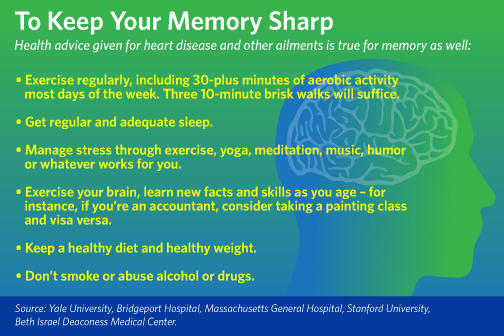
1. Keep your body healthy. Your brain is an organ just like any other. Feed it nutritious foods (see the Mediterranean Diet for example), keep stress levels down, don’t smoke, limit alcohol, keep active (at least 30 minutes of exercise a day) and get an adequate amount of rest. Consider when you do something good for your body, you are doing it for your brain health, too.

2. Try practicing “mindfulness,” a nonjudgmental and present moment awareness way of being in the world. When you keep your mind focused on what your body is doing, it offers a sense of peace and relaxation. It connects the body to the mind. Instead of daydreaming while you wash the dishes, notice the feel of the warm water on your hands. The smell of the soap. The noise the dishes make. Google search “mindfulness” and see what the latest research is showing.

3. Try a “mindful” awareness practice like Tai Chi or Yoga. These exercises combine both exercise and mindfulness and are easily adapted to suit almost everyone.

4. Do novel things. Your mind needs to be challenged. Learning and doing new things is like exercising a muscle. If you want your muscles to grow, you need to add more resistance or weights. Similarly, your brain needs to be challenged in order to grow. Learn a new language. Take music lessons. Learn how to tango. Go back to school. Try something new.

5. Try a brain games and brain training programs like “Luminosity.” Do crossword puzzles or try Sudoku. “BrainyApps” and “Elevate” are applications you can get for your smartphone or tablet. Do a Google search on “brain training” or “brain games” and find something suited for you. For fun, try playing “Words With Friends,” a mobile app version of Scrabble.

I would add a few more things: Having a variety of social connections (all ages) and healthy relationships is very important. Taking care of ourselves helps us focus on what we need to do to keep healthy. Focusing on the health and well-being of others helps us feel good about the world and each other. Caregivers need to be mindful to ensure they take care of themselves, too, so they don’t burn out. Managing our chronic illnesses like diabetes and high blood pressure help reduce our likelihood of having a stroke.

No matter what your age, keeping active and living a healthy purposeful life helps us keep engaged and thriving.

Angela G. Gentile, M.S.W., R.S.W.

Disclaimer: This information is not intended to replace the advice of your health care professional. Always consult your doctor before starting a new exercise regime.

________________________________________________________________

Angela G. Gentile, M.S.W., R.S.W. is a clinician and older adult specialist who has more than 25 years of experience working with older adults and their families in a variety of capacities. She is currently employed as a Geriatric Mental Health Clinician and enjoys writing, traveling, photography and exploring what it means to age well. She is a realistic optimist who lives in Winnipeg, Manitoba with her husband and two children.