It Takes a Village to Write a Book!

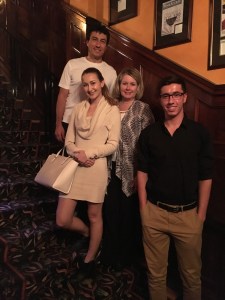
Cancer Up the Wazoo (not yet released!) is comprised of the efforts of 25 people (and that doesn’t include all those who were paid and unpaid who have reviewed, alpha read, beta read, proofed, offered design suggestions, etc.).

Thank you to all who are involved in the making of Cancer Up the Wazoo: Stories, Information, and Hope for Those Affected by Anal Cancer. Two writers chose to remain anonymous, and I respect that!

A COLLECTION

Please share with your social networks and help me get these fine folks the recognition they deserve!

Angela G. Gentile, MSW, RSW


purple-swirl-separator-hi

_DSC6188 4 x 6


Angela G. Gentile, B.S.W., M.S.W., is a registered social worker and is employed as a Geriatric Mental Health Clinician in Winnipeg, Manitoba. She is married to Agapito and has two adult children, Lorenzo and Simone. Angela enjoys writing, reading, and travelling and considers herself a realistic optimist. For more info: www.AngelaGGentile.com


Appropriate and/or Correct Words and Phrases (No offense!)

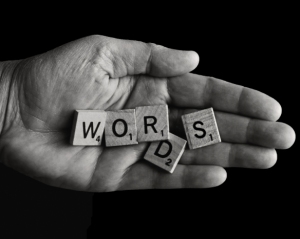
words by https://redzenradishphotography.com

Photo credit: Words by Kristina Krause of Redzenradish Photography

√ Use … × Instead of…

Mental Health:

√ Died by suicide

× Committed/Completed/Successful suicide

√ Suicidal ideation with a plan; suicide without a plan

× Active suicidal ideation; Passive suicidal ideation  

√ Alcohol use disorder/Benzodiazepine use disorder

× Alcohol dependence or use continuous

√ Person with a mental health disability; person who has/person diagnosed with depression/schizophrenia, etc.; Terminology varies throughout countries – “insane” and “insanity” are generally legal terms and reported as such in news programming

× Negative references to mental health and well-being such as: lunatic, mental patient, mental disease, neurotic, psychotic, crazy

Physical Abilities:

√ Hard of hearing; deaf; deafened or late-deafened; Deaf (uses sign language)

× Hearing-impaired; blanket term “deaf” used at the wrong time 

√ Person who uses a wheelchair

√ Wheelchair user

× Wheelchair-bound  

√ Non-disabled

× Normal

√ Person living with vision loss

√ Person who is blind

√ Person who has a vision impairment

× Blind; visually impaired  

√ Person with a disability

√ Persons with disabilities

√ People with disabilities

√ Individuals with disabilities

× Disabled, invalid, handicapped, physically challenged (challenges and handicaps are environmental conditions) 

√  Person born with a disability

× Birth defect, deformity/deformed, congenital defect

√ Person with a disability or a person with a/who has a motion disability;

√ Person with (e.g., a spinal cord injury)

× Crippled or lame

Medical Conditions:

√ Has (e.g., asthma, cancer)

× Suffers from (e.g., asthma, cancer)   

√ Person/people/individual with (a) dementia

√ Person/people/individual living with dementia

√ Person/people living well with dementia

√ A person with Alzheimer’s disease

× Dementia sufferer; demented; senile or senile dementia; burden; victim; plague; epidemic; living death (e.g., dementia is a living death)

♥ Re: “dementia patient” – okay to use when talking about people in a hospital or actually using a care service).

√  Person who has (a particular disease or condition). Ex: A person who has had a stroke.

× Suffers from; was stricken with; is confined to; or is afflicted by/with. These terms patronize, pity, victimize or insult.

Other Terms:

√ Older people; older person; older adult

× Elderly; old people; old person

 ♥ Seniors or senior citizens is an acceptable term for most.

√ Accessible parking

× Handicapped parking

√ Accessible bathrooms

× Handicapped bathrooms

√ Person with an intellectual disability or persons with learning disabilities

× Mentally retarded; retarded; mentally defective; mentally challenged

 √ Indigenous Peoples, First Nations Peoples, Inuit Peoples, Metis Peoples, Aboriginal Peoples. Note: Always go with what they are calling themselves. 

Eskimo, Indian, Native are less-used terms and can be taken as derogatory.

√ Black (as an adjective); African-American/African-Americans (as nouns) (both are acceptable, but not necessarily interchangeable.) In Canada, Black or Black Canadian.

× N-word 

SIMPLE RULE: It’s people first. The person comes first.

The disability or disease comes second.

REGARDING IMAGES: Use images that reflect the whole person, rather than a fading face or wrinkled hands. This is especially important when the article is about living a positive life or overcoming challenges.

Angela G. Gentile

purple-swirl-separator-hi

Angela G. Gentile  MSW, RSW is a clinical social worker and author of the book, “Caring for a Husband with Dementia: The Ultimate Survival Guide,” “A Book About Burnout: One Social Worker’s Tale of Survival,” “How to Edit an Anthology: Write or Compile a Collection that Sells,” and the “Dementia Caregiver Solutions” app for iPhone and iPad. She lives in Winnipeg, Manitoba with her husband and has two adult children. For more information, visit: www.AngelaGGentile.com


Search terms: politically correct, political correctness, terminology, writing, speaking, sensitive, appropriate, modern, neutral, acceptable


How a Dog or Puppy Can Bring Joy and Companionship into Your Life

Dog-Quotes-2

When I was going through my cancer ordeal, my dog, Rocky (a senior), was my constant companion. He lay beside me on my bed, he followed me downstairs when I went to get something to eat, and on the days I was bedbound, he seemed to be aware of my plight. When my family went out to work or school, or attended family functions that I wasn’t well enough to go to, Rocky was there with me. He seemed to get me more than anyone else. We bonded in a special way. I was never alone.

After my treatments were completed (which were absolutely torturous!), my daughter Simone started talking about wanting a new puppy. She was saying how she was missing having a little girl-dog around, so I encouraged her to get one for herself. I told her we would help her look after it. It didn’t take her long to decide and she went for it!

Well, what a joy this little one has brought to our lives. The fun and excitement started when my daughter called us to say one of the breeders she called said she had puppies that were just a few days old, and she could come and take a look! Soon after, Simone and I made plans to go out to the country to see the puppies. They were purebred Havanese (like a small poodle).

Simone picked out a blond female and named her Berkeley. We visited her every week as she grew old enough to be weaned from her mother. I (we) had something fun, sweet and exciting to look forward to. This helped get my mind off my cancer ordeal. Rocky was still my trusty companion, and this little addition was going to bring a new dynamic to our household. The anticipation of the day we could bring her home was killing us! We were in love.

Dog-Quotes-1

When we went to get Berkeley to bring her back to her forever home, it was as if we had brought home a new baby! We had visitors, puppy gifts, even a “Puppy Shower” my daughter planned. Simone wanted to bond with the puppy so she made sure she looked after all the pup’s needs – such as comfort, food, water and a warm comfy place to sleep. She had to get up in the night to let her out to do her business. The household and family dynamics were changed. Even Rocky had to adapt to having a little one around. Heck, I am even called Gramma now!

I was house-bound for many months during my healing and recovery, so I was the main one helping with the house-training. Often I played with Berkeley as she had lots of energy and a playful spirit (when she was awake). When she started teething, we had to make sure she had lots of appropriate chew toys and made sure the house was “puppy-proofed.”

Berkeley has added so much joy to our lives. I can’t imagine what my recovery journey would have been like without Rocky and our new little one. Raising a puppy is hard work, but the rewards are tremendous.

Please share your dog (or pet) story.

Angela G. Gentile

purple-swirl-separator-hi

Angela G. Gentile  MSW, RSW is a clinical social worker and author of the book, “Caring for a Husband with Dementia: The Ultimate Survival Guide”, “A Book About Burnout: One Social Worker’s Tale of Survival” and the “Dementia Caregiver Solutions” app for iPhone and iPad. She lives in Winnipeg, Manitoba with her husband and has two adult children. For more information, visit: www.AngelaGGentile.com.

A Blessed Mother’s Day

IMG_2979 (1)

The Gentile Family

Shortly after I was diagnosed with cancer in May 2017, I quickly learned what was important to me. I immediately feared the future loss of the joy of watching my children live their lives and have children of their own. I felt the future enjoyment of motherhood and grandparenthood was potentially and imminently being snatched away from me. This Mother’s Day is very special to me.

On Mother’s Day, the tradition is to express your appreciation for your mother or any mothers in your life. I was thinking about this and thought about how I came about to be a mother. I’d like to take a few moments to reflect on the people I want to thank for helping me to become the mother I am today.

I’d like to thank my mother for showing me how to be kind, loving, supportive, and how to offer unconditional love at all times (even when one of her children has passed from this world).

I’d like to thank my grandmothers (rest their souls) for being there for me and my mother. Their wisdom and mentor-ship helped tremendously on this journey of motherhood.

I’d like to thank my mother-in-law (may she rest in peace) for showing me unconditional love towards all others. I hear a lot of people complain about the “out-laws,” especially mothers-in-law, but I have nothing but respect for this kind-hearted, God-loving soul.

There are many to thank on this Mother’s Day.

My friends, who are mothers, supported me, advised me and encouraged me. They also act as role models as I walk down this journey of motherhood. Even as I move from mothering children to mothering adults, there is so much to learn.

I’d like to thank my husband Agapito for taking this parenting journey with me and allowing me to be a mother – without him, I wouldn’t have the two wonderful children I have now. We blended out parenting styles and did what we thought was right for our family (sometimes it came with a bit of a fight, LOL).

I’d like to thank my children, Lorenzo and Simone, for allowing me to learn how to be a mother; to make mistakes; to be happy with my style of parenting; and for making me a proud mother. (Five years ago I wrote an article called The Five Keys to Raising Great Kids. Check it out if you are in the early stages of parenting, however, it’s never too late!)

I am thankful to the teachers, professors, guides and others who helped me along this path. The post-secondary education I obtained in social work (including psychology and family studies) also helped mould me into the mother I am today. I learned about healthy and functional parenting styles, and what dysfunctional families looked like (aren’t we all dysfunctional in some way? LOL) I learned how culture influences parenting styles and how generations of parenting rule-books change based on science, media and other outside influences.

Most of all I’d like to thank God for the wonderful blessing of being able to have children of my own. The caring and protective mothering instincts I was gifted with also helped me to get to where I am today. Thanks be to God.

I feel very blessed on this day. Happy Mother’s Day.

Angela G. Gentile

purple-swirl-separator-hi

Angela G. Gentile  MSW, RSW is a clinical social worker and author of the book, “Caring for a Husband with Dementia: The Ultimate Survival Guide”, “A Book About Burnout: One Social Worker’s Tale of Survival” and the “Dementia Caregiver Solutions” app for iPhone and iPad. She lives in Winnipeg, Manitoba with her husband and has two adult children. For more information, visit: www.AngelaGGentile.com

The Truth Is – Alternative Therapies Provide Nothing More than Placebo Effects (Book Review)

trick-or-treatment-cover-vs

Trick or Treatment by Singh & Ernst

Dr. Simon Singh and Professor Edzard Ernst team up in Trick or Treatment: Alternative Medicine on Trial (2008) to bust the myths of the effectiveness of some of the most popular complementary and alternative treatments. Ernst’s impressive occupational and education history make him far more than qualified to be the one to take on this task. He was formerly a clinical doctor and studied homeopathy. Singh has a Ph.D. in particle physics and is a New York Times bestselling author. Trick or Treatment was written in response to His Royal Highness, The Prince of Wales’ request to have alternative treatments examined closely for their efficacy based on scientific testing. Ernst and Singh put together an impressive lineup of reasons why unorthodox and ancient treatments such as acupuncture, homeopathy, chiropractic and herbal medicine are mainly nothing more than a placebo and also come with risks.

This controversial stand on alternative treatments has me convinced, as I am a scientific-based kind of believer – especially when it comes to healthcare, risks and providing false hope. I am a cancer survivor and have done my due diligence of researching treatments and cures, both orthodox and integrative. I do sway sometimes into the “fantasy” and “wishful thinking” camp when it comes to some of the energy healing modalities, such as Spiritual, Reiki, Chakras and Pendulum (or dowsing) healing. I consider myself very open-minded, and if there are little costs and little risks involved, I am willing to give anything a try.

The book is quite repetitive on some points, mainly, that alternative therapies don’t work. It also seemed to be one big advertisement for St. John’s Wort, an herbal medicine that has been proven to treat mild to moderate depression. There was also some support for “fish oil” to combat inflammation in arthritis.

I liked the fact that Ernst has a history in homeopathy and he took the time to research many of the alternative and complementary therapies according to scientific-based evidence. Many of these therapies have been studied and he has dug up the dirt and given us a couple quick reference tools to refer to. For example, he has two pages of “Herbal Medicine Ratings” and cautions people that even though these are categorized as “natural” remedies, they are not always safe. He also strongly urges people to let their doctor know what herbs they are taking as they can interfere with pharmaceuticals. His second guide will be discussed below.

There are many references throughout the book giving examples of how people with cancer often seek alternative therapies (or at least are recommended by others to seek them). For example, the often-recommended “natural anti-cancer” treatment of laetrile (apricot pits) has been used and promoted since the nineteenth century. Due to scientific rigors, laetrile has since been labelled as “quackery” due to its ineffectiveness and risky side effects. Although this information is out there, people continue to use it to this day. This is true for many other alternative treatments.

The authors list ten culprits why these unproven and disproven treatments continue to be used, promoted and wrongfully touted as effective. It is an actual eye-opener, especially when we realize the power of the media, universities and alternative gurus such as Deepak Chopra and Dr. Andrew Weil.

There is an impressive “Rapid Guide to Alternative Therapies” which has about 35 different modalities covering many popular and not-so-popular techniques and gadgets people are using (e.g., crystals, magnets, special diets). The authors include a definition, background, evidence and conclusion and reassure the reader these therapies have been rigorously investigated against scientific evidence and meta-analyses where available.

This is a well-written book which has helped me open my eyes to the reasons why these alternative therapies are still around, despite the truth, that they are nothing more than placebos (and some come with risks that are rarely talked about). Placebos that are harmless offer nothing more than psychological benefits. Where there is belief and hope that something will work, it most likely will. That’s the power of the mind at work. If nothing else, it will provide the person with a sense of hope for the future, a feeling of wellness and a certain level of comfort that there is something “magical” at work. As long as there are little risks, little costs and big rewards, people will continue to seek out these treatments. Unfortunately there are some very expensive “treatments” as well, and charlatans and quacks are taking advantage of people when they are vulnerable.

Some people feel that doing something is better than doing nothing – as the placebo effect works in mysterious ways.

I would recommend this book to anyone who wants to know the truth about alternative medicine and would rather put their efforts, resources and hope into reliable, scientific-based, effective medical treatments and cures.

The other book I read on this topic came up with the same conclusion about the placebo effect – Do You Believe in Magic? The Sense and Nonsense of Alternative Medicine by Paul A. Offit.

Angela G. Gentile


purple-swirl-separator-hi

Angela G. Gentile  MSW, RSW is a clinical social worker and author of the book, “Caring for a Husband with Dementia: The Ultimate Survival Guide”, “A Book About Burnout: One Social Worker’s Tale of Survival” and the “Dementia Caregiver Solutions” app for iPhone and iPad. She lives in Winnipeg, Manitoba with her husband and has two adult children. She is creator of the Facebook communities – “Aging Well for Women” as well as “Living Well With and After Cancer” For more information, visit: www.AngelaGGentile.com

Surviving and Thriving – Before, During and After an Anal Cancer Diagnosis (Book Review)

41QU9LxgqjL._SX331_BO1,204,203,200_

Kicking Cancer in the Butt by Theresa Mayhew

4/5 Stars

Theresa Mayhew’s part memoir, part self-help book, “Kicking Cancer in the Butt: A Guide to Thriving in Spite of Anal Cancer” (2010) is an account of her experience with a rare form of cancer. She speaks highly of her involvement with the website and online community called “Blog for a Cure” and some of her female blogging friends also share parts of their experiences and advice. They have all been diagnosed with anal cancer.

Mayhew’s book is quite short, and there are lots of empty pages and white space (perhaps for notes?). The layout and formatting came with a couple of errors (such as a small gutter on the left page and page numbering format at the bottom suddenly switches at page 10.) All in all, 66 pages and a bigger font, makes for a quick read. I was able to complete it in two sittings.

Mayhew divides the book into three parts – Before (Diagnosis), During (Treatment) and After (Post-treatment). She comes from a spiritual background, called “Eckankar – Religion of the Light and Sound of God.” I had to look that one up and found out that this religion believes in karma and reincarnation. She also believes in and subscribes to non-traditional forms of healing such as “The Healing Codes” (another topic I had to look up.) She claims her spiritual and healing code practices “helped keep her in balance emotionally.” She also spoke of “MindMovies” and practicing “The Five Rites” which were all topics I was unfamiliar with.

Mayhew provides very basic information on anal cancer and a very long list of questions to ask your doctor (this list would take a long time to discuss!). She provides a list of things you may want to have on hand before your treatment starts, like ointments and baby wipes. There is a very short chapter on financial assistance.

In the first section of part two, “During”, she chronicles her own treatment, week by week, which included chemotherapy and radiation. She also includes some photographs to help the reader envision her and her experience. In this section of the book, her online blogging friends who also have cancer share some of their own experiences. Nova Sprick’s writing is very impressive throughout the book, and she shares some interesting concepts such as “Yoga Nidra” which means sleep yoga. I looked this up on YouTube and found some great relaxation guides (learned something else new!).

Mayhew and her friends at Blog for a Cure include all kinds of tips and terms, side effects, after effects and suggestions of how to navigate and cope with the diagnosis, treatment and how to “thrive” after the treatment of anal cancer. I wish they had talked more about the need for professional help in terms of depression and/or anxiety as I know this is a troublesome area for some (myself included).

The last pages of the book include a page “About the Author” and a page of “Resources.” It was an enjoyable read and I added many of my own notes, as I have been through anal cancer treatment myself. I tried to look up Mayhew via her website as noted in her “About the Author” section, but her page is no longer in service. I later found out that she passed away in 2011.

This book would be a good read and reference tool for anyone who has a diagnosis of anal cancer and it would also be of specific interest to those who are followers of Eckankar practices. Those who believe in God or a higher power would also find it helpful, as there are references to spiritual comfort and meaning throughout the book. Loved ones or caregivers would also benefit as it helps them understand what the person with anal cancer may be going through.

Angela G. Gentile


purple-swirl-separator-hi

Angela G. Gentile  MSW, RSW is a clinical social worker and author of the book, “Caring for a Husband with Dementia: The Ultimate Survival Guide”, “A Book About Burnout: One Social Worker’s Tale of Survival” and the “Dementia Caregiver Solutions” app for iPhone and iPad. She lives in Winnipeg, Manitoba with her husband and has two adult children. For more information, visit: www.AngelaGGentile.com


A Holistic Wellness and Rehabilitation Program for Those Who Have Completed Cancer Treatment – Book Review

515HM5o4t9L._SX331_BO1,204,203,200_
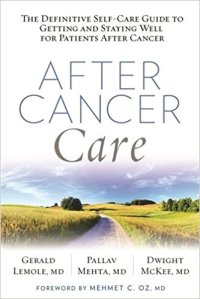
“After Cancer Care: The Definitive Self-Care Guide to Getting and Staying Well for Patients After Cancer” (2015) by doctors Gerald Lemole, Pallav Mehta and Dwight McKee is based on the premise that cancer patients would benefit from a rehabilitation program same as cardiac patients. These doctors who work within an integrative care model argue that a well-designed and personalized program which includes exercise, nutrition and stress management would help those who have been treated for cancer live a better quality of life and help reduce the risk for relapses or recurrences. The body, mind and spirit are well-covered in this holistic approach to wellness after cancer.

Although the font was very small in the paperback I read, I was able to read it although I needed my reading glasses! Most people with cancer are aged over 50 so I was surprised to see such a small font.

The nutrition section talks about the use of coconut oil as a recommended choice for cooking. Even though the authors say coconut oil is a saturated fat, they still recommend it. They also do not recommend canola oil. This information is contradictory to what some Canadian dieticians are recommending now. The recipe section near the end of the book also has coconut oil as an alternate for olive oil. These recipes and the advice re: canola and coconut oils should be researched a bit more before making your own choice in what oils you use.

The book has some repetitive information, however, the repeats seem to stress some of the important points. On the other hand, it completely neglected some important topics (or there was very little information on) such as Human Papilloma Virus (HPV) and Mindfulness. The importance and benefits of journalling and writing were not stressed and it would have been nice to see a little more written about that.

The index is not as good as it could be. I found some key terms were missing such as cervical cancer and paillomavirus.

I would have loved to see a listing of “approved” complementary or supplemental treatments, services and modalities. There is a sprinkling of ideas throughout the book, but it would have been nice to have a chapter that explained each idea and the science around them when it comes to wellness and health. It would have also been helpful to see a listing of harmful modalities or treatments.

Chapter 7, “Avoiding Toxins”, was too unrealistic for me. One of the recommendations was to rid your house of your carpets. This is an extreme measure for those of us who have carpets, and it would be a very costly venture. Some of the advice such as using non-toxic cleaning supplies and avoiding toxins in your food (such as mercury in fish) are more realistic goals to achieve. This would have been a good place to add information about HPV and the vaccine.

Chapter 8, which comprises about a quarter of the book, focuses on 11 common types of cancers and the doctors share their “Cancer Protocols” on cancers such as breast, lung and prostate. The cancer I had, anal cancer, was not mentioned in the book, unfortunately.

Overall, it’s a well-edited and researched book with a lot of scientific references in the “Endnotes” section. The “Conclusion” is an excellent reference as it lists 28 points the doctors call “The Quick Hits.” A great book for anyone who has been diagnosed with cancer, is at or near completion of treatment, and is proactive in restoring, maintaining and maximizing his or her health.

Angela G. Gentile

purple-swirl-separator-hi

Angela G. Gentile  MSW, RSW is a clinical social worker and author of the book, “Caring for a Husband with Dementia: The Ultimate Survival Guide”, “A Book About Burnout: One Social Worker’s Tale of Survival” and the “Dementia Caregiver Solutions” app for iPhone and iPad. She lives in Winnipeg, Manitoba with her husband and has two adult children. She is creator of the Facebook communities – “Aging Well for Women” as well as “God, Cancer and Me.” For more information, visit: www.AngelaGGentile.com

A Wild, Life-Changing Roller Coaster Ride in the Dark (Book Review)

51+TXv-YH+LIt was very hard to put down Michele Longabaugh’s book, If You’re Not Laughing, You’re Dying: The dawning of hope from the shadows of darkness…blogging through Stage 4 Anal Cancer (2012). Being diagnosed with anal cancer myself, I was drawn to read this book in the hopes of getting some insight into the disease and how to manage it. Being diagnosed with this type of cancer in her late 40s makes Michele relatively young (as the average age of diagnosis of anal cancer is in the early 60s). Anal cancer is quite rare, and can be difficult to find support. Not only do some consider it a stigmatizing and shameful disease, the treatment for it is torturous. Michele’s courage and the sharing of her experience helps destigmatize anal cancer and her rise from shame to advocacy is very inspiring.

The book starts with a beautifully written Foreword by Michele’s loving husband, Jerry. The way he describes her writing is “random, raw and honest.” I would definitely agree with the random and raw, as this book is comprised of her blog posts (typos and all!) written over a period of about two years. The honest part, well, we’ll have to take his word for it!

The writings are very engaging, and each chapter (blog post) has a theme and a story or insight to share. The posts are sometimes upbeat and laughable, sometimes they are stories of the hell and torture Michele endures (which is hard to take). Sometimes they are loving tales of family, friends or healthcare providers. The reader can learn a lot about Michele’s experiences with cancer and its treatment (including a lot of crying, grief and scary parts) and she shares stories about things like medications, “narcotic naps”, ointments, radiation, chemotherapy, surgery, and her fondness for “Dr. Cutie” and her blog-worthy visits with the “butt doctor.”

Michele tends to rely heavily on family, friends, and prayer (she’s Lutheran) for support and strength during her cancer ordeal. I like this about her story, because I can totally relate in many ways. In addition to having a loving husband, she has three outstanding children – Maggie, AJ and CJ. Both Michele and her husband sing high praises for Michele’s sister, “sissy” Renee, who is described as an angel on earth. Michele’s two “besties” Laurie and Marie, also shine as two very important and special people in her life. Michele is a very popular, kind and loving person, and it shows in her writing.

Michele’s adventures of checking things off her “Bucket List” makes for some interesting stories and helps her find joy and pleasure. There are plenty of tears and suffering (both physical and mental) in her life, and she is able to appreciate humourus moments by laughing along or making an odd joke here and there. Near the end of the book, Michele shares some insight about her “Un-Bucket List.” These are things she would never want to do.

Overall, this book did what it was supposed to do; it helped inspire me and gave me hope that this fight against cancer can be won. We can all join Michele on this wild roller coaster ride in the dark by continuing to follow her blog on tumbler – ihavebuttwhat.tumblr.com.

Angela G. Gentile

purple-swirl-separator-hi

Angela G. Gentile  MSW, RSW is a clinical social worker and author of the book, “Caring for a Husband with Dementia: The Ultimate Survival Guide”, “A Book About Burnout: One Social Worker’s Tale of Survival” and the “Dementia Caregiver Solutions” app for iPhone and iPad. She lives in Winnipeg, Manitoba with her husband and has two adult children. She is creator of the Facebook communities – “Aging Well for Women” as well as “God, Cancer and Me.” For more information, visit: www.AngelaGGentile.com

1 in 2 Canadians Will Develop Cancer in Their Lifetime; 89% Will Be 50 and Older

a3e4d4_2161a15a5f1241e99aa172358b73c6demv2

With age comes the increased risk for certain diseases and health problems. At age 51 I was hit with a diagnosis of cancer. When I reviewed the statistics and information on cancer and who gets it, I was quite surprised to realize that one of the risk factors is aging. There were other things I learned about cancer that was quite alarming. I think we all want to believe we are immune to it. It can strike anyone, anytime, but those 50 and older are more susceptible.

“Ageing is another fundamental factor for the development of cancer. The incidence of cancer rises dramatically with age, most likely due to a build-up of risks for specific cancers that increase with age. The overall risk accumulation is combined with the tendency for cellular repair mechanisms to be less effective as a person grows older.” – World Health Organization

The Canadian Cancer Society states cancer is the leading form of death in Canada and is responsible for 30% of all deaths. The most common types of cancer are lung, breast, prostate, and colorectal (not including non-melanoma skin cancer). Most people who are affected by cancer are aged 50 and older. In fact, 89% of all cancers occur in those 50 and up.

Unfortunately, 1 in 2 Canadians (49% men and 45% women) are expected to develop cancer in their lifetime; 1 in 4 will die from cancer.

Research is always being done and we know that about half of all cancers can be prevented by lifestyle choices. The Mayo Clinic states there are seven things we can do to reduce our cancer risk:

  1. Don’t use tobacco.
  2. Maintain a healthy body weight and be physically active.
  3. Eat a healthy, well-balanced diet.
  4. Get vaccinated (Hep B and HPV)
  5. Practice sun safety.
  6. Avoid risky behaviour (practice safe sex, don’t share needles).
  7. Get regular medical care (cancer screening tests)

More Cancer Prevention Tips

Cancer is caused by changes (gene mutations) to the DNA within cells. The cells receive errors and normal functioning is interrupted, allowing the cell to become cancerous. Some of these mutations are inherited from your parents, and others you acquire after birth. There are a number of known triggers that can cause gene mutations, such as smoking, radiation, viruses, cancer-causing chemicals (carcinogens), obesity, hormones, chronic inflammation and a lack of exercise. Who and why someone develops cancer while others do not still remains a mystery for the most part. Research is ongoing to answer these questions.

There are over 100 types of this life-threatening disease. There is currently no cure for cancer, but there are treatments that help extend life (such as chemotherapy, radiation, and surgery). Early detection is the best way to help ensure the best chances for survival. Unfortunately, many cancers don’t have any symptoms until it has spread to lymph nodes or other organs. Cancer often gets found when patients are having tests done for other health concerns.

The 10th common cancer found in women that can be successfully treated and prevented if detected early is cervical cancer. Regular screening for this type of cancer is recommended and it is performed in the doctor’s office. This is called a Pap test.

Lung cancer, colorectal cancer, breast cancer (in women) and prostate cancer (in men) are most frequent types of cancers that develop in those 50 and older. 2 out of 3 people who get lung cancer are aged 65 and older and the average age of diagnosis is 70. Lung cancer is the leading cause of cancer death in both men and women. Smokers are at a high risk for lung cancer.

Cancer screening looks for cancer before it causes symptoms. When I turned 50, I remember getting a notice in the mail for me to get a test to check for blood in my stool. The Canadian Cancer Society recommends screening for early signs of health problems that could lead to cancer. The areas that they recommend screening for those who are “older” are:

  • Breast cancer – breast exam, mammography
  • Colorectal cancer – Fecal Occult Blood Test
  • Other screening tests include digital rectal exams and prostate cancer screening.

Although age is the number one risk factor for cancer, a family history of cancer is the second risk factor. Those who have close family relatives who have developed cancer should discuss this with their doctor. The third risk factor is obesity. Achieving or maintaining a healthy weight can reduce the risk of some cancers.

Cancer is a disease that no one likes to think about or talk about. It’s a condition that affects people of all ages but is more commonly found in those 50 and older. There are steps that can be taken to reduce our risk of getting cancer, and there are screening tests that can be done when we are feeling well. Being in tune with our bodies, reporting any unusual symptoms such as pains, bleeding, lumps or sores that don’t heal to your doctor are important steps in early detection.

Angela G. Gentile, MSW, RSW


Resources:

Cancer Fact Sheet, World Health Organization. Feb. 2017. http://www.who.int/mediacentre/factsheets/fs297/en/

Canadian Cancer Statistics 2017. http://www.cancer.ca/en/cancer-information/cancer-101/canadian-cancer-statistics-publication/?region=bc

Mayo Clinic – https://www.mayoclinic.org/healthy-lifestyle/adult-health/in-depth/cancer-prevention/art-20044816

Cancer – Diseases and Conditions, Mayo Clinic. https://www.mayoclinic.org/diseases-conditions/cancer/basics/causes/con-20032378

Key Statistics for Lung Cancer, The American Cancer Society. https://www.cancer.org/cancer/non-small-cell-lung-cancer/about/key-statistics.html


purple-swirl-separator-hi

Angela G. Gentile  MSW, RSW is a clinical social worker and author of four books, including Cancer Up the Wazoo: Stories, information, and hope for those affected by anal cancer (2018). She lives in Winnipeg, Manitoba with her husband and has two adult children. She is the creator of the Facebook community – “Aging Well for Women.” For more information, visit: www.AngelaGGentile.com


Virgil’s Story About His Experience With Mesothelioma

Asbestos

Danger Asbestos – Photo credit: www.caslab.com

Please welcome our guest writer, Virgil Anderson. He has a diagnosis of mesothelioma which is a rare type of cancer that presents itself mainly in people aged fifty to seventy. He says over 90% of mesothelioma cases are found in people aged 55 plus and it disproportionately affects men due to the correlation with working in the trades. Virgil is from the USA.

General information: Mesothelioma. Resource for caregivers: Mesothelioma Caregivers. If you are looking for Canadian content, you can visit the Canadian Mesothelioma Foundation. For more information on asbestos, visit Web MD.

My Cancer Story

My name is Virgil Anderson, and my experience with mesothelioma has been a difficult one. I was exposed to asbestos through the work I did as a young man and am paying the price now by being diagnosed with this rare and terrible cancer. It causes uncomfortable, painful symptoms, limits my ability to get around, and has left me with deep emotional scars. And yet, I have managed to maintain hope and a positive perspective as a I fight this disease.

Asbestos in the Workplace

My story begins with my upbringing in West Virginia. We all worked hard in my family, and had to in order to make ends meet. As soon as I was old enough for a real, paying job, I got into demolition. This was as a teenager when I was young and strong and able to do this tough, physical work. As I helped tear down old buildings I remember being constantly surrounded by dust. Only later did I realize that there were asbestos fibers in the dust and that I was inadequately protected from it.

Later I was able to get more skilled work. I learned to be an auto mechanic, which was much more interesting work and paid better. Throughout my career in this industry I also did work that caused me to be exposed to asbestos. I tore out hood liners, which had been made with asbestos to protect against the heat of the engine. I removed and replaced brakes and clutches, also made with asbestos. Opening up those parts, the dust would fly, and again it was asbestos.

A Mesothelioma Diagnosis – The Risks of Asbestos

All of those tiny fibers of asbestos I inhaled over the years would come back to haunt me. Not everyone who is exposed to asbestos gets sick, but those who do suffer from the damage the small, needle-like fibers cause as they lodge in the tissues of the body. Because the fibers are often inhaled, they get stuck in the tissue around the lungs, called the pleura. Here they cause damage that can lead to a number of illnesses.

In my case, that illness would turn out to be pleural mesothelioma, a cancer of the pleural tissue. Around the age of 50, after working for decades, I began to experience respiratory symptoms. When I went to the ER, I was diagnosed with pneumonia, but antibiotics didn’t help and my symptoms only got worse. Eventually I was correctly diagnosed, and found out I had developed mesothelioma after years of working with and around asbestos.

Treatment for Mesothelioma

Getting treatment for mesothelioma was challenging, as there are few specialists qualified to work with this rare cancer. Ultimately I was able to secure financial assistance and care through the National Cancer Institute. I was not a candidate for surgery, but I have had chemotherapy treatments to slow the growth of the tumors.

What really keeps me going and motivates me to keep fighting are my family and my faith. Without family I don’t know where I would be. Since I can’t work I can’t earn and I rely on them to provide me with a home and to take care of me. As I fight this awful cancer, I know I may not survive it, but I take comfort in my faith and in the time I still have with the people I love. My message to others with this disease is to find your own source of comfort and inspiration. Keep fighting, and enjoy the important things in life.

Untitled

Written by Virgil Anderson

purple-swirl-separator-hi

Angela G. Gentile  MSW, RSW is a clinical social worker and author of seven books including, “Cancer Up the Wazoo: Stories, Information, and Hope for Those Affected by Anal Cancer”, “Caring for a Husband with Dementia: The Ultimate Survival Guide”, “A Book About Burnout: One Social Worker’s Tale of Survival” and the “Dementia Caregiver Solutions” app for iPhone and iPad. She lives in Winnipeg, Manitoba with her husband and has two adult children. For more information, visit: www.AngelaGGentile.com