We Must Be Doing Something Right: The Rate of Newly Diagnosed Alzheimer’s is Dropping in Canadians 65+

Photo by Andrea Piacquadio on Pexels.com

I am very interested in helping older people, especially those who are caregivers to those who have Alzheimer’s disease or related dementias. Two of my books are written specifically on this topic. January is Alzheimer’s Awareness Month here is Canada, and I was pleased to see this statement from the Minister of Health which I felt was important enough to share here (I bolded a section for emphasis!). I found there is a lot of valuable information, plus the good news that we are doing something right! It also includes steps we can take to help reduce our risks.

Way to go Canada!

Angela G. Gentile, MSW, RSW

Link to purchase my latest book on Amazon: https://a.co/d/4PDKnBj

Message from the Minister of Health – Alzheimer’s Awareness Month

From: Public Health Agency of Canada

January 3, 2024 | Ottawa, ON | Public Health Agency of Canada

January is Alzheimer’s Awareness Month. Almost half a million people in Canada live with dementia, impacting not only themselves, but their loved ones and caregivers as well.

While the risk of dementia increases with age, it is not an inevitable part of aging. In fact, the rate of newly diagnosed cases in Canadians aged 65 and over has been dropping for the last several years.

This is why the Government of Canada has been investing in the implementation of Canada’s national dementia strategy – A Dementia Strategy for Canada: Together We Aspire. It focuses on the areas of research, surveillance, awareness initiatives (including a national public education campaign), community-based projects and guidance.

Implementing the national strategy is a joint effort by a wide range of organizations across Canada, including provincial and territorial governments, academic institutions, non-governmental organizations, and health and social care providers. Over the past five years, the Public Health Agency of Canada (PHAC) has funded more than 70 dementia projects through organizations such as these across the country. A number of these projects were featured in the 2023 Report to Parliament on the national dementia strategy.

Targeted research is needed to better understand cognitive impairment in the aging brain, which is one of the reasons why the Canadian Institutes of Health Research (CIHR) launched the Brain Health and Cognitive Impairment in Aging (BHCIA) Research Initiative in March 2023. This initiative encompasses a number of aspects including the Canadian Consortium on Neurodegeneration in Aging and the Dementia Research and Innovation Funders Alliance (launched in November 2023) and several new funding opportunities.

It has been estimated that 12 risk factors that can often be managed and reduced could explain 40% of cases of dementia globally. This highlights the importance of raising awareness about these factors which include physical inactivity, smoking, obesity and chronic conditions such as hypertension and diabetes.

This January, for Alzheimer’s Awareness Month, I encourage you and your family to visit Dementia: Risk factors and prevention – Canada.ca to learn more about dementia risk reduction. Choose one habit that you can change or improve such as being more physically active, socializing regularly, or having a healthier, more balanced diet. Engaging in these healthy behaviours can help reduce the risk of dementia and delay the onset of symptoms, thereby improving your quality of life as you age.

We can all help improve the quality of life of those living with dementia. For more about how to reduce dementia-related stigma and communicate in a supportive way with people living with dementia, visit Dementia: Tips on how you can help – Canada.ca.

As more of us take these actions, we’ll reduce the impact of dementia on Canadians.

The Honourable Mark Holland

Contacts

Christopher Aoun
Press Secretary
Office of the Honourable Mark Holland
Minister of Health
613-291-4176

Media Relations
Public Health Agency of Canada 613-957-2983
media@hc-sc.gc.ca

Source: https://www.canada.ca/en/public-health/news/2024/01/message-from-the-minister-of-health—alzheimers-awareness-month.html#
My First Book on Amazon Was AI Hybrid Plagiarized Twice

My Book on Amazon was AI Hybrid Plagiarized Twice – Angela G. Gentile

In 2015, I self-published my first ebook and paperback through CreateSpace, now Kindle Direct Publishing (KDP), and sold it on Amazon. It is called, “Caring for a Husband with Dementia: The Ultimate Survival Guide.” It is my best seller and I do presentations and book talks based on it and the expanded and revised edition called, “Alzheimer’s, Dementia, and Memory Loss: A Helpful Guide for Caregivers.”

As I was preparing for a presentation, I typed my book’s title into the Amazon search bar. I was checking on the status of my reviews.

To my surprise, a book with a similar title (a sponsored title!) popped up right above mine. i clicked on the link and looked more closely at the “Book Overview.” As I started reading through I saw my words, not in the same order, but in a slightly different arrangement. My terms used in my book made up the bulk of the overview. I had a strong suspicion that this was MY book.

I wasn’t able to see any of the inside of the book via the “Read sample” option. It had only the cover, back cover (with no text on the back), title page, author’s name, and copyright information.

I checked the Amazon Prime return policy, and I was able to return the book at no extra cost. So there was no risk in my opinion. I ordered the book and waited.

When the book arrived three days later, I opened it up and saw MY photos. MY writing. This was direct plagiarism. But, the “author” had scrubbed the book clean of any personal information such as my title page, copyright information, dedication, acknowledgements, and the back-matter such as resources, recommended reading, and my about the author page.

When I opened up the book, it was a jaw-dropping moment. I was shocked. My heart sank. I felt like I had been robbed. The violation of stealing my hard work felt like a punch to my stomach. Sadness, anger, victimization all balled up into one.

After the initial shock wore off, I took a closer look and discovered that the “Introduction” was AI generated. I had plugged in the first few paragraphs into an AI Checker and it came up as being written by AI. I had never seen a book combining AI-generated text and direct or cloned plagiarism before. The bulk of the book was my work. Word-for-word. And it was taken from my 2015 ebook (which has since been revised in 2021).

I started searching Amazon to see if there were any other books plagiarizing mine and I found another one! So far, I have found two.

I have since reported both books to Amazon for copyright infringement and they have been removed. I have to be diligent though because it can happen again. There is an online Amazon Report Infringement form and process that has to be followed and you don’t get to speak to a human unfortunately. I ran into a snag because the books I was reporting on had fake ISBN numbers, so I had to use the ASIN numbers instead.

Many other suspicious books written by others have been discovered. I suspect there are hundreds if not thousands of these AI Hybrid Books on Amazon. It’s not right.

AI Hybrid Plagiarism is running rampant on Amazon. Many unsuspecting authors are being robbed and readers are being deceived. I want others to be aware of this issue in hopes of preventing the sales of these illegitimate books that disrespect the intellectual property rights of others.

My ask is I want Amazon to do a better job at checking for plagiarism. I suggest they go beyond the first 500 words. Perhaps the first 10,000.

I have a Facebook page called, “My Book was Stolen Plagiarised Pirated” with more information. Give a Follow and Like there to see what I find and what is new in the world of AI and books.

More information on my books and services can be found on my website at www.AngelaGGentile.com.

Angela G. Gentile, MSW, RSW

AI Hybrid Plagiarism: The Discovery of a Shocking Secret in the World of Self-Published Books on Amazon

AI Hybrid Plagiarism on Amazon

In the ever-evolving landscape of digital publishing, a disturbing new menace has emerged, one that poses a significant danger to both authors and consumers alike: AI Hybrid Plagiarism. This insidious practice combines AI generative text technology with direct plagiarism, creating a toxic blend of stolen intellectual property that threatens to undermine the very foundations of literature and copyright protection.

The term “AI Hybrid Plagiarism” refers to the surreptitious act of employing AI generative text models to produce books that are not only unoriginal but also directly rip off existing works, circumventing the arduous creative process. These AI-generated works are often sold on platforms like Amazon, where their prevalence has quietly proliferated into a burgeoning problem.

I know all about AI Hybrid Plagiarism because one of my books, “ Caring for a Husband with Dementia: The Ultimate Survival Guide” was plagiarized at least twice that I know of. This shocking and disheartening violation has lead me to discovering many more books that appear to be what I call, “AI Hybrids.”

It is my belief that AI ingests the original digital content belonging to the creator and generates the following:

– Book Overview on the Amazon book page (where the book can be purchased),

– A copyright statement for the front matter of the paperback.

– An Introduction for the interior of the book.

– A compelling title and lengthy subtitle.

– Perhaps even a fictitious author’s name

One thing that is unknown to me is how the book cover image and title layout is created. It could also be AI generated I suppose.

Amazon (or Kindle Direct Publishing KDP), a titan in the ebook market, employs sophisticated algorithms and bots to detect copyright infringement and pirated ebooks. However, these digital crooks have been using the text from ebooks and scrubbing it of the REAL author information. The fraudsters put together a product which is submitted to KDP which evades the plagiarism screening process. Their AI Hybrid Plagiarized book flies just under Amazon’s radar. As a result, there are currently hundreds, perhaps thousands, of these plagiarized books available for purchase on Amazon, unbeknownst to the ripped-off authors and deceived readers.

This issue not only robs authors of their hard-earned intellectual property rights but also misleads unsuspecting readers who believe they are purchasing original content and supporting well-deserved authors.

AI Hybrid Plagiarism jeopardizes the livelihoods of genuine writers and compromises the integrity of literary creation, all while leaving a trail of copyright infringement in its wake.

To combat this burgeoning problem, it is imperative that both publishing platforms and authors remain vigilant and proactive in identifying and reporting instances of AI Hybrid Plagiarism. Perhaps Amazon KDP needs to revamp and beef up their plagiarism checkers – Do better, Amazon.

Furthermore, raising awareness among consumers is crucial to ensure they can make informed choices and support genuine authors while rejecting stolen content. The battle against this menace is ongoing, and the stakes for the world of literature and copyright protection have never been higher.

Angela G. Gentile, MSW, RSW

Ironically, this article was created with the help of Chat GPT.

An Encouraging and Supportive Time-Out By and For the Caregiver

Today’s guest post is by Brent Hoag. Reprinted with permission. Originally published on Facebook.

*****

A BOND
A PLEDGE
A COMMITMENT
LOVE

A husband caring for his wife
A wife caring for her husband
A daughter &/or son caring for their mother &/or father
A grandchild caring for their grandfather &/or grandmother
A relative caring for someone related to them
A friend caring for a friend
A partner caring for a partner
A human being caring for a stranger
A human being caring for someone they know
Human beings caring for human beings who are vulnerable and in need

I just read for 90 minutes various Posts & Comments in a few support groups that were written by a cross section & diversity of members/caregivers. I don’t often do this for a number of reasons. I was overwhelmed yet again at the pain, despair, grief, and anxiety and so much more that we share in common. And the sadness, oh the sadness in our lives & hearts.

However, in complete candor, I felt such a sudden unexpected pride because of what each of you, & we collectively, are doing. I honestly felt such a sense of pride to be associated with you even though we have never met. I empathize. I cannot overstate the importance of our being able to relate to, & rely upon, one another as caregivers.

This is about feeling privileged & honored about being in a group of people who notwithstanding our sadness, frustrations, challenges, & yes again the exhaustion, are caring for another human being who is so vulnerable. You have not only endured & coped but you have risen above and persevered in spite of daunting challenges in order to care for another human being. You are pushing through an incredible amount of sadness & difficulty in order to care for another human being. You are trying to afford them some peace, comfort, dignity, respect, & level of care that they so desperately need.

Your own selflessness & sense of responsibility & compassion for another human being is making a difference in their journey. We don’t expect or want recognition or applause. That’s not why we are doing this. Why we do it is so personal & can be simple or profound. However, here we are.

Love for another human being is often the most powerful & compelling element that each of us feel and have in our hearts. We then care, share & support.

Tonight I read & read. There are so many of us & we are such a diverse group of people who are at very different places in our journeys with our loved ones. And yet here we are under one “bubble” sharing, empathizing, & supporting.

No cheerleaders, no bands, no celebrations, no speeches, no oscars, no victory laps. However there is something that I want to share with you caregiver to caregiver. We’re “doing it”. We’ll get through this. I understand only too well your sense of humility but now & then we need help to get back up & to carry on & some deserving recognition & praise can give us the ability & required strength. And yet in our very special group of human beings not only are we selflessly caring for another human being but we are lending assistance to one another as caregivers.

You, your steadfast dedication, your ongoing sacrifices, your compassion, your perseverance, your doing the best that you can, and yes your love are a bond that we share. Whoever you are & whatever your connection with the person that you are caring for, I just want you to know how sad it was for me to read so many of your posts/comments but how much of a sense of pride & honour it allowed me to feel during such dark times. Thank you for that.

You are pretty remarkable even though you likely don’t feel that way. Most of us don’t. However, I hope that in some way when you hear it from a fellow caregiver that it resonates with you & that you can carry some of this in your hearts & minds in going forward.

I have sometimes been criticized for my Posts being too long. Caregiving & the challenges that Alzheimer’s/Dementia presents doesn’t often have a short version when it comes to supporting, sharing, & feeling for a fellow human being. In this Post, I could have simply written “I’m proud of you & honored to be associated with you”. However, in my opinion the topic/message was too important to abbreviate, condense, or underemphasize. You deserved so much more than that.

It’s bittersweet for all of us, but I wanted to take a rare “time out” to acknowledge you for what you are doing.

It’s tough. It’s almost impossible at times, but here we are caring as best as we can for a fellow human being. I will never take that for granted & even though it is a long Post it is one of the rare one’s where a caregiver reminds other caregivers just how remarkable they are.

Who knows, when times are especially low, sad, & challenging perhaps you will allow yourself a “time out” to re-read this as a source of encouragement, support, etc. After all, that is one of the reasons why I wrote this, one caregiver to another caregiver. 💜

How to Get Dementia – Top 10 Tips (Satire)

A break from my usual programming…

I have been reading a lot about how to prevent dementia. My books on dementia caregiving have made me think a lot about how we can prevent getting dementia or some other form of neurocognitive disorder such as Alzheimer’s. Dementia is a condition in the brain that affects our capacity to remember things, process information, and organize our thoughts. It can impact our ability to make safe and wise choices and it can affect our language and movement. I have been listening to webinars, reading books, and scanning the Internet for organizations who have authority on the subject. Here’s a satirical piece on the subject, a break from my usual kind of writing.

Top Ten List of Ways to Increase Your Chances of Getting a Dementia Diagnosis

1.Live a very long life. The older we get, the better our chances are to get dementia. Dying at a younger age can work against you if you really want to experience the joys of dementia. If you are lucky, you may end up getting early-onset dementia which is when it comes when you are under the age of 65.

2. Don’t exercise. Stay very sedentary. The less you move, the better it is for dementia to set in. The less stress you put on your heart and your muscles, the more chances your brain and vascular system has to suffer the consequences of very slow and gentle blood circulation. Moving more and getting your blood pumping would deliver more oxygen and healthy cells to your organs, so the less chances of that happening, the better.

3. Smoke and drink alcohol. The more you smoke and drink, the better. If you started smoking and drinking (they go hand-in-hand!) at a younger age, that would definitely increase your chances for getting dementia. If you haven’t smoked or drank in your life, you should start now. The unfiltered cigarettes are the best. Any kind of alcohol is perfect (just remember if you don’t want to get cancer or heart disease, you may faced with a difficult decision.)

4. Eat lots of junk food. The more sugar in your diet, the better! Dementia (and cancer – what a bonus!) loves sugar. If you have diabetes that is even better. Poorly managed blood sugars can also increase your risk for stroke and heart attack. They don’t call dementia Type 3 diabetes for nothing. Eat whatever you want to your hearts content. Just avoid nutritious meals like what they recommend for the MIND or Mediterranean Diet (you know like lots of fresh fruits, vegetables, nuts, and seeds). They say “What’s not good for your body is not good for your brain” so that’s a good mantra to put on repeat. The more processed foods you can add to your diet would be very advantageous. And while you are at it, stop drinking so much water. That way you don’t have to piddle so much (that tip comes from my mom!).

5. Invite and create lots of stress in your life. Studies show that stress can cause lots of stress on your system which can lead to lots of bad things happening in your body – including cognitive decline. It would be advisable to avoid things like meditation, self-care, having fun, and taking breaks. If you are still of working age, find a job that is really stressful that pushes you to the limits. You may also end up getting high blood pressure, anxiety, and sleep deprivation, so these combined can really enhance your chances of getting some sort of brain drain and cognitive problems.

6. Stop doing novel things. If you like to be bored and thrive on doing nothing new, this is the perfect thing for you! Keep on turning down opportunities that can enhance your learning. Your brain will feel good and learn how to build new neural pathways, so this is a no-no when it comes to wanting an unhealthy brain. Traveling can also cause an increased risk of learning and expanding the brain cells. People who want to get dementia stop traveling and especially refuse to learn new things such as a new language or take a dance class.

7. Welcome and encourage head injuries. If you want to increase your chances of banging up your head and causing some damage, you can do risky things like riding a bike without a helmet, or be in a motorized vehicle without a seatbelt (one downside of not wearing a seatbelt is that you may be fined or you may get a really bad body injury, not just a “traumatic brain injury” or even death). If you are a bit unsteady when you walk, don’t use a cane or walker. Using mobility aids can help prevent you from falling, and therefore it could help prevent a bonk to the head. Taking a risk to go from here to there with the walker will only decrease your chances for bumping the old noggin.

8. Try not to sleep so much. The less sleep you get, the better. Your brain cleans itself at night, so the less sleep you get, the less chance your brain has to clean itself. It’s better to let the impurities build up in hopes it could cause some build of of plaques and maybe even tangles (I am not quite sure how the plaque and tangles form, but I am thinking it may have something to do with poor sleep habits.)

9. Avoid contact with others. Stay in to win! One of the best ways to get dementia is to stay home on your own, most of the time. If you live with family or have a roommate, try to avoid them as much as possible. They say the more you converse with and interact with people, the more healthy your brain is. If you play bridge or scrabble, stop playing it. The brain is stimulated by sitting with others, strategizing the next move, and it’s really bad for (helps reduce the risk of) dementia. “Just say no!”

10. Don’t correct your poor vision or hearing. Toss away your glasses and hearing aids. It has been proven that if you can see and hear well, it reduces your chances to get Alzheimer’s and other forms of dementia. I am not completely sure of how that works, but they are learning that people who have poor hearing and don’t wear hearing aids have a bigger chance of getting dementia. Same goes for difficulties with vision.

What other things can we do to help ourselves get dementia? I want to hear it!

Angela G. Gentile, MSW, RSW

Sugar, Heroin, and Alzheimer’s Disease – Kick the Sugar Habit to Decrease Your Dementia Risk

Photo by Alexander Grey on Pexels.com

Why is it so hard to take just one bite of that sugary treat? One square of chocolate? One jelly bean? Why do some of us need “double sugar” in the morning? Why do we crave sweets?

It could be due to sugar’s addictive quality.

There are many dangers of too much sugar consumption. Whether it’s hidden in our food or drinks, or put in our coffee in plain sight, it’s a well-accepted modern-day “drug” consumed by all ages. Research is finding that one of the many dangers of ingesting too much sugar is the increased risk of Alzheimer’s disease dementia.

Sugar Addiction is Compared to Drug Addiction

Sugar has long been compared to addictive illicit drugs like heroin due to its ability to trigger pleasure centres in the brain and create a sense of euphoria. While the addictive qualities of sugar are not as extreme as those of heroin, there are certainly some similarities between the two substances.

Firstly, both sugar and heroin activate the brain’s reward system. When we consume sugar or take heroin, our brain releases dopamine, a neurotransmitter that creates feelings of pleasure and reward. Over time, our brain becomes accustomed to these dopamine spikes, and we may crave more sugar or heroin to recreate that sense of pleasure.

Secondly, both sugar and heroin can lead to tolerance. As we consume more sugar or take higher doses of heroin, our brain becomes less sensitive to dopamine, and we may need more of the substance to experience the same level of pleasure. This can lead to a vicious cycle of increasing consumption and decreasing pleasure, similar to the cycle of addiction.

Finally, both sugar and heroin can lead to withdrawal symptoms. When we abruptly stop consuming sugar or heroin, our brain chemistry is disrupted, leading to a range of physical and emotional symptoms. These can include anxiety, irritability, headaches, and fatigue.

Differences Between Sugar and Heroin

There are important differences between sugar and heroin. Heroin is an illegal and highly dangerous drug that can lead to severe health problems and addiction, while sugar is a legal and relatively harmless substance in small quantities. However, the similarities between the two substances highlight the potential dangers of consuming too much sugar and the importance of reducing it in our diet.

Kick the Sugar Habit for Health

While sugar and heroin are vastly different substances, they share some similarities in terms of their effect on the brain’s reward system, tolerance, and withdrawal symptoms. By understanding these similarities, we can better appreciate the potential dangers of sugar (including Alzheimer’s disease dementia) and make informed decisions about our consumption of this ubiquitous ingredient. Read labels and learn more about the hidden added sugar in your food. Reduce your dementia risk and kick the sugar habit.

Angela G. Gentile, MSW, RSW

Made with the help of ChatGPT

You may also like: 30-Day No Sugar Challenge Prep Week

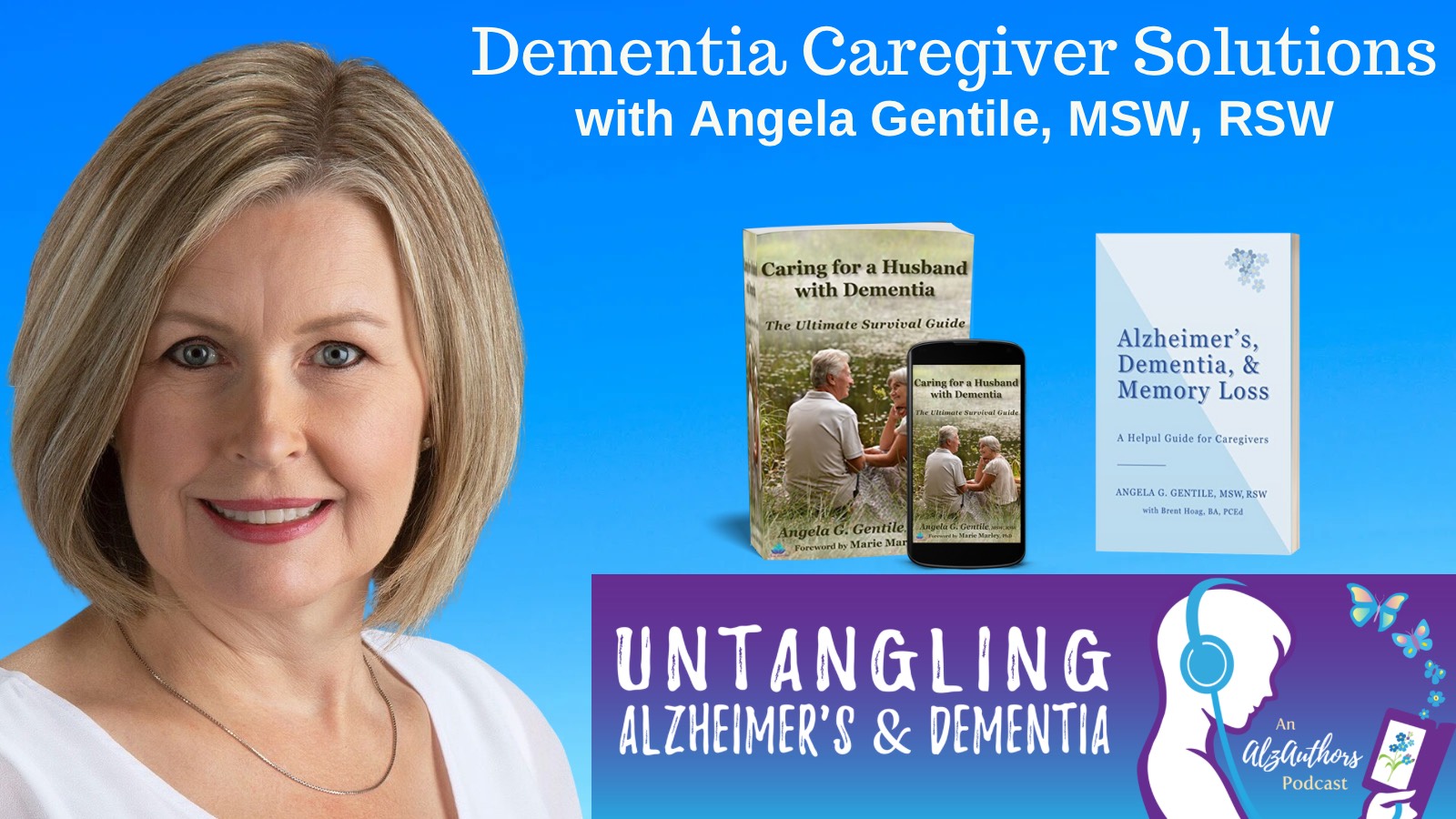
Untangling Alzheimer’s and Dementia: A Podcast Interview Regarding My New Book

Marianne Sciucco of AlzAuthors interviewed me and put together a podcast for your listening pleasure. Check it out, here.

She asks me lots of great questions about myself and my new book, “Alzheimer’s, Dementia, & Memory Loss: A Helpful Guide for Caregivers.” Available now on Amazon in paperback and ebook for Kindle.

Angela G. Gentile, MSW, RSW

Stressed Out? Consider Counselling and Speak to a Therapist

Photo by Pedro Figueras on Pexels.com

Stress is a normal part of life and can be caused by a wide range of factors such as work, relationships, financial problems, aging, caregiving, and health issues. While some level of stress can be helpful in motivating people to take action and find solutions, chronic stress can have a negative impact on a person’s mental and physical health.

People may seek counselling for stress because it provides a safe and supportive environment to explore and understand their thoughts, feelings, and behaviours related to stress. A therapist can help individuals identify the root cause of their stress, develop coping strategies to manage it, and learn relaxation techniques to reduce symptoms of stress.

Therapy can also provide an opportunity for people to process their experiences, address past traumas or negative life events that may be contributing to their stress levels, and develop a better understanding of their emotions and thoughts.

In addition, counselling can also help individuals with stress-related conditions such as anxiety, depression, and burnout. By working with a therapist, people can gain a deeper understanding of their patterns of behavior and thought, and develop a more holistic approach to managing stress.

Overall, therapy for stress can provide people with the tools and support they need to manage and reduce stress levels, and improve their overall mental and physical well-being.

Check out my Psychology Today profile for up-to-date information on my counselling services.

Angela G. Gentile, MSW, RSW

Made with the help of ChatGPT.

“Sail On” by Brent Hoag (Poem & Song) – Coping with Ambiguous Loss When a Loved One Has Dementia

Sail On by Brent Hoag

YouTube video by Marilyn Christian: Sail on by Brent Hoag https://www.youtube.com/watch?v=TyRAhRZ4ud0. Brent Hoag wrote a poem for his wife, Sally, who suffers from Alzheimer’s. The words were put to music by Songfinch and sung by Effee.

On page 92 of, Alzheimer’s, Dementia, & Memory Loss: A Helpful Guide for Caregivers, which Brent Hoag helped me with, I explain about ambiguous loss, a term coined in the 1970s by Dr. Pauline Boss. It is the unfortunate situation whereby a loved one is still alive, but “lost” at the same time. They are physically present but psychologically absent. This happens when someone is affected by a disease such as Alzheimer’s or one of the many other neurocognitive disorders. Damage to and dying parts of the brain ultimately affects one’s personality. Some caregivers find writing can help them cope with their grief. Brent Hoag wrote a poem in 2021 called “Sail On” which is dedicated to his wife Sally (see below). He then had it made into a song, then naturally a video on YouTube followed (see above).

The book, “Alzheimer’s, Dementia, & Memory Loss: A Helpful Guide for Caregivers” that I helped author Angela G. Gentile in part to write, has been well-received with a lot of positive feedback. My original poem “Sail On,” which I dedicated to my wife Sally who is in the later stages of Alzheimer’s, appears on page 93 which follows Chapter 9 that I wrote addressing humour and coping in relation to Alzheimer’s/Dementia.

For your ease of reference purposes, I am also including the original poem that I wrote that went viral across Canada, the USA, and beyond. I am so grateful to have heard back from countless people who thank me and let me know how much the poem (and now song) resonate with them. It is also great to learn that it has been disseminated/shared within the Alzheimer Society British Columbia and amongst personnel primarily at the renowned UBC Brain Health Centre. The song “Sail On” was also played at a national conference on-line discussion at the University of Waterloo in Ontario, Canada.

Brent Hoag
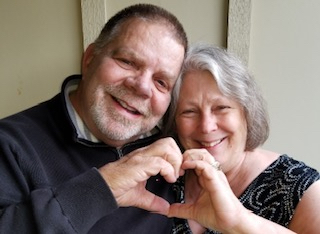
Brent and Sally Hoag

DEDICATED TO SALLY

SAIL ON

So far from the shore

I feel like I am no more

So far from land

I am now a lost husband

I am losing you

You are going away

Like a lost horizon on a cloudy day

From the deck I will release a dove

As a sign for you the one I love

Even though you are still here

I find that you are no longer near

Because you went adrift at sea

I will never again really be me

I love you Sally wherever you are

My heart is broken because you have forever gone afar

Even though I have found the shore

The “we” and “us” are never more

Sail on my love

Sail on my love

I pray that you find my dove

That I sent to you my love

Sail on

Sail on

Until you are finally free

From the bonds of this cruel sea

I will see you one day beyond the horizon

And my heavy tears will be no more

As we join together once again

So far from the shore

Love, Brent 💙

A special thank you goes out to Brent for sharing his beautiful poem. My heart goes out to him.

Angela G. Gentile, MSW, RSW

Note: Brent says, “Feel free to share and further disseminate this.”

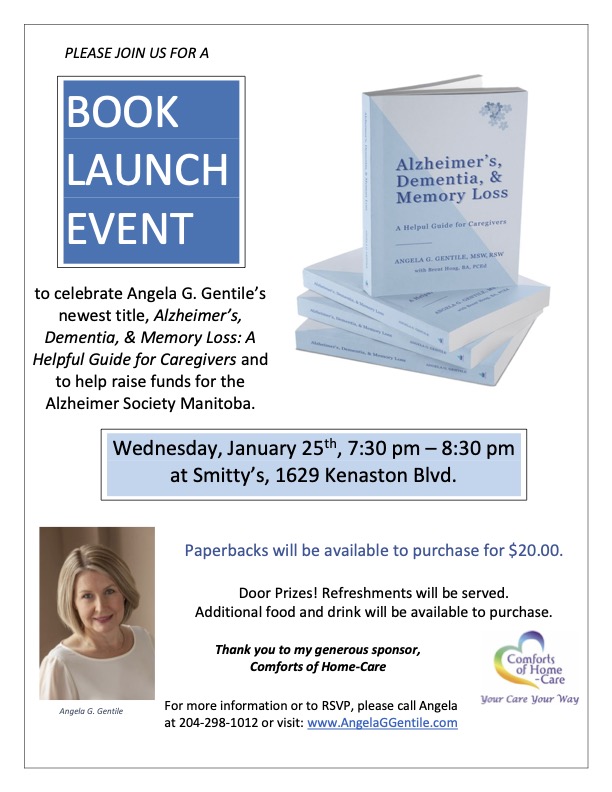
Book Launch and Alzheimer Society Manitoba Fundraiser

January is Alzheimer’s Awareness Month and I am planning to launch my newest book, Alzheimer’s, Dementia, & Memory Loss: A Helpful Guide for Caregivers on Wednesday, January 25th, 2023, 7:30 – 8:30 pm, at Smitty’s, 1629 Kenaston Blvd. here in Winnipeg, Manitoba.

I hope you can make it! Seating is limited so please let me know if you plan to be there.

Please help me out and share this with anyone you feel would be interested in attending.

Angela G. Gentile, MSW, RSW