We Must Be Doing Something Right: The Rate of Newly Diagnosed Alzheimer’s is Dropping in Canadians 65+

Photo by Andrea Piacquadio on Pexels.com

I am very interested in helping older people, especially those who are caregivers to those who have Alzheimer’s disease or related dementias. Two of my books are written specifically on this topic. January is Alzheimer’s Awareness Month here is Canada, and I was pleased to see this statement from the Minister of Health which I felt was important enough to share here (I bolded a section for emphasis!). I found there is a lot of valuable information, plus the good news that we are doing something right! It also includes steps we can take to help reduce our risks.

Way to go Canada!

Angela G. Gentile, MSW, RSW

Link to purchase my latest book on Amazon: https://a.co/d/4PDKnBj

Message from the Minister of Health – Alzheimer’s Awareness Month

From: Public Health Agency of Canada

January 3, 2024 | Ottawa, ON | Public Health Agency of Canada

January is Alzheimer’s Awareness Month. Almost half a million people in Canada live with dementia, impacting not only themselves, but their loved ones and caregivers as well.

While the risk of dementia increases with age, it is not an inevitable part of aging. In fact, the rate of newly diagnosed cases in Canadians aged 65 and over has been dropping for the last several years.

This is why the Government of Canada has been investing in the implementation of Canada’s national dementia strategy – A Dementia Strategy for Canada: Together We Aspire. It focuses on the areas of research, surveillance, awareness initiatives (including a national public education campaign), community-based projects and guidance.

Implementing the national strategy is a joint effort by a wide range of organizations across Canada, including provincial and territorial governments, academic institutions, non-governmental organizations, and health and social care providers. Over the past five years, the Public Health Agency of Canada (PHAC) has funded more than 70 dementia projects through organizations such as these across the country. A number of these projects were featured in the 2023 Report to Parliament on the national dementia strategy.

Targeted research is needed to better understand cognitive impairment in the aging brain, which is one of the reasons why the Canadian Institutes of Health Research (CIHR) launched the Brain Health and Cognitive Impairment in Aging (BHCIA) Research Initiative in March 2023. This initiative encompasses a number of aspects including the Canadian Consortium on Neurodegeneration in Aging and the Dementia Research and Innovation Funders Alliance (launched in November 2023) and several new funding opportunities.

It has been estimated that 12 risk factors that can often be managed and reduced could explain 40% of cases of dementia globally. This highlights the importance of raising awareness about these factors which include physical inactivity, smoking, obesity and chronic conditions such as hypertension and diabetes.

This January, for Alzheimer’s Awareness Month, I encourage you and your family to visit Dementia: Risk factors and prevention – Canada.ca to learn more about dementia risk reduction. Choose one habit that you can change or improve such as being more physically active, socializing regularly, or having a healthier, more balanced diet. Engaging in these healthy behaviours can help reduce the risk of dementia and delay the onset of symptoms, thereby improving your quality of life as you age.

We can all help improve the quality of life of those living with dementia. For more about how to reduce dementia-related stigma and communicate in a supportive way with people living with dementia, visit Dementia: Tips on how you can help – Canada.ca.

As more of us take these actions, we’ll reduce the impact of dementia on Canadians.

The Honourable Mark Holland

Contacts

Christopher Aoun
Press Secretary
Office of the Honourable Mark Holland
Minister of Health
613-291-4176

Media Relations
Public Health Agency of Canada 613-957-2983
media@hc-sc.gc.ca

Source: https://www.canada.ca/en/public-health/news/2024/01/message-from-the-minister-of-health—alzheimers-awareness-month.html#

New Research Indicates Marijuana is Bad for Your Brain and Heart

Photo by RDNE Stock project on Pexels.com

The American Heart Association put out two research study findings related to marijuana or cannabis usage. Smoking weed is NOT good for your health – especially your brain and heart health.

The Research Highlights included: “In one study, daily use of marijuana raised the risk of developing heart failure by about one-third, even after considering other factors, compared to people who reported never using marijuana.”

I wonder how Snoop Dog and Willie Nelson will fare in light of this news? Will it change their usage habits? Will it influence how often others are using it?

There is a particular focus on older adults in one of the studies. The research pointed out that there was an “increased risk of major adverse cardiac and cerebrovascular events in elderly non-smokers who used cannabis.” This reminds me that when I am asking clients about their alcohol use I also need to ask about their use of marijuana. The lead study author Avila’s Mondal, M. D., a resident physician, stated that, “Since 2015, cannabis use in the U.S. has almost doubled, and it is increasing in older adults, therefore, understanding the potential increased cardiovascular risk from cannabis use is important.”

Unfortunately, the research didn’t differentiate between eating and inhaling marijuana. I hope they can build upon these findings as we all know how bad smoking is for our health. But we don’t know if the edibles or ingesting it is also as bad.

For the full article, check out this link: https://newsroom.heart.org/news/marijuana-use-linked-with-increased-risk-of-heart-attack-heart-failure

Angela G. Gentile, MSW, RSW

(Shared with permission.)

What To Do When You Feel Bored

Woman playing guitar, Canva Text to Image

When you feel bored, there are several activities you can consider to help alleviate boredom and make the most of your time. Most you can do on your own, some require a willing participant. Here are some suggestions (a few overlap!):

1. Pursue a hobby: Engage in activities that you enjoy and are passionate about. It could be painting, playing a musical instrument, crafts, making jewelry, writing, photography, gardening, or any other hobby that interests you.

2. Read a book: Pick up a book that you’ve been meaning to read or explore different genres to discover new authors and stories. Reading not only entertains but also expands your knowledge and imagination.

3. Exercise or engage in physical activity: Physical exercise is a great way to combat boredom while improving your health and well-being. Go for a walk, run, cycle, or try out a new yoga or workout routine.

4. Learn something new: Use your free time to acquire new skills or knowledge. You can explore online courses, tutorials, or educational platforms to learn about a subject you’re interested in, such as cooking, brain health, coding, photography, or a foreign language.

5. Engage in creative activities: Get creative by drawing, painting, writing stories or poems, crafting, or working on DIY projects. Expressing your creativity can be fulfilling and help pass the time in an enjoyable way.

Older man riding a bicycle, Canva Text to Image

6. Connect with others: Reach out to friends or family members, either in person or through a phone call or video chat. Go shopping and speak to other shoppers or store employees. Engaging in conversations and social interactions can help alleviate boredom and foster connections.

7. Explore new music, movies, or TV shows: Discover new artists, genres, or movies and TV shows that you haven’t explored before. You can use streaming platforms or online recommendations to find content that suits your interests.

8. Organize and declutter: Use the opportunity to tidy up your living space, organize your belongings, or declutter areas that need attention. It can be a productive way to spend your time and create a more organized environment.

9. Play games or solve puzzles: Engage in activities that challenge your mind, such as solving puzzles, playing board games, or trying out online games. They can be entertaining and mentally stimulating.

10. Volunteer or help others: Look for opportunities to contribute to your community or help others in need. Volunteer at a local charity, participate in community events, or assist friends or neighbors with tasks they may need help with.

Remember, the key is to find activities that align with your interests and bring you joy. Experiment with different options to discover what engages you the most and helps alleviate your boredom.

What other suggestions do you have?

Angela G. Gentile, MSW, RSW

Written with the help of ChatGPT

Taming the Sweet Tooth: A 30-Day No Sugar Challenge Experience

Nutritionally, people don’t need any sugar in their diet. – World Health Organization

I noticed my chocolate and sugar habits were getting out of hand, and I wanted to cut back. Since my “Dry January” experience went so well, I thought, “I should try cutting sugar out of my diet for a month.” I wanted to reboot and reset my relationship with sugar, so I put a message out to my contacts to see if anyone else was up for if. I ended up getting five other ladies who were also interested in the challenge. Cutting sugar and sweets out of our diet for one month can’t be that hard, right? I created a group chat on Messenger and then made a private Facebook group so we could put our links to videos and other messages there for ease of sharing and reference.

Prep Week

The first few days was “Prep week.” We educated ourselves about added sugar (or “free” sugar), natural sugar (“good” sugar), artificial sweeteners, the dangers and problems with sugars, learning all the different names for sugar (maltodextrin, sucrose, etc.). We read labels, watched videos, read articles, and shared our experiences and thoughts with each other. Each of us had some choices to make. Did we want to avoid artificial sweeteners too? Did we want to allow small amounts of natural sugar sources such as honey and maple syrup? Did we want to count natural sugar grams (because sugar occurs naturally in foods such as fruit, vegetables, and milk products)?

Once we decided on our goals and reasons for wanting this sugar break (“Know our why”), and determined our individual “rules” and game plan, we had one last weekend to enjoy our sweets. I designed the challenge to start at the beginning of the week. For us, it was Monday, March 27, 2023.

Sweet tooth: A craving or fondness for sweet food. – Merriam-Webster

We Learned A Lot

The first few days were great! Swapping recipes, food item ideas, reading labels, supporting each other during this sugar fast was easy. We learned that certain wines have more sugar than others. We quickly realized that MOST packaged food has added sugar. Sometimes sugar is added for flavour, sometimes as a browning agent, and other times as a stabilizer or preservative. Sugar in bread helps feed the yeast, so it’s hard to find bread without sugar! Sourdough or pumpernickel can have no sugar, but it’s always good to check the labels if you are trying to avoid the sweet stuff.

I ran into a difficult situation the first week when my daughter and her boyfriend came over. We were celebrating Brayden’s birthday and Simone had brought over an Oreo Dairy Queen ice cream cake. Oh my gosh! It looked so good. As they were cutting it I could smell the sweetness and chocolate. I was encouraged to “cheat” and have a bit. It took all the willpower I could muster and I politely declined even a small piece. I had mixed feelings though. Not having a piece of birthday cake to celebrate a birthday felt wrong. I felt it was rude to not partake in the celebration. Was I rejecting the idea of celebrating a person? Was I saying “No” to him and “Yes” to me? Was it worth being “selfish”? How much did Brayden care that I didn’t have a piece of cake? I have no idea. But I know looking back, I feel that I should have cheated. I regretted not having that cake. Not for the sake of the taste, but for the social aspects of it. I learned a hard lesson that day. It is socially expected, encouraged, and polite to partake in having a piece of celebratory cake. Whether it’s a birthday, anniversary, or some other happy occasion. In hindsight, I decided that I should have taken a small piece of cake in order to appease my manners. If the tables were reversed, I would have felt honoured if a person decided to “break the rules” for my birthday by having a small piece of cake to celebrate me.

The next challenge for me was trying to enjoy my porridge and finding sweets that would satisfy my growing craving for chocolate. I started putting a little cinnamon on my porridge hoping it would switch it up. My blueberries were starting to taste sweeter than I remember. Dried apple crisps were very sweet! Applesauce was hitting the spot (it has some “puree” in it so I am not sure if it had added sugar or not).

I was enjoying unsweetened Greek yogurt with strawberries and a small amount of honey. I found out that honey and maple syrup, although technically not “white sugar”, was still sugar but in a natural form.

My ladies were sharing stories about how they passed on certain pleasures like muffins and iced sugary drinks. I decided to avoid alcohol as well, so I enjoyed my SodaStream fizzy drinks enhanced with flavoured Bubly drops. We were doing great.

How do I know if I have a sweet tooth? A sweet tooth is a regular or consistent craving for sweets, like candy, chocolate, cookies, and cakes. If you would rather reach for a handful of gummy bears than some chips for a snack, you have a sweet tooth. If you feel that any meal without dessert just is not complete, you have a sweet tooth. Source

I Hit A Wall and Changed Course

At the two-week mark, I hit a wall. Easter was coming, and we had a big family gathering planned. There was going to be lots of food and I am sure desserts. I was finding it too difficult to continue with the challenge the way I had been doing it. I decided I wanted to switch gears and integrate what I had learned about sugar, so I decided to try sticking to the 25g or less of added sugars daily (or 175g weekly). That way I was still being very mindful of my sugar intake and keeping it at a healthy level according to the leading world experts such as the World Health Organization (WHO).

I was able to enjoy eating at Easter and have a small piece of, again, Dairy Queen ice cream cake! I had a small piece and I estimated it was about 25g worth of sugar. I enjoyed it immensely and I felt like I could have eaten the whole cake!

My Recommendation

I would suggest moving forward that if you are interested in doing a 30-Day No Sugar Challenge, start with a Prep Week (7 days) then consume no added sugars (according to your own rules) for two weeks (14 days). Then take the next nine days incorporating what you learned into your everyday habits to see how you can change your eating habits for the better.

I am so glad I joined this group thank you Angela for being such a good leader.  This group gave me the motivation and more awareness of all the hidden sugars.  And I have overcome many challenges.  I think going forward I will be carrying this forward and sugar will not control me.  I also will educate others around me.  I have lost some weight also.  Sugar also affects the heart and since I have heart disease is more important that I stay off.  Thank you again Angela it was fun and you made it supportive and informative. – Francesca

It Was Worth It

I am so glad I did this challenge. It has rebooted my relationship with chocolate and sugar and I feel much better for it. I am sleeping better. I have less aches and pains, I lost four pounds, and I know my heart and brain thank me for it. When I have a sugary treat like dark chocolate I will enjoy it and think about how much I will have and why. I think I have lost interest in sweet sugar-loaded drinks like Pepsi. Just like alcohol, I will have the cake on special occasions. Sugar and alcohol are not necessary in our diets, so for me, learning how to enjoy these “treats” in a healthy way was the main goal.

A few sugary items that I would normally have – such as the occasional can of pop at work – I tried a little bit of root beer & right away it tasted like pure sugar! I looked on the label & it contained 42g of sugar so that’s something I will be staying away from going forward. – Lori

A special thank you goes out to my No Sugar Gals who went along with me on this challenge.

On to the Next Adventure – Yoga

My next adventure is going to be a 30-Day Yoga Challenge. If you are interested in joining me, please let me know. I have created a private Facebook group and you are welcome to come along. It is based on Yoga With Adriene’s Center program and it’s completely free. We start Monday, May 1, 2023.

Angela G. Gentile, MSW, RSW

You may also like: 30-Day No Sugar Challenge Prep Week

You may also like: Sugar, Heroin, and Alzheimer’s Disease – Kick the Sugar Habit to Decrease Your Dementia Risk

How to Get Dementia – Top 10 Tips (Satire)

A break from my usual programming…

I have been reading a lot about how to prevent dementia. My books on dementia caregiving have made me think a lot about how we can prevent getting dementia or some other form of neurocognitive disorder such as Alzheimer’s. Dementia is a condition in the brain that affects our capacity to remember things, process information, and organize our thoughts. It can impact our ability to make safe and wise choices and it can affect our language and movement. I have been listening to webinars, reading books, and scanning the Internet for organizations who have authority on the subject. Here’s a satirical piece on the subject, a break from my usual kind of writing.

Top Ten List of Ways to Increase Your Chances of Getting a Dementia Diagnosis

1.Live a very long life. The older we get, the better our chances are to get dementia. Dying at a younger age can work against you if you really want to experience the joys of dementia. If you are lucky, you may end up getting early-onset dementia which is when it comes when you are under the age of 65.

2. Don’t exercise. Stay very sedentary. The less you move, the better it is for dementia to set in. The less stress you put on your heart and your muscles, the more chances your brain and vascular system has to suffer the consequences of very slow and gentle blood circulation. Moving more and getting your blood pumping would deliver more oxygen and healthy cells to your organs, so the less chances of that happening, the better.

3. Smoke and drink alcohol. The more you smoke and drink, the better. If you started smoking and drinking (they go hand-in-hand!) at a younger age, that would definitely increase your chances for getting dementia. If you haven’t smoked or drank in your life, you should start now. The unfiltered cigarettes are the best. Any kind of alcohol is perfect (just remember if you don’t want to get cancer or heart disease, you may faced with a difficult decision.)

4. Eat lots of junk food. The more sugar in your diet, the better! Dementia (and cancer – what a bonus!) loves sugar. If you have diabetes that is even better. Poorly managed blood sugars can also increase your risk for stroke and heart attack. They don’t call dementia Type 3 diabetes for nothing. Eat whatever you want to your hearts content. Just avoid nutritious meals like what they recommend for the MIND or Mediterranean Diet (you know like lots of fresh fruits, vegetables, nuts, and seeds). They say “What’s not good for your body is not good for your brain” so that’s a good mantra to put on repeat. The more processed foods you can add to your diet would be very advantageous. And while you are at it, stop drinking so much water. That way you don’t have to piddle so much (that tip comes from my mom!).

5. Invite and create lots of stress in your life. Studies show that stress can cause lots of stress on your system which can lead to lots of bad things happening in your body – including cognitive decline. It would be advisable to avoid things like meditation, self-care, having fun, and taking breaks. If you are still of working age, find a job that is really stressful that pushes you to the limits. You may also end up getting high blood pressure, anxiety, and sleep deprivation, so these combined can really enhance your chances of getting some sort of brain drain and cognitive problems.

6. Stop doing novel things. If you like to be bored and thrive on doing nothing new, this is the perfect thing for you! Keep on turning down opportunities that can enhance your learning. Your brain will feel good and learn how to build new neural pathways, so this is a no-no when it comes to wanting an unhealthy brain. Traveling can also cause an increased risk of learning and expanding the brain cells. People who want to get dementia stop traveling and especially refuse to learn new things such as a new language or take a dance class.

7. Welcome and encourage head injuries. If you want to increase your chances of banging up your head and causing some damage, you can do risky things like riding a bike without a helmet, or be in a motorized vehicle without a seatbelt (one downside of not wearing a seatbelt is that you may be fined or you may get a really bad body injury, not just a “traumatic brain injury” or even death). If you are a bit unsteady when you walk, don’t use a cane or walker. Using mobility aids can help prevent you from falling, and therefore it could help prevent a bonk to the head. Taking a risk to go from here to there with the walker will only decrease your chances for bumping the old noggin.

8. Try not to sleep so much. The less sleep you get, the better. Your brain cleans itself at night, so the less sleep you get, the less chance your brain has to clean itself. It’s better to let the impurities build up in hopes it could cause some build of of plaques and maybe even tangles (I am not quite sure how the plaque and tangles form, but I am thinking it may have something to do with poor sleep habits.)

9. Avoid contact with others. Stay in to win! One of the best ways to get dementia is to stay home on your own, most of the time. If you live with family or have a roommate, try to avoid them as much as possible. They say the more you converse with and interact with people, the more healthy your brain is. If you play bridge or scrabble, stop playing it. The brain is stimulated by sitting with others, strategizing the next move, and it’s really bad for (helps reduce the risk of) dementia. “Just say no!”

10. Don’t correct your poor vision or hearing. Toss away your glasses and hearing aids. It has been proven that if you can see and hear well, it reduces your chances to get Alzheimer’s and other forms of dementia. I am not completely sure of how that works, but they are learning that people who have poor hearing and don’t wear hearing aids have a bigger chance of getting dementia. Same goes for difficulties with vision.

What other things can we do to help ourselves get dementia? I want to hear it!

Angela G. Gentile, MSW, RSW

The Magic Wand – A Brainspotting Therapy Session

Photo by Mikhail Nilov on Pexels.com

I would like to tell you about my recent therapy experience. I believe in order to be a good therapist, one should be seeking therapy as needed to deal with their own issues. Even the best therapists need a therapist occasionally! To optimize my emotional and psychological health, I occasionally seek outside help. With this in mind, I saw Clinical Social Worker Ruth B.Z. Thomson of Winnipeg, Manitoba, for a therapy session. She used a therapy technique called “Brainspotting” (BSP) which was new to me and which I was very curious about. 

“Brainspotting is a powerful, focused treatment method that works by identifying, processing, and releasing core neurophysiological sources of emotional/body, pain, trauma, disassociation, and a variety of other challenging symptoms. Brainspotting is a simultaneous form of diagnosis and treatment, enhanced with bilateral sound, which is deep, direct, and powerful, yet focused and containing.”

David Grand, Phd, Brainspotting Developer and Trainer

By the way, bi-lateral and BIO-lateral are two different things. It sounds confusing, but here is a way to explain the difference. Also, there is a link between brainspotting and EMDR therapy (Eye Movement Desensitization Reprocessing).

After filling out forms and consenting to treatment I entered Ruth’s beautifully decorated and comfortable office. She said I could choose any chair to sit on. There were about six chairs. I scanned the room, chose a chair, sat down, and got comfortable. I rearranged the cushions and used a little step stool. She sat across from me. She told me after a brief talking session, I would be listening to music with headphones, and she would use a wand for me to look at and focus on. The wand looked like one of those telescopic back scratchers and it had a dark blue handle.

We chatted for a bit to discuss my issues and then she told me we were going to get started with the brainspotting treatment. She passed me the headphones and made sure I could hear the music in both ears. It was not too loud as she also wanted me to be able to hear her. She said she was going to be watching me and I was to focus on my physical and emotional responses related to the issues I had presented to her with. 

The music she chose for me is called “bilateral” and it’s not exactly music. It was calming peaceful sounds such as chimes, waves, and birds chirping. The sounds alternated between the left and right ears. 

The music was very relaxing and calming. I noticed a yellow “glow” around the wand. (It almost looked like a magic wand!) Ruth held the wand to the left of her, almost at an outstretched arm’s reach, at eye level and I stared at it. She moved the wand slowly and watched my physical reaction. Sometimes I blinked more or fidgeted or took deep breaths. She also watched my facial expressions. 

After a few minutes she moved the wand and asked me to follow it. She moved it to the right of her body. It was about eye level. Very slowly and methodically she would move the wand up or down all the while watching my reaction. 

She asked me what I was feeling and thinking. I shared my thoughts, then she took the wand and moved it back to her right side. 

The music was very calming. I processed some feelings and thoughts. At one point I felt mad, and this was a bit of a revelation. This was good!

She then had me talk it out some more until I was done with my observations and feelings about the issue at hand. 

Then Ruth had me close my eyes and brought the wand closer to me. She had me open my eyes and I followed the wand, and she brought it back to her right then circled downward and back up closer to me. She repeated this closeup – back to the right – downward swoop movement in a fluid moderately paced motion about 4-5 times. It was like drawing a sideways “D” in the air with the wand. We then paused for a bit. 

Photo by Laura Stanley on Pexels.com

She then had me do a relaxing visualization. I found myself on a hammock in Hawaii! All the while the bilateral music played quietly in my ears, alternating between left and right.

After the guided imagery was over, she had me take off my headphones. There was a long pause as we sat in silence. She then asked me for my thoughts. 

I told her I like analogies to explain things when I can’t quite put my feelings and thoughts into words. I told her it felt like I was put into a long, dark tunnel and now I’ve come out of the tunnel and I’m not quite sure where I am. I’m looking around, but I’m not quite sure what just happened and where I ended up. It feels good though. I told her I think it’s going to take me a little while to process what just happened. She agreed and said that it will take a few days for the neural pathways to change. She told me to drink lots of water and gave me a couple pages to read on brainspotting.

As promised, she emailed me this link as an example of bilateral music – 1 HR Bilateral Music Therapy – Relieve Stress, Anxiety, PTSD, Nervousness – EMDR, Brainspotting (best heard with headphones). 

I am hopeful that this treatment will help me with my issue, and I could already tell just a couple hours later that I was already feeling some benefit. 

For more information on brainspotting check out David Grand’s book, Brainspotting: The Revolutionary New Therapy for Rapid and Effective Change.

Angela G. Gentile, MSW, RSW

“Flourish or Fade” Book Launch Giveaways and Contest Details

Celebrate National Women’s Health Week with us! On May 11, 2021, at 8:00 pm CST, Angela G. Gentile will be hosting a Zoom book launch for her newest book, “Flourish or Fade.” Register on Eventbrite to attend. There are a number of awesome books, services, and products that have been donated by some amazing women to help make this book event special. Please see the list below and enter to win! (see Contest Details below).

Flourish or Fade

1. Angela G. Gentile: “Flourish or Fade: A guide to total well-being for women at midlife and beyond” (paperback, $21.00 CAD value). Now available!

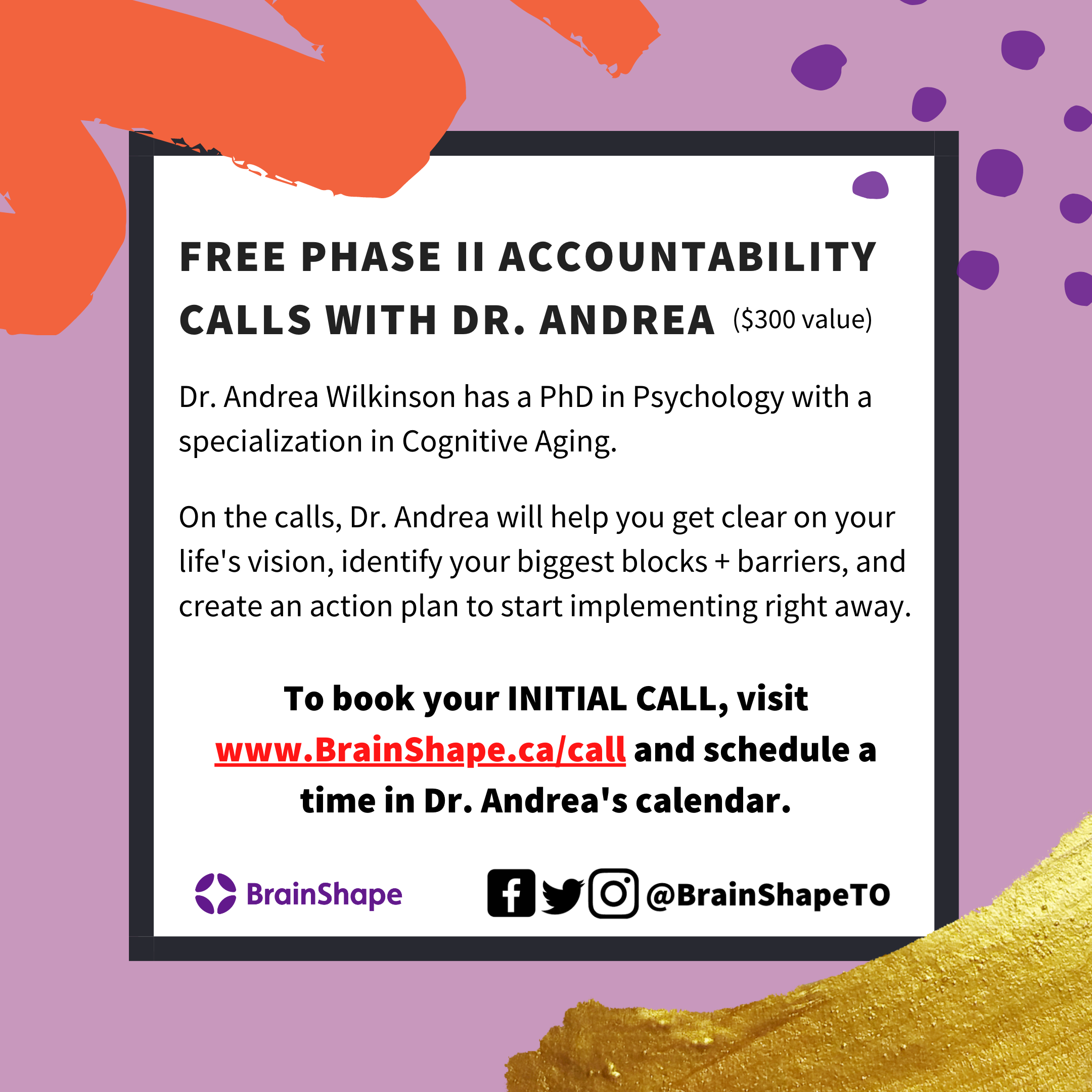
BrainShape Accountability Calls

2. Dr. Andrea Wilkinson: BrainShape Accountability Calls ($300.00 CAD value)

“Free Phase II Accountability Calls with Dr. Andrea of BrainShape” ($300 CAD value)

Accountability Appointments take place via TWO 60-minute video calls. 

CALL 1: Discuss your concerns and struggles + build a plan to help you address them (e.g., sleeping difficulties, chronically stressed, low energy, lacking mental focus, etc.) Whatever the problem, let’s talk about it & build a plan you can implement right away. 

CALL 2: Accountability Appointment to check-in on the goals you set out in Call 1.

The winner of the BrainShape Services prize will book their INITIAL CALL by visiting www.BrainShape.ca/call and book a time in Dr. Andrea’s calendar. This is a free offering of the supportive elements provided inside the Brain Vitality Blueprint, and helps people take the first step towards improving their health and well-being. 

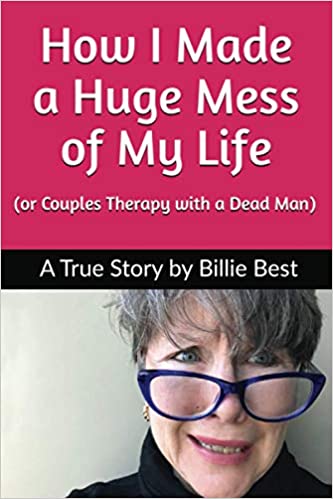
How I Made a Huge Mess of My Life

3. Billie Best: “How I Made a Huge Mess of My Life” (paperback, $12.99 USD value)

https://billiebest.com/

The World Came to Us

4. Molly Duncan Campbell: “The World Came to Us” (paperback, $12.99 USD value)

http://mollydcampbell.com/

The Playground of Possibilities Card Deck

5. Kay Ross: “The Playground of Possibilities” (card deck, $20.00 USD value)

This card deck is a self-help, personal-development tool with 52 questions for you to ask yourself. Every question starts with “What would be possible for me if I…?”, to prompt you to let go of your old, limiting thoughts, beliefs and stories about yourself and the world, choose more useful ones, take inspired action, and improvise more resourceful, joyful ways of being. Kay was born in Scotland, grew up in Australia, and has lived in Hong Kong for 27 years. She’s passionate about personal development and healing, and is also an improv performer. The deck costs $20 USD plus postage from Hong Kong (the full amount depends on the number of decks ordered and the destination).  

https://playgroundofpossibilities.com/card-deck/

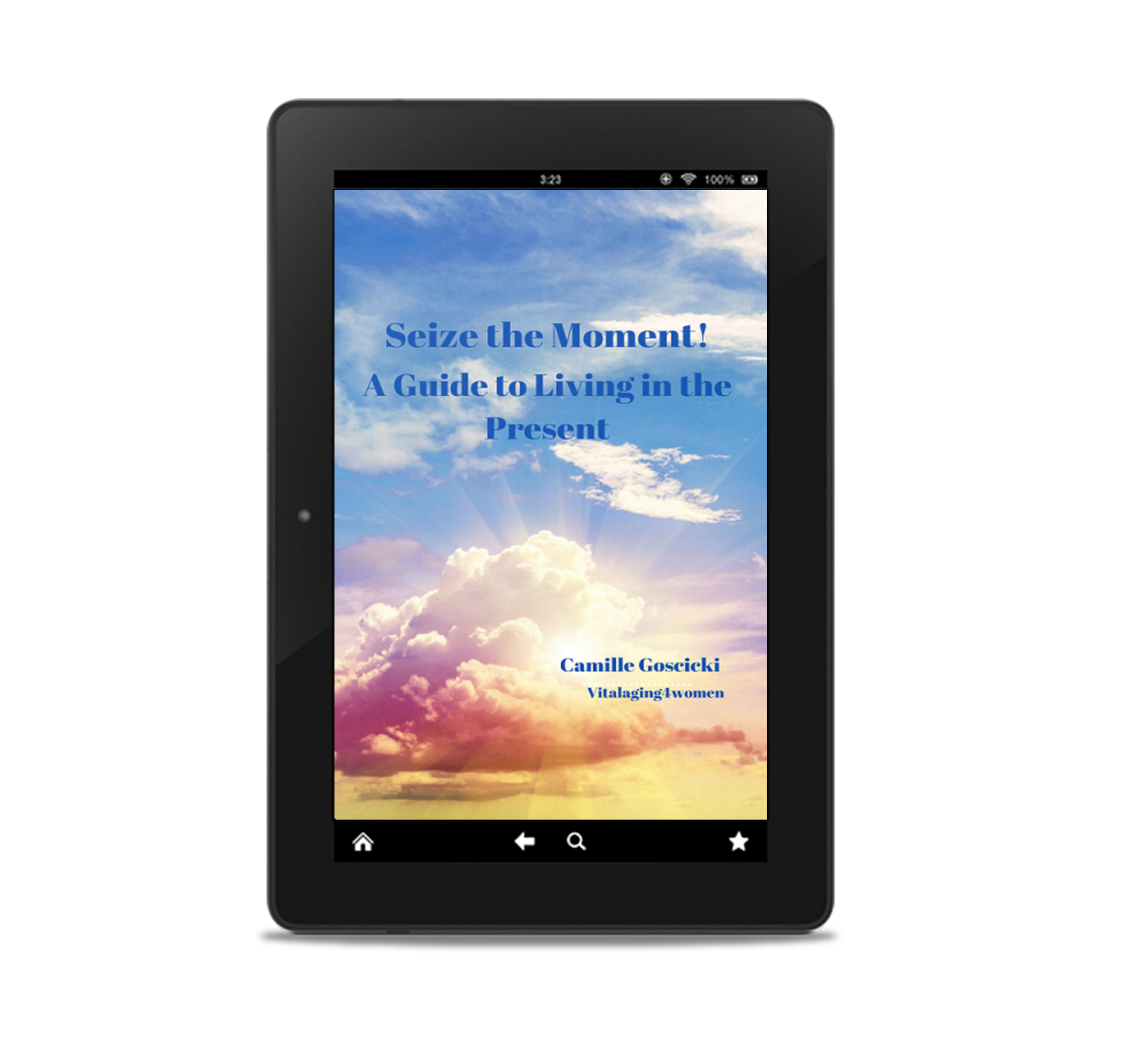
Seize the Moment!

6. Camille Goscicki, of Vitalaging4women, “Seize the Moment! A Guide to Living in the Present” (ebook, $4.99 USD value)

Do you live with regrets from the past, and fear the unknowns of the future?

It’s time to let go of fears and regrets and live for today. Seize the Moment! is your mini-guide to grab the present moment and live for today. It includes three bonus worksheets that will help you become more mindful. (Everyday mindfulness tips, practicing mindfulness, and becoming present for peace of mind.) Note: eReader not included.

https://www.vitalaging4women.com

The Unexpected Journey of Caring

7. Donna Thomson: The Unexpected Journey of Caring (hardcover book, $39.00 CAD value).

“The Unexpected Journey of Caring: The Transformation From Loved One to Caregiver” by Donna Thomson and Zachary White, PhD with a foreword by Judy Woodruff (Rowman & Littlefield, 2019) Available at all online booksellers Hardcover – $39.00 CAD)

With a foreword by Judy Woodruff, The Unexpected Journey of Caring is a practical guide to finding personal meaning in the 21st century care experience.

Personal transformation is usually an experience we actively seek out—not one that hunts us down. Becoming a caregiver is one transformation that comes at us, requiring us to rethink everything we once knew. Everything changes—responsibilities, beliefs, hopes, expectations, and relationships. Caregiving is not just a role reserved for “saints”—eventually, everyone is drafted into the caregiver role. It’s not a role people medically train for; it’s a new type of relationship initiated by a loved one’s need for care. And it’s a role that cannot be quarantined to home because it infuses all aspects of our lives.

Caregivers today find themselves in need of a crash course in new and unfamiliar skills. They must not only care for a loved one, but also access hidden community resources, collaborate with medical professionals, craft new narratives consistent with the changing nature of their care role, coordinate care with family, seek information and peer support using a variety of digital platforms, and negotiate social support—all while attempting to manage conflicts between work, life, and relationship roles. The moments that mark us in the transition from loved one to caregiver matter because if we don’t make sense of how we are being transformed, we risk undervaluing our care experiences, denying our evolving beliefs, becoming trapped by other’s misunderstandings, and feeling underappreciated, burned out, and overwhelmed.

Informed by original caregiver research and proven advocacy strategies, this book speaks to caregiving as it unfolds, in all of its confusion, chaos, and messiness. Readers won’t find well-intentioned clichés or care stereotypes in this book. There are no promises to help caregivers return to a life they knew before caregiving. No, this book greets caregivers where they are in their journey—new or chronic—not where others expect (or want) them to be.

“Nobody grows up planning to be a caregiver, but many of us will become one and sometimes when we least expect it. Thomson and White bring powerful insights to help understand what it means to be a caregiver and how to truly support those of us who will travel this unexpected journey.” – Samir K. Sinha, director of geriatrics, Sinai Health System and University Health Network, Toronto; health policy research director, National Institute on Ageing

www.donnathomson.com 

Keeping it Together

8. Eleanor Silverberg: “Keeping it Together: How to Cope as a Family Caregiver without Losing Your Sanity” (paperback, $20.00 CAD value)

https://www.eleanorsilverberg.com/kit-book

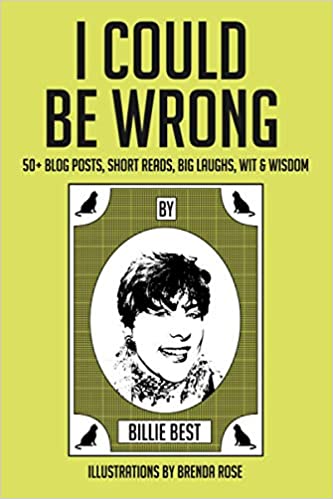
I Could Be Wrong

9. Billie Best: I Could Be Wrong (paperback, $7.99 USD value)

https://billiebest.com/

Contest Details:

  • Contest open to adults aged 18+, worldwide. No purchase necessary.
  • Identify which prize(s) you would like to win. Submit the item name/number, your name and email address to Angela at caretoage@gmail.com. (Your name and email address will not be given out to anyone else, unless it is required in order for you to obtain your prize(s)).
  • One entry per person, per item.
  • Entries accepted from Wednesday April 21, 2021 at 5:00 pm CST until Saturday May 15, 2021 at 12:00 noon CST.
  • Winners will be drawn on or before Sunday May 16, 2021 at 12:00 noon CST.
  • Qualified winners will be notified by email and your mailing address will be required so we can ship you your prize.
  • Every attempt will be made to get your prize to you, however, in the unfortunate event there are restrictions in your country, you will be ineligible. In that case, another draw will be made to seek a suitable winner.

Good luck!

Angela G. Gentile, MSW, RSW

www.angelaggentile.com

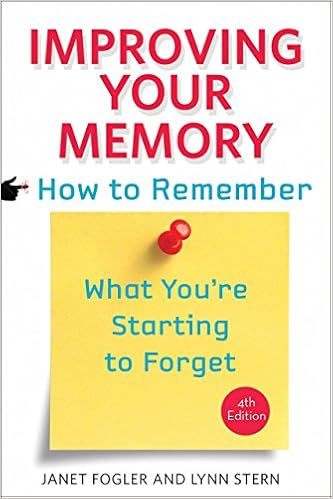
“Improving Your Memory” –– A Great Handbook for Those Concerned About Memory Changes (Book Review)

What do you get when two clinical social workers who work in a geriatric centre write a handbook on how to improve your memory skills? A fine little guide for helping older people who are concerned about the changes in their memory!

Janet Fogler and Lynn Stern team up in “Improving Your Memory: How to Remember What You’re Starting to Forget” (2014) in this fourth edition. Originally published in 1988, these social workers have created the book that I have been looking for. In this fourth edition, they have included the smartphone and other technologies that are helpful to us as we manage our daily tasks and are challenged by our aging minds and bodies.

The paperback (168 pages) is medium-sized and is packed with real-life stories and examples to help the reader understand the concepts. There are also quizzes throughout to help the reader apply the knowledge learned (to help one remember!). It is divided into four parts:

  1. How memory works
  2. How memory changes as we age
  3. Factors that affect memory
  4. Techniques for improving your memory

I cracked open the book and dived into section four, as I was eager to see what techniques the authors were recommending. They offered some great ideas, and even ones I had not heard of before. One of them had to do with switching your ring or watch to your other hand or wrist, as an indicator that you had something to remember. It is much like the classic “tying a string around your finger” trick. I found some of the mental exercises fun and a little tricky, and I enjoyed trying out some new skills to help me remember things. The one example for myself that comes to mind is when I am attending an appointment and I have to park in a large parkade. I will use an “active observation” technique so I won’t forget where I left the car!

The first three parts of the book are very easy to understand and come with an illustration of “A Model For How Memory Works.” For us visual learners, these kinds of diagrams are helpful. Encoding (getting something to stick) and retrieval (being able to recall something) can become a little more difficult as we get older, for a variety of reasons. The authors explain, in simple language, why these things happen and how we can try to combat them. Whether our forgetfulness is due to stress, grief, depression, poor concentration, medications, or illness, memory problems can cause added stressors. The authors give some good advice in the appendix on Alzheimer’s Disease and Related Dementias; “What is good for your heart is also good for your brain, so monitoring heart disease, diabetes, stroke, high blood pressure, and high cholesterol is important” (page 142).

I was surprised to learn the book doesn’t talk about “mild cognitive impairment” and the prevalence rates of Alzheimer’s disease and other related dementias. Knowing that the risk of Alzheimer’s disease increases with age is important to know, but not knowing the level of risk does not allay any fears or concerns one may have. (The World Health Organization estimates, of those 60 and over, 5 to 8 people per 100 will develop dementia.)

I also noticed the absence of the terms “mindfulness” and “meditation,” as those two terms are used quite often in most of the current brain health literature I have been reading. Fogler and Stern mention how alcohol can negatively affect your memory, but they omitted any mention of drugs. Interestingly the nutrition section has no reference to supplements. I also observed God, higher power, and spirituality are not discussed.

Overall, a highly recommended guide and workbook for those who want to learn about: how the brain stores and retrieves information (in our “working” and “long-term” memory); what happens to the aging brain; what may cause memory problems; and tips and techniques on how to maximize your chances of remembering things. I’ll leave you with these two tips: “Much of what is called ‘forgetting’ is a lack of paying attention” (p. 137); and “Study after study shows that increased fitness levels result in improvement on cognitive tests” (p. 64).

Angela G. Gentile, MSW, RSW
Author/Specialist in Aging

www.AngelaGGentile.com

“Brain Rules for Aging Well” Misses the Mark – Book Review

766124454

Dr. John Medina’s book, “Brain Rules for Aging Well: 10 Principles for Staying Vital, Happy, and Sharp” (2017), disappointed me. Perhaps I had high expectations as I was impressed with his first book “Brain Rules.” He has labeled himself the “grumpy neuroscientist” and his writing in this book shows. The hefty price of the hardcover ($36.99 CAD) made me believe that the information contained within must be good. As a specialist in aging, and someone who is very interested in the concept of “aging well,” I had to take a look.

I was encouraged by most of the reviews that this book was full of useful and helpful strategies to help one age well. As I dug in, I quickly realized that the book’s premise was inspired by the findings of an experiment from 1979 known as the “counterclockwise study” (Langer).  This was a very small study based on the experience of eight seventy-year-old men who were “stereotypically old.” For one week they were subjected to a time warp –– and lived as if it were 1959. After being immersed in the happy days of old, they came out seemingly younger –– happy with improved postures, hearing, and vision. Their hand grips strengthened and they moved with improved ease. As a woman in my fifties, I started to doubt how this book could adequately cover the topic of aging well – and my doubts were confirmed.

The book is divided into four sections, with the proposed “10 Brain Rules for Aging Well” which Medina starts and ends with as the guiding principles. Parts called Social Brain, Thinking Brain, Body and Brain, and Future Brain with a handy index at the end comprises the layout of the book. He refers to many scientific studies and other resources, and he directs us to “Extensive, notated citations at http://www.brainrules.net/references.” I found this style of referencing quite odd, and it was difficult to find what I was looking for. When I sit down to read a book, I don’t want to have to go to the internet to find the references. Also, the way the references are listed doesn’t make it easy to find what you are looking for.

I found myself bored with all the scientific jargon and his stories to help explain some of the complicated workings of the brain didn’t hit the mark. I ended up skim reading through quite a bit. Some of his aging well advice, such as engaging in friendly arguments and playing certain video games were quite surprising to me. I have yet to understand how a specialist in brain research would suggest arguing with people and playing video games as part of a good plan for overall brain health.

I liked the summaries at the end of each chapter. Medina’s advice about exercise, healthy diet, friendships and “say no to retirement” were well-taken. I found the discussion on the updated term “working memory” for the outdated term “short-term memory” interesting.  The personal stories he shares were endearing, especially the one about nostalgia, reminiscing and the “our song” syndrome he and his wife share.

The book was apparently well-proofed and edited (as Medina notes in his acknowledgments); however, I found two glaringly obvious errors. The first was on page 104, where Medina mistakenly tells us that reading from books 3.5 hours a DAY will help reduce our risk of dying by a certain age when compared to those who didn’t. In actuality, the research states it is a 30-minutes-a-day activity, which translates into 3.5 hours WEEKLY.

The second error, which I was astonished by (as an author and editor myself), was on page 164. Medina was talking about research on exercise done with people with limited mobility. He said that the participants were “assessed by a test called” and there was a blank space after that. The next paragraph started with a period. Perhaps that was the period that he deliberately omitted back in the introduction on page 7? I’d be pretty ticked if I were Medina, knowing this one slipped by all the reviewers.

I believe this was a good attempt by Medina to write a book on Aging Well; however, his dated references to works from 30-40 years ago (e.g., Hauri’s book No More Sleepless Nights, and the movie Cocoon) made me less confident in thinking he was using fresh and current research. This book was a good attempt at starting the conversation about brain health and aging well, but I think he has a lot more reading and researching to do on the subject. One last thought –– I wish he’d avoid using the term “elderly.” That’s a term we are getting away from in the aging well literature when discussing older adults. I believe mainstream media is also moving away from using that term.

Angela G. Gentile, MSW, RSW

www.AngelaGGentile.com


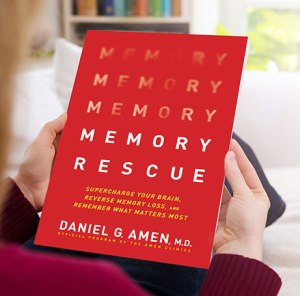
Memory Rescue by Dr. Daniel Amen (2017) – Book Review

img01


I am a geriatric mental health clinician, and frequently I am asked: “How can I improve my memory skills?” The usual recommendations from doctors are, “Exercise and learn new things.” I have been on a quest to find some other tips and tools that people can use to help improve or maintain their brain and memory functions as they age. This need has led me to try to find the perfect book to recommend to those who are looking for more information. “Memory Rescue” has some useful information but it’s not the book I was looking for.

I purchased a copy (Amazon) of psychiatrist Dr. Amen’s book “Memory Rescue: Supercharge your brain, reverse memory loss, and remember what matters most” which has a second subtitle, “The official program of the Amen Clinics.” The Amen Clinics are found all over the USA, and the services and programs offered there are to help people with various mental health and brain health concerns (such as memory loss, ADD, and traumatic brain injury).

This book starts out with 20 testimonials and reviews which is very impressive until I realized they were all from men. The male-dominated view about memory problems and the Amen Clinic program was very strong. The only female presence I felt was from Dr. Amen’s wife, Tana, which was very sparse. There were also a handful of case studies that were about females. As a woman reader and professional, I wish there had been a more balanced perspective.

The overall takeaway of this book, for me, was that this was a big advertisement for his Memory Rescue Program that he offers through his Amen Clinics and the MyBrainFitLife.com website. There were case examples of how his clinics help people, and there were lots of “SPECT” (single photon emission computed tomography) scan photos to “prove” it. Even after looking at numerous SPECT images, I still wasn’t 100% sure what I was looking for. I felt these images were a bit overkill.

Here in Canada, we don’t have access to Amen Clinics, and SPECT scans are reserved for those exceptional cases (which I am still not sure what those cases are.) We tend to favour CT, MRI and PET scans.

Ultimately I was looking for concrete tips on “how to improve memory skills” and “how to improve memory problems.” Amen’s program is intended to enhance your mood and memory skills using the BRIGHT MINDS risk factor approach, with each letter standing for a component of the “ultimate memory formula.” Blood Flow, Retirement and Aging, Inflammation, Genetics, Head Trauma, Toxins, Mental Health, Immunity/Infection Issues, Neurohormone Deficiencies, Diabesity, and Sleep Issues. There was quite a lot of repetition throughout the book, with the main recommendations being: Exercise, Nutrition, Nutraceuticals (and supplements).

On pages 28-30, you can take the “Amen Clinics’ Early Warning Signs Questionnaire.” Your score will provide you with a risk of “significant memory issues,” from low to high. Amen states, if you are at moderate to high risk, it is important to get a thorough medical evaluation.

This book brought up some new terms and concerns. Those including my need for nutraceuticals (which Amen sells on his BrainMD website), getting tested for the APOE gene (related to Alzheimer’s disease), an integrative medicine doctor (but doesn’t say where I can find one). He was heavy on the recommendation of Gingko Biloba (a natural supplement that has limited research evidence to help prevent memory problems, see GEM study). He was anti-marijuana use and wasn’t that clear on what the recommendation was for alcohol use (was it 2-4 servings a week or only 2?).  He suggests coconut oil is good for our brains, but I have read that it is not good for our bodies. There is a lot of reference to the Memory Rescue Diet, but it is not discussed until chapter 16. There are a lot of references to the Bible, which surprised me. He also suggested that “praying to release your worries and to rejoice over the good things around you can help reduce your risk of mental health problems” (p. 337).

Ultimately, as I mentioned earlier, I was looking for specific tips and techniques to help people improve their memory skills. The most helpful part of the book in this regard is found in Chapter 17 “Sharpen Your Memory––Brain Workouts for a Richer Life.” He provides a lot of suggestions of what activities can help strengthen the different areas of the brain such as playing Scrabble, completing crossword puzzles, and learning to play a new musical instrument. He suggests engaging in “map reading” without a GPS device. He’s a big fan of table tennis and other coordination activities, such as dancing, yoga, and tai chi. He says we should travel to new and interesting places and develop relationships with smart people. Music, especially classical, can enhance memory and cognitive function. Surprisingly, I didn’t find the instruction to “pay attention” to what we are doing, which I believe is an essential tip for being able to remember things in the first place. He doesn’t speak to word-finding difficulties, either, which is one thing a lot of older folks are initially concerned about.

The book is well-referenced, and he claims to walk the talk. The index is sub-par, and it could have been enhanced to make finding things a lot easier to find. Some of the reviews online of Amen Clinics state it is a very costly program. There is no mention of costs, but there is mention that the process of improving cognition or mental health often takes months. It’s assumed the program costs thousands of dollars. The MyBrainFitLife.com online program also has a cost, a yearly fee of USD 99. There are some free Brain Assessments (which I completed) which can help one decide on the level of risk one is at. If someone already has memory impairment, a caregiver or loved one will need to read this book as it tends to have some jargon and technical language, and there is lots to read and learn about.

I would recommend this book to anyone who is interested in the Amen Clinic Memory Rescue Program. For specific information on brain health and tips for improving memory skills, Chapter 17 is where you want to start. If you believe in God or a higher power, this will also confirm your faith in how prayer and scripture can support your mental health. The book is somewhat repetitive, however, it drives home the main message––that having a healthy body means better chances for a healthy brain.

I’ll leave you with this: Amen provides hope––“Yet new research suggests that a ‘memory rescue’ program, like the one presented in this book, can dramatically improve memory and can prevent and sometimes even reverse some forms of dementia. Given how most doctors approach this issue, however, you cannot count on traditional medicine to rescue your memory.” (p. 4).

Angela G. Gentile, MSW, RSW (Specialist in Aging)