Watch Your Step! Fall Prevention Tips

used-image-courtesy-of-simon-howden-at-freedigitalphotos-net

Source: Simon Howden, Free Digital Photos.net

Did you know that one in three Canadians over the age of 65 will fall this year?

Some of these falls are life-threatening. In fact, falls are the leading cause of injury-related hospitalizations of older adults in Canada (Smith, Wager & Elliott, 2010). In 2004 Statistics Canada reported falls cost the health care system an estimated $2 billion.

In Canada, falls are the leading cause of head injury hospitalizations in adults (Canadian Institute for Health Information). Thirty-five percent of injuries from a fall result in broken or fractured bones (Statistics Canada). The cost to the health care system and to personal quality of life is staggering.

It is important to know the risks and to prevent falls from happening.

These falls happen everywhere; be it in the home, the community or in long-term care. There are some helpful online risk assessment tools and other resources to help older adults who are at risk, or who simply want to be pro-active in fall prevention. A study done in 2009/10 showed that fall related injuries from simply walking comprise forty-five percent of self-reported injury. (Statistics Canada, Community Health Survey).

Self-Assessment for Older Adults Who Live Independently

For older adults who live alone, the Staying on Your Feet website provides a self-assessment questionnaire for older adults, called Prevent Falls Check-Up. Once completed, a Check-Up report is provided which offers a variety of suggestions and tips for falls prevention. The main message here is that most falls are preventable, and steps can be taken to reduce risk.

Safety is far more important than what preventative and risk-reducing measures “look like.”

Concerns about getting in and out of the bathtub? Arrange to have grab bars installed. The Canadian Mortgage and Housing Corporation has released guidelines on the best placement for grab bars for maximum effect and ease of use. We have to get past the idea that grab bars may make us look weak or frail.

Taking medication? For those on three or more medications who are experiencing bouts of feeling light headed or dizzy, regular medication reviews are recommended. Medication adjustments may be required to help reduce unwanted and potentially harmful side effects that can cause an increased risk for falls.

Could the home surroundings be made safer? When a person has lived in a place for many years, they tend to not see where improvements can be made. If the person tires easily, perhaps a relative can help select rest areas where small chairs can be set to provide breaks. If the person tends to walk the same path through his/her home, move furniture to ensure a clear pathway.  If a small pet tends to get underfoot, install a bell on its collar. Move commonly used kitchen items to easy-to-reach areas to reduce the need for step stools. For hard to reach items, never stand on a chair – always use an appropriate stool or short step-ladder made for such a purpose, and preferably one with a handle at the top to provide steady support.

Is footwear safe? Slippers or mules with no backs, overly worn soles or shoes that are too tight, can all contribute to falls. Ensure the person has a good pair of well-fitting shoes, preferably without laces that could cause tripping, and with lots of room in the toe box. Wear these shoes in the house. Shoes that move with one’s feet will help reduce falls in the home.

Problems with blood pressure? Postural hypotension, or a sudden lowering of blood pressure when changing head elevation, is common among those 65 and older. A good tip is to get in the habit of sitting on the edge of the bed for a few seconds upon awaking before standing up. This allows the blood pressure to adjust to reduce the risk of dizziness upon rising.

Overactive bladder? If bladder incontinence or urgency poses problems, rushing to the bathroom can be a fall risk, especially in the night, and especially for homes where the bathroom is not close to the bedroom. Consider purchasing a bedside commode. The commodes of today are much more user-friendly and attractive than in our grandmother’s day, and we should not be embarrassed to install one in our bedroom. Purchase a screen to hide it during the day if embarrassment is an issue.

Need to use the stairs? Falling on stairs is the third most reported reason for falls, (Statistics Canada, Community Health Survey) after walking and snow/ice slips. 12 Steps to Stair Safety at Home is a one-page checklist on stair hazards and ways to look at stair issues effectively. First and foremost handrails should be on both sides of the staircase and should be used in every instance, no exceptions.

fall

What to Do After A Fall is a poster that can be printed off and kept in various places around the home. It is especially recommended for those who live alone and have already experienced a fall.

Personal Response System to Ensure Safety

If the risk for falls is high or family members are concerned about their loved one falling, one popular option is to get a personal response system. The Philips Lifeline AutoAlert service is a great optional feature that will automatically summon help if the person falls. There are many other such services and some of them are:  ADT, Alert1, Bay Alarm, Care Innovations, LifeAlert, LifeFone, LifeStation, Medical Guardian, Mobilehelp, and RescueAlert. Some research may be needed to find the one right for the circumstances, and these may not all be available in Canada. Some people are worried about the appeal of wearing a device such as a necklace or bracelet but modern technology makes many of these devices appear as regular jewellery. In Canada, Costco stores provide two such devices – Medical Alert and Direct Alert.

Buddy Systems

Although there are reportedly only one fifth as many falls in residential care facilities as in private homes (according to Statistics Canada), it is still important to be aware of fall risks and prevention strategies in seniors’ residences.

Some seniors’ residences have a buddy system or a safety check program in place. Examples would be where the tenant puts a door knob hanger or other signal (garbage can for example) outside their doors at night and remove them in the morning to signal that all is well. Alternatively, a phone call once or twice a day can ensure one’s safety with the added bonus of social interaction.

The Prevalence of Falls in Long-Term Care and Residential Facilities

Some people who live alone move into long-term care settings because of their complex medical needs and increased risk for falls. Nursing Home (NH) residents who fall are at risk for injury such as a fractured hip or other bones. Sometimes a fall results in death.

The Winnipeg Regional Health Authority listing of Critical Incidents Reported to Manitoba Health from October 1, 2013 – December 31, 2013 identified 34 NH resident falls over the three-month period. One of these falls resulted in death. Seven of the falls were witnessed by a staff member, and 27 were unwitnessed. Of these unwitnessed falls, 16 resulted in a fractured hip and a trip to the hospital for surgical repair.

According to a 2008 Winnipeg Regional Health Authority publication, the Personal Care Home View, 18,868 falls were reported in nursing homes in Winnipeg in one year. Most falls occurred in residents’ rooms on evenings and weekends.

Falls Risk Assessment Tool for Long-Term Care Facilities

The Johns Hopkins Falls Risk Assessment Tool (FRAT) helps identify the level of risk in NH residents, based on the following criteria:

  • Recent falls
  • Medications
  • Psychological factors
  • Cognitive status

If a person has had recent falls, it increases the risk for a repeat occurrence. Certain medications, such as sedatives, antidepressants, antipsychotics, anti-Parkinson’s, antihypertensive, diuretics or hypnotics can also increase risk. Psychological factors such as dementia, anxiety, depression, decreased cooperation, impaired insight or judgment (esp. re: mobility) also increases risk for falls. Finally, the higher the level cognitive impairment, the higher the potential for an incident.

The overall FRAT score is out of 20, with a higher score indicating increased risk. A low, medium or high Fall Risk Status is identified on the resident’s care plan. For those with identified risks, intervention strategies can be formulated, and referrals to other specialists may be initiated. For example, a geriatric psychiatrist or pharmacist may be consulted to review medications. Additionally, an occupational therapist may be required to assess mobility to determine the need for mobility aids and appropriate footwear. For example, hip protectors may be recommended. Also, anti-slip etching can be applied on the floor around the bed and most certainly should be in the bathroom in the shower area.

Identify, Prevent and Reduce Risk

Most falls can be prevented, and education is key. If You Fall is a guideline that can be kept on hand regarding what to do if a person has a fall including “How to get up” and the importance of “Telling the doctor.”

Regular exercise can help strengthen muscles and keep the body limber. It can also help with balance issues. Seek out the help of a qualified professional such as a physiotherapist for a tailor-made exercise program.

A healthy balanced diet and regular doses of sunshine (or Vitamin D) are also important to help keep bones and muscles strong and healthy.

Whether the older adult is living independently or in a long-term care setting, education and assessment can help identify, prevent and reduce the risk for falls. If you are keen on the subject, consider holding an awareness month, week or day like the Fall Prevention Awareness Month promoted in British Columbia and consider what kinds of activities you would like to include.


Angela G. Gentile, MSW, RSW

August Janice Bailey, Dip. Herb, HCA

 

purple-swirl-separator-hi

Angela G. Gentile, M.S.W., R.S.W. is a clinical social worker and author of the book, “Caring for a Husband with Dementia: The Ultimate Survival Guide”, “A Book About Burnout: One Social Worker’s Tale of Survival” and the “Dementia Caregiver Solutions” app for iPhone and iPad. She lives in Winnipeg, Manitoba with her husband and two adult children. For more information, visit: www.AngelaGGentile.com

August Janice Bailey, Dip. Herb, HCA is a Health Care Aide, an herbalist, a writer, and a falls prevention researcher and analyst. She is interested in many aspects of healthy aging including  nutrition and movement strategies. She works with seniors to reduce fall risks in their homes. August lives on the West Coast in Courtenay, British Columbia with her daughter. She can be reached through LinkedIn.


Additional References/Resources:

Government of Manitoba (2014). Critical Incidents Reported to Manitoba Health. Retrieved from http://www.gov.mb.ca/health/patientsafety/docs/ciq31314.pdf

Preventing Falls in Older Adults – Winnipeg Regional Health Authority, Manitoba, Public Health Resources  http://www.wrha.mb.ca/community/publichealth/PREVENTINGFALLSINOLDERADULTS_000.php

Partners Seeking Solutions with Seniors and Manitoba Pharmaceutical Association. Date Unknown. Fall Prevention: How does what I take or what I drink affect my risk of falling?  Retrieved from http://mpha.in1touch.org/uploaded/web/Legislation/Practice%20Resources/PSSSFallsPreventionPamphlet%20Updated%20Nov2014.pdf

Scott, V., Wager, L. and Elliott, S. (2010). Falls and Related Injuries Among Older Canadians. Retrieved from http://www.hiphealth.ca/media/research_cemfia_phac_epi_and_inventor_20100610.pdf

Statistics Canada (2014) Seniors’ Falls in Canada: Second Report. Retrieved from http://www.phac-aspc.gc.ca/seniors-aines/publications/public/injury-blessure/seniors_falls-chutes_aines/index-eng.php

Winnipeg Regional Health Authority (2008). Personal Care Home View, April 2008. 5:4. Retrieved from http://www.wrha.mb.ca/ltc/pch/files/PCHView_Apr08.pdf
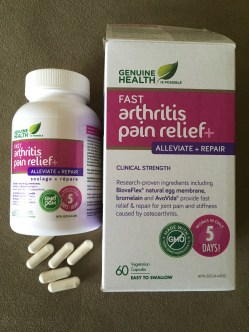
How to Manage Arthritic Pain and Stiffness – A review of Genuine Health’s Fast arthritis pain relief+

image

Genuine Health FAST arthritis pain relief+

I have been living with osteoarthritis for the past 20 years or so. I come by it honestly, as my grandmother had a bad case of it. Arthritis is a condition of inflammation of the joints. It affects one in six Canadians over the age of 15 and is the number one cause of disability in women (and third in men).

Arthritis, like all diseases and conditions, affects people in different ways. For me, the pressure and stress over the years has resulted in sacroiliac (SI) joint and lower back (lumbar vertebrae) issues. The SI joints  are used to transfer movement from the upper body to the lower body and are especially important when you turn over in bed (see diagram below).

There have been times when I wince in bed, with that dreadful reminder that my SI joints are inflamed. There is usually no specific trigger. Sometimes I think it’s the weather – other times I blame hormones.

I was approached by The Publicist Group to see if I was interested in trying out Genuine Health’s FAST arthritis pain relief+ or one of their other products (FAST joint care+ and FAST pain relief+) The claim was it would help relieve pain in five days (hence, the word FAST in the title). They had other products too, but this one seemed to speak to me. I had used Aleve, Advil and Tylenol in the past. I have also purchased a Lumbar Brace and Tens and an ice pack to help when my SI joint is aggravated.

I have also been to physiotherapists in the past. I have been prescribed exercise programs and the main treatments for my problem is core strengthening and stretching. Yoga has also been recommended. Walking, cycling, gentle exercise on the elliptical, weights, calisthenics and stretches are activities I try to do at least twice weekly. I say “try” because sometimes this isn’t a priority in my life – at least not as big of a priority as I know it should be. When the pain is really bad, I usually find laying down for 10-15 minutes helps relieve my pain.

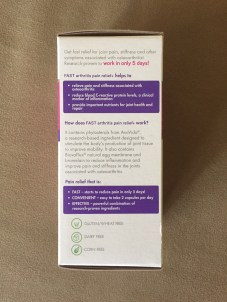
So, I agreed to try out FAST arthritis pain relief+. I was given a complimentary bottle of 60 tablets. The directions say to take two caplets daily. Information on the bottle states:

image“How does FAST arthritis pain relief+ work?
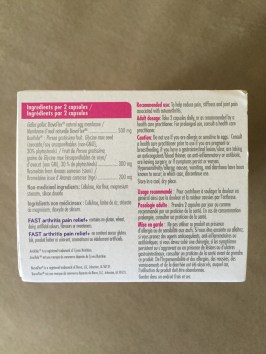
It contains phytosterols from AvoVida®, a research-based ingredient designed to stimulate the body’s production of joint tissue to improve mobility. It also contains BiovaFlex® natural egg membrane and bromelain to reduce inflammation and improve pain and stiffness in the joints associated with osteoarthritis.”

I found the study the company did and it showed favourable results by an impressive number of people who had tried out the product. I noticed they did not have a placebo group (a group of people who thought they may have been taking the product to be tested but were given a fake pill). There is a certain amount of placebo effect whenever you are given a treatment. If you believe a treatment will help you, the power of the mind will help you achieve the desired results. This is in fact a phenomenon that is currently perplexing to scientists and we have a lot more to learn about the power of the mind and the placebo effect.

imageI decided to document my experience by recording my level of pain each day on a scale of 1-10 (1 being no pain, 10 being excruciating pain).

I knew this may take a few days to take effect, so I was prepared to focus on this for at least a week. I also decided (as in the study) not to take any other pain-relieving medications during the time I took the easy-to-swallow caplets (although there were days I wanted to!).

Overall,  it took me 7 days (not 5 – this product is “research-proven to work in only 5 days”) to feel pain relief. Over the next couple of weeks I had a couple of times where my arthritis flared up and I had to take some Advil to help alleviate the pain. I probably won’t continue to take this FAST on a regular basis, unless I find a huge change in my arthritic pain once I have completed my 3o-day trial.

I would say the FAST caplets are worth trying out. I have seen the cost for this product at $62.00 – 79.99 for 120 caplets (a two-month supply). Sold on Amazon (see links below) and available at other locations.

Here are some other tips on how to cope with arthritis:

  • Ensure good ergonomics when sitting at the computer
  • Take frequent short breaks when sitting at the computer such as getting up to get a glass of water or standing up and stretching (every 15 minutes or so)
  • Massage can help bring needed blood flow to the area, and loosen and stretch the muscles surrounding the joints. However, avoid aggressive massage such as what is offered in a massage chair can aggravate inflamed joints
  • Chiropractic adjustments may help
  • Laying down for 10-15 minutes can provide much-needed relief
  • Gentle stretches can be helpful (see a physiotherapist for exercises and stretches) or try this SI Joint Stretch
  • Walking and gentle exercise can help provide relief and stretching can keep joints limber
  • Voltaren emulgel can help relieve pain
  • Ice and/or heat can help relieve the pain
  • A warm shower or bath can also provide relief
  • Housework can cause a flare-up (haha)

Check out these resources for more information on how to manage osteoarthritis:

Genuine Health – Natural pain relief proven to reduce inflammation. Find where to buy the product on this website (in stores and online).

Top 3 Tips for Osteoarthritis by Eugene Sims, a physiotherapist

The Arthritis Society – Information, resources, tools and expert access

Buy Now from Amazon:

FAST ARTHRITIS RELIEF+

Genuine Health fast arthritis pain relief+ 60 capsules

Age well, my friend!

Angela G. Gentile, MSW, RSW

purple-swirl-separator-hi

Angela G. Gentile, M.S.W., R.S.W. is a clinical social worker and author of the book, “Caring for a Husband with Dementia: The Ultimate Survival Guide”, “A Book About Burnout: One Social Worker’s Tale of Survival” and the “Dementia Caregiver Solutions” app for iPhone and iPad. She lives in Winnipeg, Manitoba with her husband and two adult children. For more information, visit: www.AngelaGGentile.com

Memory and Aging Program™ is Motivating and Uplifting


MAP_Logo_Baycrest_Health_Sciences_large

Creative Retirement Manitoba – Memory and Aging Program™

I first heard Dr. Ronak Patel, clinical neuropsychologist, speak about the Memory and Aging Program™ last fall here in Winnipeg. This is an evidence-based program that comes out of Baycrest Centre for Geriatric Care in Toronto, Ontario. Many of us fear developing dementia in our older years, and many of us start to get worried when we have memory problems. Now there is a program to help enhance memory skills that works. (It doesn’t prevent Alzheimer’s or related dementias, however.)

I met up with a friend, Sherry Cels, a retired social worker, who completed the Memory and Aging Program™. She says it is a very popular program, and there is a wait list for people who want to go. It’s very popular with those 60 and over who are experiencing memory problems.

For Sherry, at 70, she was worried about her own cognitive health and memory skills. One of her parents had Lewy Body dementia, and she was concerned she may have inherited the condition.

I asked her, if after taking the course, was she still worried about developing Lewy Body dementia and she replied,

“There is no predicting that. But for now, I believe my memory problems are very normal for my age group. Sharing with others in the class helped me see that.”

Not everyone has problems in this area, but she learned it is quite normal to experience changes and there are things that can be done to combat these memory problems. I asked her to tell me about the Memory and Aging Program™ she attended.

logo.png

The workshop was $150.00 and it is held at the classroom at 1075 Portage Avenue in Winnipeg (The Creative Retirement Manitoba office). Free parking is available. The building has an elevator, but unfortunately it isn’t reliable. Space is limited to 25 participants. They met once weekly for five sessions, of two-hours duration (1:30-3:30pm). She said everyone, except for one man, attended every session. No one stayed home!

They are given a 74-page participant workbook, “A Practical Guide to Managing your Memory: Memory and Aging Program™.” It has “Baycrest” on the cover, and it is authored by Dr. Angela K. Troyer and Dr. Susan Vandermorris. It’s unfortunate that the binding is already falling apart, but the content is very useful (it’s well-used!). This was the book that Dr. Patel used during the course. It includes worksheets and space for notes. Each participant had “at home” activities to complete between sessions.

The content includes three sections:

  1. The Science of Memory
  2. Memory Strategies
  3. Putting your Skills to Practice

The main focus of the course was on the Memory Strategies portion. The acronym SHARP is used, which stands for:

SHARP:

  • Seeing and Saying

  • Habits

  • Associations

  • Records

  • Practice Retrieval

4a633c666b74a911cc5dc23cfab3ec79

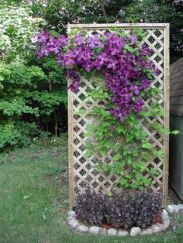
Sherry learned about associations, and how it can help her learn names. For example, she has a beautiful garden in her backyard. In order to remember the names of flowers, she makes an association with them. She doesn’t forget the name of the “climbing” Clematis anymore. She is able to remember her license plate by giving each letter a name of the people she knows or knew. I was impressed when she told me the names of the new neighbours, including their kids names, based on association!

She uses the same purse she’s had for years because it helps with remembering where everything is. This is an example of the the “Habit” strategy she learned about. This made me well aware of the fact that I need to decide what purse pocket to put my keys in because I can never remember which pocket I put my keys in! Sherry learned we can develop new habits to help us remember things more easily.

Sometimes habit can backfire though. We laughed as we could both relate to our forgetfulness in the shower. For example, we both use shampoo and conditioner. We sometimes forget if we’ve used the conditioner or not!

“Hmm, let me think? Does my hair feel like it was conditioned? Did I use conditioner?”

To help correct this memory issue, we are to pay attention to what we are doing, instead of doing activities on autopilot. At least if we put our seat belt on without thinking about it, we can easily check to make sure it’s fastened. This reminded me of the term “mindfulness” and how we can be more in tune with our actions if we pay more attention and be mindful of what we are doing.

brainmapprintv4_green-1008x661.jpg

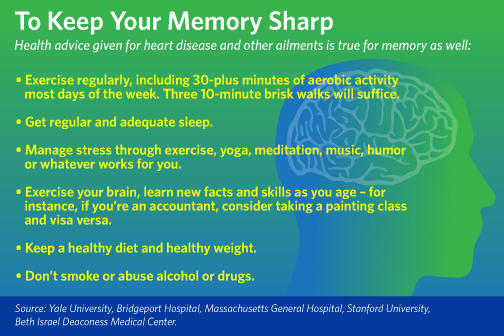
Deep breathing and visualization (such as meditation) is recommended for managing stress and promoting relaxation.

An important part of the program is keeping a log of your activities. The program recommends at least 100 minutes a week of physical activity (to get the blood flowing to the brain for good brain health) and cognitive activity which includes brain exercises and socializing with others. Good nutrition is also an important part of nurturing our bodies and brains for good brain health.  Canada’s Food Guide can also be helpful.

Sherry and I were also discussing the different ways we prefer to learn and remember things. I like to write things down, as doing this can help me remember. How many of us write our shopping list out, then can still remember the items on the list although we forgot the list at home? When receiving and retaining information, some of us need to see it, others need to hear it. Some of us may also say it out loud to ourselves to help remember. Others like to do or act it out. The four main learning styles are: Visual, Auditory, Kinesthetic (movement) and Tactile (touch). Exploring what your preference is and implementing it can make a big difference in remembering.

The main takeaway for Sherry was the emphasis on lifestyle and memory strategies. She felt very uplifted. The group discussions among the participants were quite helpful. She says with the cocooning phase of a Winnipeg winter, she found her “memory slipping,” and this course has motivated her to make lifestyle changes, such as “more physical and cognitive activity.” Adding to this, several new strategies practiced in the five weeks of the course has resulted in an improved memory and more positive attitude. She would highly recommend it anyone 60 or older who is experiencing mild memory problems.

Memory_Sharp


Angela G. Gentile, MSW, RSW

http://www.AngelaGGentile.com

Embracing My Inner Dance Goddess

IMG_4224


Mama Gena would be proud.

A few years ago I read a book by Regena Thomashauer called, “Mama Gena’s School of Womanly Arts” (2002). I remember how cutting edge and liberating her advice was. She had women thinking about their “lady parts” and taught about flirtation as well as other forms of womanly behaviour. Her book’s subtitle, “Using the Power of Pleasure to Have Your Way with the World” was intriguing. Her use of the Goddess theme was empowering and mystical.

Fast forward to 2015, I was reading a book by Dr. Christiane Northrup, “Goddesses Never Age.” (2015). She referred again to our inner Goddess and she also referred to Mama Gena.

I think Mama Gena and Dr. Northrup would both be proud of me. Maybe even Loretta Laroche. Loretta wrote “Juicy Living, Juicy Aging” (2009). She encourages us to do something fun no matter what our age.

Why would they be proud? Because I decided to host a Dancing Diva Pole Party.

I have always been intrigued with pole dancing and pole fitness. I have seen scantily-clad women dancing in strip clubs in the movies. I have also seen videos of pole fitness classes. Those women (and men) are strong! On the extreme end of pole fitness think of the “human flag” performances and pole climbers in Cirque du Soleil. Those gymnasts are strong. (Check out the Florida Pole Fitness Champion of 2014 if you want to see some great pole fitness!)

I posted an Event on Facebook, talked to a few of my friends and my daughter, and we found a few women who were also interested in learning more about pole dancing. I contacted Debbie at Dancing Diva Parties and we set a date.

The Pole Dance Party Begins

As the ladies arrive our instructor Debbie sets up the big silver pole in my living room. It is complete with a stage and two 50 lb. sandbags to keep it stabilized.

As we settle in and sip on our wine, Debbie gave us waivers to sign. Then she explains the “rules” which aren’t really anything out of the ordinary.

She tells us there are typically three types of dancers. The first is a Goddess, the second is a Nun, and the third is in-between. We wonder which one we are. Time will only tell.

We are all given stage names. Mine is “Cherry Poppins.”

“It was fun, empowering and an encouraging environment.” – Sweet Vixen

Debbie says in the next two hours we are going to learn a pole dance routine. We will each receive instruction then take turns learning how to do a few moves.

Top 40 music was suggested and this gets us into the dancing mood. We are told  to think of a favourite song to dance to for our final “performance.”

The lights are dimmed, and I put on my mini laser light show. It makes the room sparkle.

Before we know it, my living room is transformed into an exciting nightclub.

Deciding who is to go first or next depends on each woman’s comfort level. We all take turns being first, being most courageous, being silly and sexy. We encourage each other through our shyness, awkwardness and insecurities. We cheer, clap and laugh. We laugh at ourselves and with each other.

This is an intergenerational event, as there are some moms and daughters. This does create some awkward moments. For example, my daughter (18) doesn’t like it when I make eye contact with her as I dance. So, I tell her for tonight I am not her mom. Instead, I tell her to pretend we are “friends.” Later on, we thought it would have been fun to have the grandmothers there!

“Really fun! I had a great time and felt really comfortable in the environment. Great support and teaching style!” – Dee Cupz

We learn all kinds of new moves, including the following (some are made-up names because I can’t remember them all!):

♦ The Sexy Walk
♦ The Christina Aguilera
♦ Make Love to the Pole
♦ Fan Kick
♦ Leg Hook
♦ Viva Slide
♦ Firefighter Spin
♦ Flamingo
♦ Floor Show including The V

We are encouraged to blow kisses, shake our booty and strut our stuff. We laugh, smile and giggle.

The older women show the younger women that we can be sexual beings and have fun at any age. The older women appreciate the energy and strength combined with innocence and freshness of the younger women. It teaches us that it’s healthy and good to explore and embrace the feminine inner dance Goddess within, no matter what our age.

Finally it is time to pick our songs for our final routine. I pick “Candy Shop” by 50 Cent. My inner dance Goddess is released. I strut, twirl, slide and kick. My encouraging audience throws play money at me as I do my floor show.  I blow kisses at everyone. I feel confident and silly at the same time. I am “outside my comfort zone.” I feel empowered.

After our performances are over, we take some photos. The boas come out. They add a feminine and glamourous touch. I thank Debbie for all her instruction and encouragement.

“It was an amazing time. The lady who ran it made us all feel confident and sexy. It was fun. It was so well put together and enjoyable for everyone, no matter your ability. I would totally do that again.” – Sparkly Juice

A Physical, Fun, and New Experience

Was it a workout? Well, I was a bit stiff the next morning. Maybe my aches were due to all the crazy moves I was trying out. Some ladies were able to do a cross leg hold high up on the pole. Some were really good at the spins. We all were good at having a great time.

In terms of aging well, this is a great (and safe) way to explore, express and celebrate our inner dance Goddess. I encourage learning new things and getting out of our comfort zone. This kind of dancing  helps us embrace our feminine playful spirit at any age. It helps keep us feeling vibrant and alive. It helps boost our confidence. Doing it in a safe, nonthreatening, supportive environment can do wonders for our soul.

“Very fun! Really enjoyed dancing! Good instructor!” – Miss Bootylicious

I would do it again for sure. I am fifty and fearless, perhaps? I would also recommend this type of ladies’ night to anyone who is willing to show off a bit, express her inner dance Goddess, learn something new, share some laughs and have fun.


Angela G. Gentile, MSW, RSW
Specialist in Aging
www.AngelaGGentile.com


Blogs and Newsletters I Follow

BTI-Website-tiles-in-the-know

I have been following a number of great bloggers over the years. These writers have been posting about issues related to aging and I appreciate their positive and proactive take on growing older. Sometimes they are amusing, sometimes they are educational. Usually they are insightful and entertaining.

I also subscribe to a few newsletters related to aging and elder care. This is a great way to keep up with current topics.

I receive their posts and newsletters directly to my email inbox. It’s very convenient.

Please consider signing up to receive these blog posts and newsletters. I am sure they would be thrilled to see new followers. Here are my favourites in no particular order:

Blogs:

Time Goes By: What it’s really like to get old by Ronni Bennett

The Generation Above Me by Karen D. Austin

Lines of Beauty: A blog about aging naturally, one wrinkle at a time by Louise Cady Fernandes

Aging Investors by Dr. Mikol Davis and Carol Rosenblatt, R.N., Attorney

Aging But Dangerous

Points of Life org

Newsletters:

Caregiving Matters

Dementia News and Knowledge by Karen Tyrell, Personalized Dementia Solutions

Comforts Connection by Comforts of Home Care

Senior Living from A Place for Mom

The Caregiver’s Voice by Brenda Avadian

ElderCare Matters

Prime Women

Coming of Age NYC

Help for Dedicated Caregivers by Maria Marley, Ph.D.

My Elder Advocate by Jack Halpern, CEO

AlzLive: For those who care

SMARTLiving365

The Taos Institute – Positive Aging Newsletter


Have something to add? Please let me know.

Have a great day!

Angela G. Gentile, MSW RSW

Specialist in Aging

http://www.angelaggentile.com

New Book, App Promotion and Women’s Group Announced

Angela has been very busy these days and she wanted to make sure all her subscribers don’t miss out on the news. Here are some of the projects she’s been working on.

New Book

agentileebook091015v2


Her new book, A Book About Burnout: One Social Worker’s Tale of Survival is now available on Amazon.com. It’s an eBook for Kindle and it’s a personal memoir plus tips on how to recognize and survive job burnout and compassion fatigue.


FREE APP PROMOTION

Ce1xkPeBp3iH43Lal6Zrbb6b4b0hlJtyNtTo1sIRUbs


The mobile app, Dementia Caregiver Solutions for iOS 8 and up, is being offered for FREE from September 13 – 26, 2015 in recognition of World Alzheimer’s Day (September 21, 2015). Tell your friends.


NEW WOMEN’S Group

11226047_10153042578306128_1169184377110265414_n

Aging Well for Women Group on Facebook

A new members-only, CLOSED, Facebook group has been started, Aging Well for Women Group. Angela’s community Facebook page, Aging Well for Women has reached millions of people and she is excited to announce a more personalized and private experience for women. Request to join!

For more information: www.AngelaGGentile.com


How to Boost Your Energy

iStock_000007339043Large DENTES

Photo credit: iStock_000007339043Large DENTES


I have been putting a lot of thought into Life Coaching concepts and I’d like to share my beliefs on the root cause of many peoples’ problems when it comes to feeling depleted or drained.

I often use analogies or metaphors in my work, so here is my take on how we can understand why so many of us say we are “tired” or “have no energy” and what we can do about it.

There are three main concepts when it comes to personal energy:

1. Eliminate the clog

If you have clogged arteries, the blood doesn’t flow. The same is true for clogged drains or pipes. When the blood doesn’t flow or the water doesn’t drain, we may end up with some major catastrophe. Sometimes we need to unclog the pipes. If there is too much accumulation of debris (unwanted waste), we will end up with a blockage. If we imagine that debris is our emotional stress, physical clutter, or other unwanted things we want out of our life, this is what can block our energy flow.

  • Make a list of these unwanted items/situations. Work on eliminating one item at a time to help unclog the energy flow. It’s not easy and sometimes it takes another person to help us with this. This will help the energy flow better.

2. Close the drains and fix the leaks

Imagine trying to fill up a sink with water. In my bathroom, I have one of those stubborn metal levers that you pull on to close the drain. If the drain doesn’t close properly, down the sink goes the water. I try to fill the sink with water as it’s going down the drain. Or imagine you have a big pool, and it springs a leak. You have to keep adding water to the pool until you get the leak fixed.  This is an analogy to trying to boost yourself up with positive and helpful energy, and as fast as you are adding it to your energy pool, it’s going down the drain or leaking out. It’s important to get those stoppers and leaks fixed so that you can reserve that precious energy for when you really need it.

  • Reflect on what your energy drains are. Fix them or eliminate them altogether. When these drains are corrected, the energy you have will be allocated in a positive direction.

3. Keep the positive energy flowing and utilized in the most efficient way possible

I know for myself, I get a boost of mental and physical energy when I exercise. It gets my blood pumping and keeps the positive energy flowing. I have better energy flow when I feel happy, when I am productive and when I have exciting plans (travel, projects, etc.). I feel energized after a great nights’ sleep. Plus, I feel more energy after drinking one of my favourite caffeinated beverages. 🙂

  • Explore where your supply of positive energy comes from. Make sure you get a sufficient dose on a regular basis so that you have enough energy to handle whatever may come your way. Life isn’t always easy, so we need lots of energy in storage to handle those difficult times. This will ensure we have the energy to “get back up again.”

Please share your experiences and thoughts on the subject of energy drains and energy boosts.

Angela G. Gentile, MSW RSW, Specialist in Aging
www.AngelaGGentile.com

Aging with Grace is All About Acceptance and Attitude

Aging with grace logo

Aging with Grace Defined Survey Results


What does “Aging with grace” mean to you?

To help me get a sense of what this term really means, I surveyed 24 people of all ages (most aged 50-69) and asked them to define “Aging with grace.” I enjoyed reading through the responses and I’d like to thank everyone who participated. I’d like to share with you what I learned, and I will also include my own thoughts on the subject.

“Grace is a quality that many aspire to, but I think in the context of today’s society, what defines grace is somewhat elusive.” – Survey respondent, 49 or under

For the most part, aging with grace is one’s ability to accept growing older and all the changes that come with it. We could almost change the term to, “Aging with Acceptance.” Aging (or the passing of the years) brings many changes to our appearance and abilities (physically, mentally); it also brings changes to the world and our lives. Aging with grace means we are able to accept, adapt and accommodate these changes.

The attitude we carry into our later years will also influence our ability to age with grace.

People who are aging gracefully…

  • accept aging
  • are happy
  • are confident
  • are wise
  • live a healthy and active lifestyle

Regarding “healthy” lifestyle — as we age, our risk for developing age-related illnesses and diseases increases. I think it is important that even if we develop health conditions, we take care of ourselves and try to recover quickly or learn how to live well with chronic illness. I know many people who are aging with grace despite chronic illnesses. It all comes down to attitude.  For example, does arthritis become who you are or is it just something you need to live with and manage?

“Grace is an inside job with outside effects.” – Survey respondent, 49 or under

If we are able to practice self-love as we age, by “nurturing our bodies and minds,” (Survey respondent, 50-69) we tend to be happier and more at peace. It helps us improve our confidence, and live a life that is in line with our true and authentic selves. As we become more compassionate about ourselves we will become more compassionate about others. We can continue to be “gracious to others, and make people feel good”, no matter what their age (Survey respondent, 50-69).

“Aging with grace means aging with confidence, valuing the experience, knowledge and wisdom that comes with age, and rising above a youth-oriented culture.  – Survey respondent, 50-69

Harnessing the wisdom and personal power that comes with age helps us age with confidence. There is great significance in the realization of the value of knowledge and experience gained from years lived. Only then are we able to choose to live a life designed and driven by our own personal values. We realize that we are responsible for our own lives and decisions are made with the wisdom that comes with age and the personal power that we embrace and celebrate.

“Allowing the power and wisdom of aging to be apparent in one’s presence –      including the ability to break stereotypes of aging.” – Survey respondent, 50-69

Being present in the moment in the here-and-now, while focusing on the good things in our life will help us live and age with gratitude. Practicing mindfulness will help us age with grace.

The ability to re-frame our challenges and limitations can help improve our outlook and overall attitude. Being resilient in the face of adversity will also help us a great deal.

Living a conscious life, knowing that we have a finite time here on earth, enables us to focus on living a life that honours our individual values and goals.

I can also tell you what aging with grace IS NOT. It is not about complaining – such as “moaning upon standing” or “whining about wearing reading glasses.” Aging with grace is “void of anger, regrets and baggage from the past.”

The more we learn to accept aging as a normal lifelong process, make peace with it (not war), the happier and more confident we will be.

I’ll leave you with this: Only one person over 70 answered the survey, and gave me something to laugh about. When asked, “How would you define aging with grace?” the answer was:

“I don’t know anyone named Grace, but, I am aging.”

The survey will remain open for a few more weeks, so if you’d like to give me your definition of Aging with Grace, please go to this survey and answer three quick questions. Thanks!

Have your say – please comment below. I’d love to hear from you.

Angela G. Gentile

purple-swirl-separator-hi

Angela G. Gentile, MSW, RSW is a clinical social worker who specializes in aging. She has helped hundreds of people who are struggling with the challenges aging can bring. Angela is passionate about challenging ageist myths and stereotypes and exploring what it means to age well. She considers herself a realistic optimist but she still can’t tell her left from her right. Find out more at http://www.angelaggentile.com.