
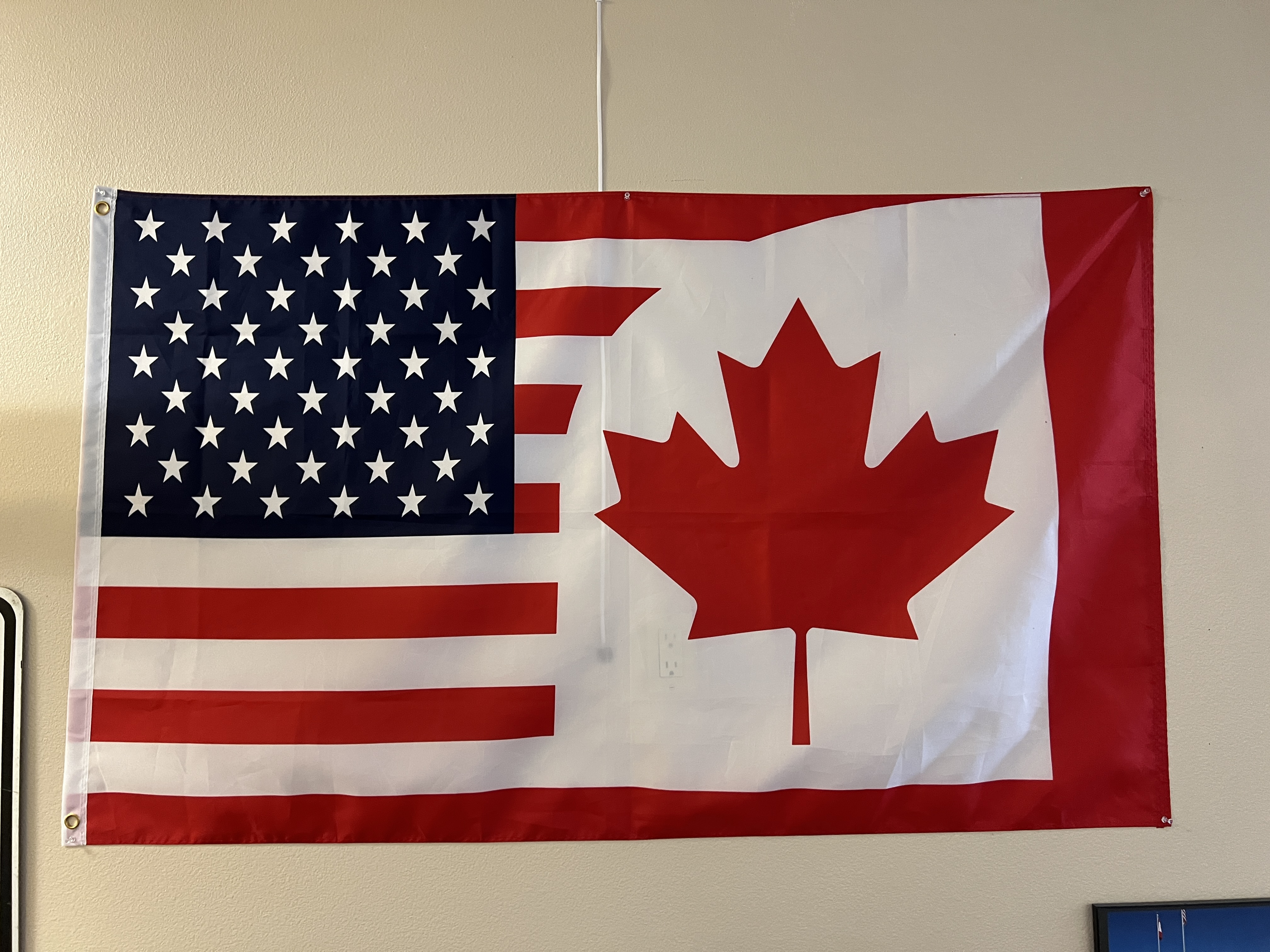
David Brooks believes America (USA) has lost some of its moral vocabulary. Mark Carney is articulating a balance between liberty and social responsibility. But perhaps John F. Kennedy said it most simply 65 years ago.
By Angela G. Gentile, BSW, MSW
On January 20, 1961, President John F. Kennedy delivered one of the most memorable lines in American political history:
“Ask not what your country can do for you—ask what you can do for your country.”
It is so familiar that we may no longer hear what Kennedy was actually saying.
Citizenship is not simply about what we receive. It also carries obligations.
We have rights, but we also have responsibilities. We are individuals, but we belong to communities. Freedom gives us the ability to pursue our own lives, but a healthy society asks us to care about something beyond ourselves.
More than six decades later, perhaps America needs to hear Kennedy’s message again.
From Individual Freedom to Individualism
In his 2025 Atlantic essay, “Why Do So Many People Think Trump Is Good?”, columnist David Brooks asks how tens of millions of Americans can observe behaviour in Donald Trump that Brooks considers dishonest, cruel and corrupt and nevertheless regard him as morally acceptable—or even admirable.
His answer goes far beyond Donald Trump.
Drawing heavily on philosopher Alasdair MacIntyre, Brooks argues that Western society has gradually lost much of the common moral framework that once helped people think about character, responsibility and the common good.
Historically, people understood themselves as members of families, communities, professions, religions and nations. Those relationships imposed obligations.
A teacher wasn’t simply an individual earning a living. Being a teacher meant accepting standards associated with the profession.
Being a parent meant something.
Being a neighbour meant something.
Being a citizen meant something.
There were serious problems with that older social order. Communities could be restrictive and intolerant. Women, minorities, LGBTQ people, religious minorities and others were frequently denied the freedom to determine the course of their own lives.
The expansion of individual liberty was an enormous human achievement.
But Brooks asks whether the pendulum eventually swung too far.
We moved from:
“Society determines who you must be.”
to:
“I determine who I am.”
That was liberating.
But taken too far, it can become:
“What I want is what matters.”
Healthy individualism says:
My life belongs to me, but I am part of something larger than myself.
Unrestrained individualism says:
My life belongs to me, therefore my interests come first.
That distinction may explain a great deal about our present political moment.
When Politics Becomes Identity
Brooks argues that as traditional sources of meaning and belonging weakened, politics increasingly began filling the vacuum.
Political affiliation became identity.
The other party became the enemy.
Compromise became betrayal.
Winning became more important than the character of the person doing the winning.
And once politics becomes a struggle between us and them, people can become remarkably tolerant of behaviour from their own side that they would condemn instantly in their opponents.
Brooks doesn’t exempt Democrats from this criticism. His argument is about a broader cultural problem.
That is important because turning this into another explanation of what is wrong with Trump supporters would miss his larger point.
The deeper question is not:
What is wrong with them?
It is:
What has happened to all of us?
America’s two-party political structure can intensify this problem. If there are essentially only two viable political camps, rejecting one frequently means accepting the other.
Millions of Americans don’t fit neatly into either package.
A person can believe strongly in individual freedom while supporting public health care.
Someone can support secure borders and legal immigration.
Someone can support capitalism while believing society has obligations to people who are struggling.
Someone can be socially liberal while believing that rights should coexist with personal responsibility.
Those positions aren’t necessarily contradictory.
Perhaps the political categories are simply too narrow.
Canada Is Having an Interesting Conversation
This is where Canadian Prime Minister Mark Carney becomes relevant—not because America should become Canada, and not because Carney or Canada has all the answers.
What is interesting is the political philosophy Carney has been articulating.
At Canada’s National Prayer Breakfast in March 2026, Carney said:
“Canadians take care of each other.”
But he also spoke about balancing generosity and collective responsibility with fiscal realities and “the principles of liberty.”
In a January speech at the Citadelle of Québec, he described Canadian values as including inclusion, fairness, solidarity and ambition. He also spoke about creating the conditions in which individuals can flourish.
And in September, at the Canada Investment Summit, he reduced his message to two simple ideas:
Canada must take care of itself.
And Canadians must take care of each other.
That balance matters.
Liberty and responsibility.
Individual opportunity and social solidarity.
Personal ambition and the common good.
Why must we choose between them?
Why can’t a society encourage entrepreneurship while maintaining strong public institutions?
Why can’t people be independent while accepting obligations toward one another?
Why can’t a country be economically strong and compassionate?
This is where Carney’s language intersects with Brooks’s argument.
Brooks is primarily asking:
What kind of person should we become?
Carney is asking:
What kind of country should we build together?
Brooks emphasizes character—honesty, fidelity, compassion, self-restraint and concern for others.
Carney emphasizes liberty, opportunity, solidarity, institutions and national strength.
They arrive from different directions, but they meet at an important place:
The individual matters enormously—but the individual does not exist alone.
JFK Already Said It
And that brings us back to Kennedy.
“Ask not what your country can do for you—ask what you can do for your country.”
Kennedy wasn’t arguing against individual liberty.
He was arguing that liberty carries responsibility.
His inaugural address was a call to service and sacrifice—to the idea that citizenship requires something from us.
That is essentially the principle Brooks fears we are losing.
It is also remarkably close to what Carney means when he talks about Canadians taking care of themselves and taking care of one another.
Kennedy, Brooks and Carney are obviously very different people speaking in very different circumstances.
But a common thread runs through all three:
Freedom without obligation eventually becomes self-interest.
Community without freedom becomes conformity.
A healthy democratic society needs both.
America Doesn’t Need Mark Carney
America obviously doesn’t need a Canadian prime minister.
It needs an American leader capable of expressing this balance in an authentically American way.
And 2028 offers an opportunity.
America could use a leader who can say:
Your life belongs to you.
But also:
You belong to a country with other people.
A leader who can defend individual rights without encouraging radical self-interest.
A leader who can celebrate business and entrepreneurship while recognizing that markets exist within communities.
A leader who can protect borders without treating outsiders as enemies.
A leader who can support social programs without pretending government can solve every human problem.
A leader who can disagree with political opponents without humiliating them.
A leader who understands that the presidency is not personal property but an institution temporarily entrusted to its occupant.
Most importantly, America could use leadership that restores the idea that freedom is not the absence of obligation.
Good Neighbours Again
Canadians have another reason to hope America rediscovers this philosophy.
The relationship between Canada and the United States has become badly strained.
Trade conflict, tariffs and President Trump’s repeated references to Canada as a potential “51st state” have damaged a relationship Canadians once took largely for granted.
Carney has responded by arguing that Canada must become more economically independent and less vulnerable to coercion.
But Canada and the United States cannot simply stop being neighbours.
We share geography, trade, security, families, culture and history.
Good neighbours disagree.
But good neighbours don’t need to dominate one another.
They recognize that the relationship itself has value.
And perhaps the same principle applies to citizenship.
Being a neighbour means something.
Being an ally means something.
Being president means something.
Being prime minister means something.
Being Canadian means something.
Being American means something.
These roles should place obligations upon us—not simply provide opportunities to get what we want.
Individuality With Obligation
Perhaps the philosophy America needs isn’t actually new at all.
Maybe Kennedy gave it to us in 1961.
Individuality with obligation.
We don’t need to return to a society in which communities dictate how everyone must live.
The gains of individual freedom are worth protecting.
But we can restore something that has weakened along the way.
I can choose my own life and still owe something to my neighbour.
I can pursue success and still care about my community.
I can disagree with you and still respect your humanity.
I can love my country without needing another country to lose.
I can demand my rights while respecting yours.
I can be an individual without making myself the centre of the universe.
That isn’t collectivism.
It is citizenship.
Perhaps the question Americans should ask themselves as they approach 2028 isn’t simply:
Which party do I want to win?
Perhaps it is:
What kind of country do we want after the election is over?
Kennedy’s challenge still provides a remarkably good place to begin.
Ask not only what your country can do for you.
Ask again what you can do for your country—and for one another.
If America can rediscover that idea, perhaps it can rediscover something else along the way:
How to be a good neighbour again.
(Written with help from ChatGPT by a concerned Canadian who has family in the USA.)

