Unveiling the Hidden Solution: Brainspotting – The Breakthrough Quick Fix for Mental Health!

Photo by Andrea Piacquadio on Pexels.com

When Talk Therapy Falls Short, Discover the Astonishing Power of Brainspotting to Transform Your Life!

Are you tired of endless talk therapy sessions that leave you feeling stuck and frustrated? Frustrated with circular discussions that get you nowhere? What if I told you there’s a groundbreaking technique that can offer a rapid and effective solution for your mental health concerns? A method that can be done in person or virtually online?

Brace yourself for the rise of Brainspotting – a cutting-edge approach that’s taking the therapeutic world by storm. In this article, I uncover the secrets behind this little-known yet astonishingly effective therapy, designed to help you find healing when nothing else seems to work!

The Therapy Revolution: Brainspotting is revolutionizing the way we tackle mental health challenges. Developed by Dr. David Grand, this innovative technique bypasses the limitations of mere conversation and dives straight into the depths of your subconscious mind, where true transformation takes place. Enhance your traditional talk therapy sessions by augmenting it with powerful, focused, Brainspotting sessions. 

When Talk Therapy Hits a Wall: Have you reached a plateau or do you feel stalled in your talk therapy journey? Fear not! Brainspotting offers a lifeline when traditional therapy approaches fail to deliver the desired results. By targeting the brain’s emotional centre and encapsulated memories, Brainspotting processes and releases deep-seated trauma and emotional blocks that may have eluded talk therapy’s grasp.

The Rise of Brainspotting: While Brainspotting may not be a household name yet, it’s rapidly gaining popularity as the go-to quick fix for mental health concerns. As word spreads about its astounding efficacy, more and more individuals are flocking to trained Brainspotting therapists, eager to experience the life-changing benefits for themselves.

The Science Behind the Magic: Brainspotting works by tapping into the brain’s natural ability to heal itself. By focusing your gaze on specific “brainspots” linked to unresolved trauma, cognitive blocks, or emotional distress, Brainspotting therapy activates the brain’s innate healing mechanisms. It’s like hitting the reset button on your mind, paving the way for rapid and lasting transformation. There is still a lot we don’t know, and the science is evolving. What we do know is “Where we look affects how we feel.”

A Game-Changer for Most People: Are you skeptical about yet another “miracle” therapy? Rest assured, Brainspotting has been proven effective for a wide range of mental health issues. Whether you’re battling anxiety, fear, depression, grief, shame, past trauma, or even performance blocks, this revolutionary technique has shown remarkable success rates for most individuals, opening doors to a brighter and happier future. It has been effective with all ages, including children. 

Rapid Results, Lasting Change: The best part? Brainspotting is not a long, drawn-out process. Unlike traditional therapy that may span years, Brainspotting can yield significant breakthroughs in just a handful of sessions. Experience profound shifts in your emotional well-being and witness the transformational power of this accelerated therapeutic modality.

If you’ve been searching for that elusive quick fix for your mental health struggles, look no further than Brainspotting. With its rising popularity and proven effectiveness, this revolutionary technique is redefining the therapeutic landscape. Enhance the benefits of counselling by embracing the power of Brainspotting to unlock your true potential, heal your deepest wounds, and embark on a path of profound personal growth. Don’t miss out on this life-altering opportunity – discover Brainspotting today!

Angela G. Gentile, MSW, RSW

Trained in Brainspotting, Phase 1

Written with the help of ChatGPT
Brainspotting Therapy Now Available

If you are looking for a Brainspotting Therapist (Phase 1) I am now officially trained (as of March 12, 2023). Here is my info sheet on Brainspotting Therapy (BSP):

What is Brainspotting Therapy (BSP)?

Where you look affects how you feel. – Dr. David Grand

Brainspotting Therapy (BSP) was discovered by Dr. David Grand, PhD in 2003. BSP functions as a neurobiological tool to locate, focus, process, and release experiences and symptoms that are typically out of reach of the conscious mind and its cognitive language capacity. Working with the deep brain and the body through its direct access to the autonomic and limbic systems, it taps into and harnesses the body’s innate self-scanning capacity to process and release focused areas which are in a maladaptive homeostasis or “frozen primitive survival modes.”

More simply: BSP is the utilization of fixed eye positions which appear to stimulate neural networks and facilitate both the associative process and the resolution, digestion, or healing of both physiological and psychological trauma. 

Who benefits from BSP?

Children, teens, and adults can benefit from BSP. 

What are the risks of BSP?

The risks are similar to regular talk therapy in that you may feel tired or fatigued after your session and processing of your emotions may spill over into the next day. 

What can be expected during a BSP session?

During a session, the trained therapist might:

  • guide you to think about an issue or problem that causes trouble or concern, such as memories of bad experiences, arguments, physical pain, worries, etc. The therapist will ask a few questions about the problem but does not focus on an in-depth discussion of the issue or trauma. 
  • help you find an eye position (i.e., Brainspot)
  • guide you to be aware of how your body is feeling, e.g., noticing any tension in the head, neck, shoulders, stomach, or other areas. 
  • encourage you to harness the deep, mindful processing of your issue.
  • suggest you be open to what comes up; it could be an image, thought, memory, or sensation in your body
  • suggest you listen to bilateral sounds, a type of music or nature sounds which move back and forth between right and left ears. Bilateral sound causes alternating activation of the right and left-brain hemispheres and activates the parasympathetic, or calming, part of the nervous system. 

Through these and other interventions, the therapist helps your brain reprocess anxiety, trauma, and stress. When completed, like most people, you will likely report feeling calmer and more relaxed.

Tips:

  • During your session, you may or may not be able to (or want to) verbalize your thoughts. It is completely up to you if you want to remain silent or not.  
  • You may become upset, tearful, or some other strong feelings (activation) may emerge. This is completely normal, and it will likely come in waves of intensity.
  • You may feel like closing your eyes at times and that is okay, too. Just remember when you open your eyes to try and come back to the brainspot. 
  • If you feel like you need to move, or shake it off, that is okay, too. 
  • Your therapist may check in with you and will let you know when the Brainspotting session is coming to an end. 
  • Most sessions last about 40 minutes. 
  • Self-Brainspotting is not recommended. 

Note that although ideally it is done face-to-face, BSP can also be done virtually.

For more information on Brainspotting: https://brainspotting.com

or contact myself, Angela G. Gentile, MSW, RSW

xxxxxx

Articles to read for more insight into Brainspotting and how it can help: A Case Study in Brainspotting (2014) – https://sharonkocina.com/case-study-brainspotting/

Research article: Psychotherapeutic Techniques for Distressing Memories: A Comparative Study between EMDR, Brainspotting, and Body Scan Meditation

ResearchGate: Brainspotting – Science topic. Explore the latest publications in Brainspotting, and find Brainspotting experts: https://www.researchgate.net/topic/Brainspotting/publications

The Magic Wand – A Brainspotting Therapy Session

Photo by Mikhail Nilov on Pexels.com

I would like to tell you about my recent therapy experience. I believe in order to be a good therapist, one should be seeking therapy as needed to deal with their own issues. Even the best therapists need a therapist occasionally! To optimize my emotional and psychological health, I occasionally seek outside help. With this in mind, I saw Clinical Social Worker Ruth B.Z. Thomson of Winnipeg, Manitoba, for a therapy session. She used a therapy technique called “Brainspotting” (BSP) which was new to me and which I was very curious about. 

“Brainspotting is a powerful, focused treatment method that works by identifying, processing, and releasing core neurophysiological sources of emotional/body, pain, trauma, disassociation, and a variety of other challenging symptoms. Brainspotting is a simultaneous form of diagnosis and treatment, enhanced with bilateral sound, which is deep, direct, and powerful, yet focused and containing.”

David Grand, Phd, Brainspotting Developer and Trainer

By the way, bi-lateral and BIO-lateral are two different things. It sounds confusing, but here is a way to explain the difference. Also, there is a link between brainspotting and EMDR therapy (Eye Movement Desensitization Reprocessing).

After filling out forms and consenting to treatment I entered Ruth’s beautifully decorated and comfortable office. She said I could choose any chair to sit on. There were about six chairs. I scanned the room, chose a chair, sat down, and got comfortable. I rearranged the cushions and used a little step stool. She sat across from me. She told me after a brief talking session, I would be listening to music with headphones, and she would use a wand for me to look at and focus on. The wand looked like one of those telescopic back scratchers and it had a dark blue handle.

We chatted for a bit to discuss my issues and then she told me we were going to get started with the brainspotting treatment. She passed me the headphones and made sure I could hear the music in both ears. It was not too loud as she also wanted me to be able to hear her. She said she was going to be watching me and I was to focus on my physical and emotional responses related to the issues I had presented to her with. 

The music she chose for me is called “bilateral” and it’s not exactly music. It was calming peaceful sounds such as chimes, waves, and birds chirping. The sounds alternated between the left and right ears. 

The music was very relaxing and calming. I noticed a yellow “glow” around the wand. (It almost looked like a magic wand!) Ruth held the wand to the left of her, almost at an outstretched arm’s reach, at eye level and I stared at it. She moved the wand slowly and watched my physical reaction. Sometimes I blinked more or fidgeted or took deep breaths. She also watched my facial expressions. 

After a few minutes she moved the wand and asked me to follow it. She moved it to the right of her body. It was about eye level. Very slowly and methodically she would move the wand up or down all the while watching my reaction. 

She asked me what I was feeling and thinking. I shared my thoughts, then she took the wand and moved it back to her right side. 

The music was very calming. I processed some feelings and thoughts. At one point I felt mad, and this was a bit of a revelation. This was good!

She then had me talk it out some more until I was done with my observations and feelings about the issue at hand. 

Then Ruth had me close my eyes and brought the wand closer to me. She had me open my eyes and I followed the wand, and she brought it back to her right then circled downward and back up closer to me. She repeated this closeup – back to the right – downward swoop movement in a fluid moderately paced motion about 4-5 times. It was like drawing a sideways “D” in the air with the wand. We then paused for a bit. 

Photo by Laura Stanley on Pexels.com

She then had me do a relaxing visualization. I found myself on a hammock in Hawaii! All the while the bilateral music played quietly in my ears, alternating between left and right.

After the guided imagery was over, she had me take off my headphones. There was a long pause as we sat in silence. She then asked me for my thoughts. 

I told her I like analogies to explain things when I can’t quite put my feelings and thoughts into words. I told her it felt like I was put into a long, dark tunnel and now I’ve come out of the tunnel and I’m not quite sure where I am. I’m looking around, but I’m not quite sure what just happened and where I ended up. It feels good though. I told her I think it’s going to take me a little while to process what just happened. She agreed and said that it will take a few days for the neural pathways to change. She told me to drink lots of water and gave me a couple pages to read on brainspotting.

As promised, she emailed me this link as an example of bilateral music – 1 HR Bilateral Music Therapy – Relieve Stress, Anxiety, PTSD, Nervousness – EMDR, Brainspotting (best heard with headphones). 

I am hopeful that this treatment will help me with my issue, and I could already tell just a couple hours later that I was already feeling some benefit. 

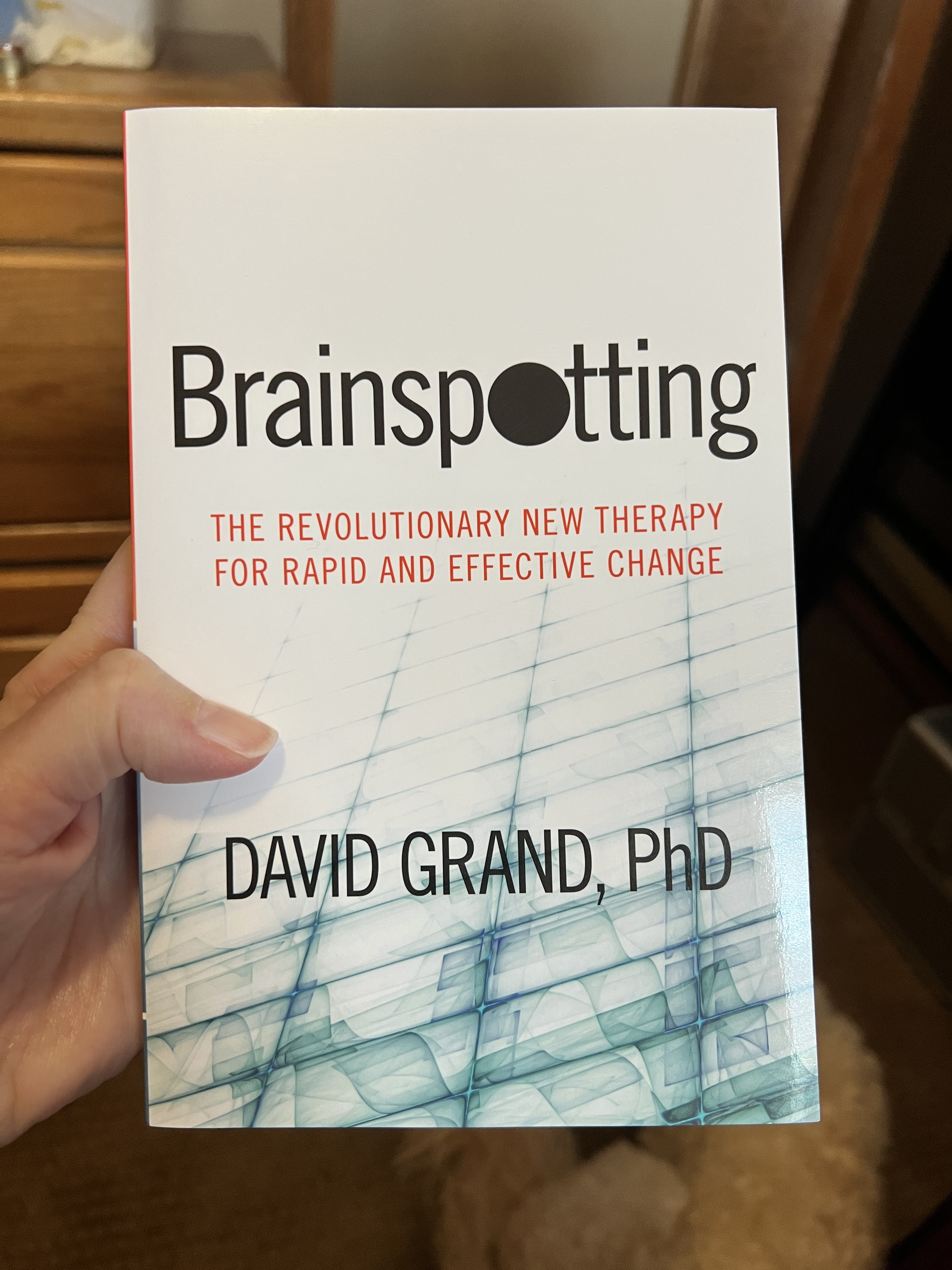
For more information on brainspotting check out David Grand’s book, Brainspotting: The Revolutionary New Therapy for Rapid and Effective Change.

Angela G. Gentile, MSW, RSW