30-Day No Sugar Challenge Prep Week

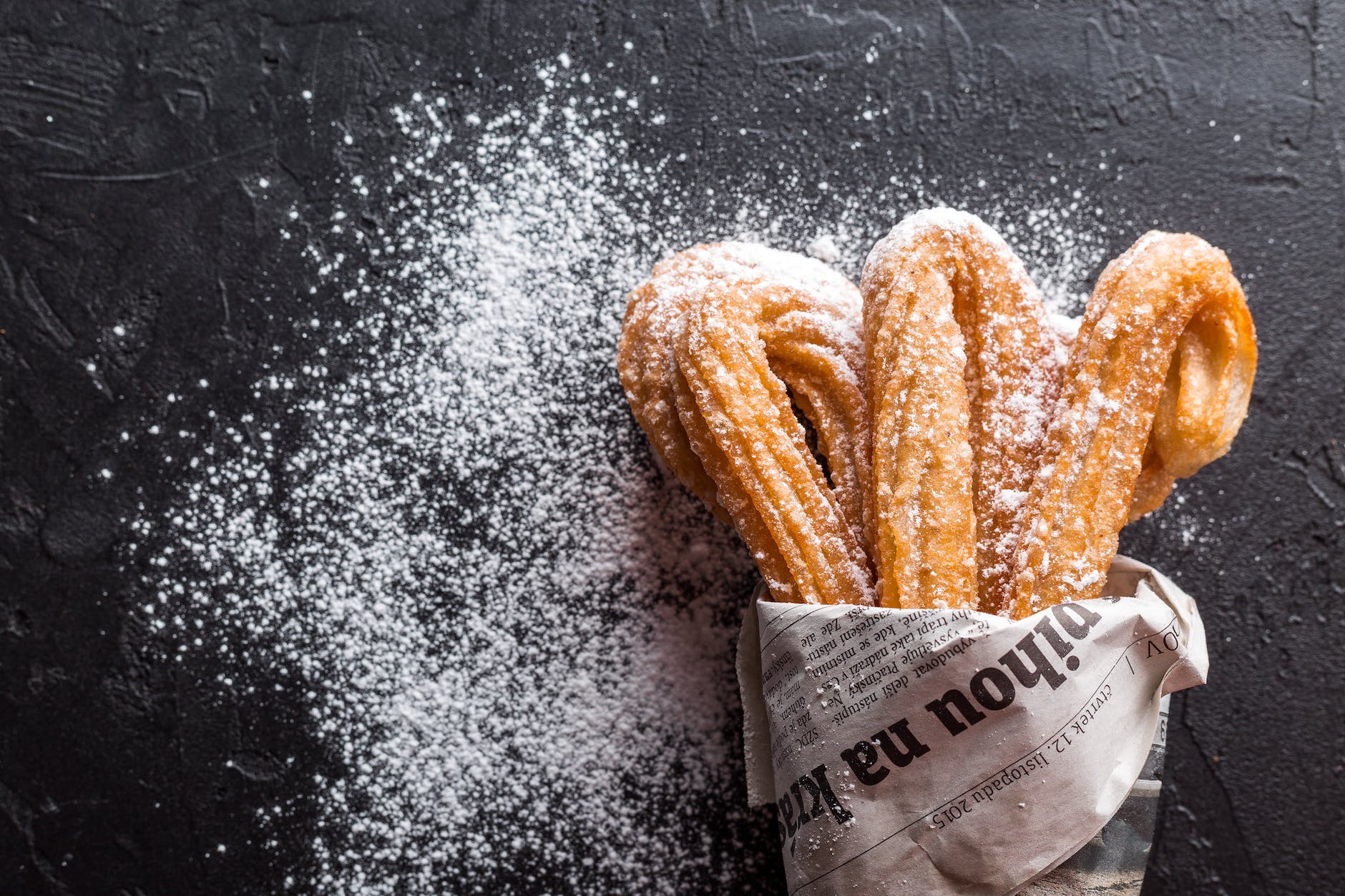
Photo by Pixabay on Pexels.com

The COVID-19 pandemic is now into its fourth year. There are many concerns of how the pandemic has impacted our health and in a negative way. Weight gain and adopting unhealthy habits has certainly been my experience. In addition to rebooting my relationship with alcohol this past “Dry January,” I now want to take a closer look at my relationship with sugar and how I got started on my first 30-Day No Sugar Challenge.

My First Memories of Sugar

My first memories of sweet treats included candies called Black Babies, Wax Bottles, Marshmallow Strawberries, Pixy Stix, and Fun Dip. Many of these treats were found in convenience stores and cost pennies or nickels. Coming out of the corner store with a small paper bag filled with candies was always a fun and exciting time. Little did we know at the time that consuming too much of these sweet treats could cause tooth decay and cavities. Something we learned when we got a tooth ache or went to the dentist for a check-up.

As an adult, I have to admit I still love those Marshmallow Strawberries. My tastebuds have now matured and I have a very close attachment to dark chocolate (dark chocolate is good for you, right?). These sugary treats make me happy. Most sweet foods have a connection to mood. Cake, cookies, ice cream, pop, and other sweet food products are usually consumed when we want to either “treat ourselves” (reward to make us feel good), celebrate, socialize, or commiserate. “Pop and chip parties” have always had a very positive meaning to me. Still to this day I think of pop and chips in a fond way. Sugar and sweeteners (artificial or otherwise) appear to have an emotional component connected to them. “Instant gratification” can be achieved by simply going to the ice cream parlour and getting a sugar rush. We also know there are feel-good hormones related to the consumption of sugar. The Cleveland Clinic explains why we love sugar so much.

“Our brains are wired to enjoy things which make us happy,” says Taylor. “Sugar, in particular, releases brain chemicals, like serotonin, that make us feel good.” This leaves us wanting to experience that good feeling over and over again, day after day.

Cleveland Clinic

Emotional Hunger and Real Hunger

I have learned there are two types of hungers. One is emotional (a.ka. brain or head) hunger and the other is real hunger. Many of us eat when we aren’t really physically hungry and needing fuel and nutrition to feed our bodies. The Brisbane Obesity Clinic gives a list of reasons why we eat when we are emotionally hungry.

“Emotional hunger, also known as head hunger, refers to eating in response to an emotion or a habit. This type of hunger usually comes on suddenly, and people tend to crave a particular food (usually sweet, salty or a comfort food).

  • Eating on autopilot whether you are watching TV or sitting on the couch. Here, you associate a habit or activity with food even though you are not hungry.
  • Do you automatically grab something at the servo when you stop for fuel?
  • Do you eat something at a party only because it is offered to you/is free?
  • Do you get the free muffin when you buy your coffee, even though you didn’t want the muffin in the first place?
  • Do you order an entrée or dessert when dining out with friends just because others have ordered it?
  • Do you tend to eat when bored, stressed or sad?

All of these external cues are driven by head hunger, and have nothing to do with being truly hungry. In summary, head hunger has social and emotional triggers.” 

Brisbane Obesity Clinic

Sugar Addiction and Detox

In order to prepare for my 30-Day No Sugar Challenge (NSC), I did a lot of research online. I started by reading this article on Healthline called, What are 30-Day No Sugar Challenges? All You Need to Know. I put an announcement out on social media and invited any other people who wanted to do a NSC to message me. Six other ladies joined me! I created a chat group on Facebook Messenger as well as a private Facebook Group. I joined the private SugarDetox Support Group as well for more tips and support.

The first week I called “Prep Week.” We started reading food labels and learning all about the different names of sugar and sugar substitutes. It was a week of discovery. I read about other people’s experiences with this type of challenge and how it reset their sugar-craving urges and addictions. Their stories of weight loss, blood sugar regulation, and generalized feelings of well-being were very inspiring. I also learned there is a small proportion of the population who have a bonafide sugar addiction and their best defence is to avoid all sugar and sugar substitutes. Similar to the Cleveland Clinic’s position on sugar and feel-good hormones, the Wellness Retreat Recovery Center explains in “Sugar and Dopamine: The Link Between Sweets and Addiction,” that “there is a link between sugar and dopamine, the same chemical that releases in the body during illicit drug use. What this means is that sugar and drug addiction are similar in a lot of surprising ways.” The instant spike in dopamine and serotonin feel-good hormones are the main reasons why we love sugar so much and why we need a continuous supply. The more we rely on sugar to do this for us, the less our brain does it for ourselves.

Added sugar, also known as free sugar, has no nutritional value and eating foods and drinks with high sugar content can cause an excessive amount of “empty calories.” We can live without it. But for some reason the North American diet is full of it. It comes in almost all packaged and processed foods. There is actually a “Bliss Point” of sugary sweetness that is a marker for how much sugar people like in their food. “Hidden sugar” can be found in products such as gravy mixes, granola bars, mayonnaise, and luncheon meats. Even McDonald’s products have sugar. For example, their world-famous french fries have dextrose, which is another form of sugar. Maltodextrin is in many packaged foods we have in our pantry!

Natural Sugar is Okay

Some foods, such as fruits, milk and vegetables, contain natural sugar, which is OK to consume. What you should watch out for is processed sugars and sweeteners. These “hidden” sugars are in foods such as crackers, drinks, pasta sauces and even pizza. When checking the ingredients list, look for the words “malt,” “syrup” and those ending in “-ose.”

Mayo Clinic Health System

Sugar Danger

Eaten in high quantities sugar can be detrimental to our health. In a Harvard article called, “The Sweet Danger of Sugar,” we learn that there is a link between high added sugar consumption and increased risk of heart disease and stroke.

This CNN article called Study Finds 45 Negative Health Effects of Added Sugar is very eye-opening. Our recommended daily “free” or added sugar allowance, as suggested by three leading organizations, is 25 grams or about 6 teaspoons per day, as explained below:

“The findings — in combination with existing guidance from the World Health Organization, World Cancer Research Fund and American Institute for Cancer Research — suggest people should limit free sugar intake to less than 25 grams, or about 6 teaspoons, per day. There’s that much sugar in 2 ½ chocolate chip cookies, 16 ounces of fruit punch and about 1 ½ tablespoons of honey. A doughnut has around 15 to 30 grams of sugar, according to the Cleveland Clinic. 
The authors also recommend reducing consumption of sugar-sweetened beverages to less than one serving (about 200 to 355 milliliters) per week. That’s the equivalent of an up to 12-ounce soda, Aggarwal said via email.”

– Kristen Rogers, CNN

How sugar actually affects heart health is not completely understood, but it appears to have several indirect connections. For instance, high amounts of sugar overload the liver. “Your liver metabolizes sugar the same way as alcohol, and converts dietary carbohydrates to fat,” says Dr. Hu. Over time, this can lead to a greater accumulation of fat, which may turn into fatty liver disease, a contributor to diabetes, which raises your risk for heart disease.

Harvard Health Publishing

Sugar substitutes or artificial sweeteners can be found in many so-called “sugar-free” foods. Consuming these added sweeteners in the short-term appear to be safe, however, research is ongoing.

Researchers are checking to see if sugar substitutes affect cravings for sweets, the way people feel hunger and how the body manages blood sugar.

Mayo Clinic

Find Your Why

To prepare for this month without sugar (what we call “Prep Week”), myself and a few other ladies have been learning about sugar, reading food and drink labels, and talking to others about our upcoming no-sugar challenge. We have come up with our individualized plans for how we want to tackle our challenge. We all have to decide what will be doable for each of us, individually. We have learned there is no “one size fits all” approach. Awareness of, and reducing the amount of sugar we consume is the key. Avoiding ALL sugar is next to impossible. We all have our own reasons for doing this challenge and we are encouraged to “Find our why.” I will report back after my month without the sweet stuff.

Angela G. Gentile, MSW, RSW

Eat According to Your Genes – Nutrigenomix. Part 1

IMG_5373

Nutrigenomix packaging

I have been learning a lot about nutrition and diets. After reading Gin Stephen’s book “Feast Without Fear,” I was curious to find out what kind of “personalized nutrition” options were available to me. I came across this company called Nutrigenomix (out of Toronto, Ontario, Canada) and talked to my doctor and dietician about it. It’s a genetic test for personalized nutrition worth $499.00 CAD, so I wanted to make sure it was worth it.  With a doctor’s referral, I could get 80% of the cost covered by Manitoba Blue Cross. My doctor agreed to give me a referral.

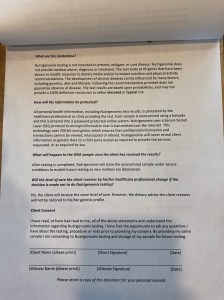
I found a dietician that was trained in doing this kind of testing (at the Wellness Institute in Winnipeg), and I booked an initial consultation with Laura. On the first visit, I had to read over and sign a consent form.

IMG_5370

Page 1 of Nutrigenomix consent form

IMG_5371

Page 2 of Nutrigenomix consent form

IMG_5372

Tube for Nutrigenomix saliva (DNA) sample

Laura then took a history, a brief assessment and told me a little about the DNA test. She was very interested in my intermittent fasting, so we talked a little bit about that. I also told her about the Low FODMAP Diet (for irritable bowel syndrome) and that I was learning I have an intolerance to certain foods like pistachios, almonds, and wheat flour.

She opened up the packaging and told me to get ready to provide a saliva sample for the DNA test. I had done a similar test for Ancestry DNA a few years back, so I knew it would take me a while to fill the tube up to the line (not including bubbles!). She said she would call when the results were in, which would take about three to four weeks.

Easy-peasy. Now the wait begins. Stay tuned. Watch for Part 2 when I receive the results!


Angela G. Gentile, MSW, RSW


The Benefits of Participating in a 24-Hour Online Group-Fast for Health and Wellness

ID-100475296

Image courtesy of WorldWideStock at FreeDigitalPhotos.net

I have been using the “intermittent fasting” method for health and weight management for four months now. Intermittent fasting, or IF, includes a variety of approaches to patterned eating. My typical schedule evolved from fasting for 16 hours a day to 17 – 18 hours a day. Depending on my social and family life, sometimes I change my fasting time to include longer 24-hour fasts. I have also used fasting as a health tool to help boost my immunity. My longest fast to date was 60 hours.

Due to my interest and passion for helping and supporting others in their health and wellness goals, I created and now administer a Facebook group for women called “What IF.” We help and encourage each other on our IF methods and approaches. A few weeks back I shared a great article by Benjamin Hardy called “The Number One Secret to Superhuman Willpower,” and it was all about fasting. Hardy spoke mainly about the spiritual aspects of going for long periods of time without eating, and he made a point about “getting a group of people together to fast…leads to miracles and radical breakthroughs.” He goes on to say “fast in whatever group you want – so long as the purpose for the fast is relevant to each member of the group.”

I was inspired by Hardy’s idea of fasting in a group and wanted to see if there were people online that would be interested in doing a virtual 24-hour group fast. I set up an “Event” on my Author Angela G. Gentile Facebook page and shared the link in various other groups and on my personal Facebook page. It was advertised 11 days ahead of the event.

The plan was to fast from a Wednesday evening after our supper meal, until the same time (24-hours later) on a Thursday evening. The start and stop times were going to be staggered, and it could be personalized to suit a person’s lifestyle. I chose to fast from 6:50 pm until 6:50 pm the next day. I answered questions as they came up and encouraged people to let me know when they started and ended their fast. I also made a “24-Hour Fast” chat group on Messenger.

The response was more encouraging than I expected! I ended up with “25 Went and 45 Interested.” The event was a huge success, and I decided to do a short survey on “Survey Monkey” afterward to see if I should do this again, and how I could improve on it.

I received 21 survey responses – from 19 women and two men. The responses were helpful, insightful and encouraging. See the highlights below.

1. How did you first hear about the “24-Hour Group-Fast” event?
What IF Facebook group (8), Angela G. Gentile’s personal Facebook page (7), Author Angela G. Gentile’s business Facebook page (1), Other (6) included Keto groups on Facebook

2. How many hours did you successfully fast for this 24-hour event?
Surprisingly a few went way past the 24-hour mark. It seemed to trigger something in some people. The longest fast was recorded as 61 hours! The shortest was 22. There were a few who did over 40 hours. 17 of us did between the 23.5-36 hour mark!

3. How did you feel DURING the fast?
Most people reported feeling “Fine,” “Good,” “Great!”. One person said “Amazing!!!! A new level of happy and wellbeing.” Another response was “Focused!” One person said “I felt really great! I had forgotten how fasting makes your sides feel clean, as I hadn’t done it for so long!”
For those who felt hungry, they said “I felt OK as long as I kept busy” and “Fine in the AM. Hungry around 17-20, but less hungry the last 4 hours.” One person said they were “only hungry when I had to prepare food for my daughter.”
Not everyone had a great experience though. One person said “I felt bad at first. I am out of practice. But at 20 hours I felt great.” One had a “slight headache and felt tired late in the day”; another reported my “head ached and felt jittery at the end.” One felt a “little light-headed later in the afternoon but got home from work, relaxed and felt better.”

4. How did you feel AFTER the fast?
Most people had something very positive to say about how they felt after the fast. Typical responses were: “Good,” “Great!” “Really Good!” “Excellent,” “Empowered!” “Energized” and “Energetic.” One person said, “Energized, hopeful and happy.” One person felt “Detoxed,” and another said their “bowel seemed to work better.” Two said they could have gone longer.” One person said they felt “Tired.” Another reported, “I felt my good choice after fasting wasn’t great and I felt icky after eating.” One enthusiastically stated, “I slept better than I had in a very long time! I felt so refreshed!”

5. How often would you like to do a fast?
“Once a week” received the most responses (9). “Once a month” (6), and “Once every two weeks “ (4). One person said they were “going to try to fast from Sunday night until Tuesday afternoon each week for the month of May.” One would like to do this “3-4 times a week.”

The “general” responses included lots of “Thank yous” and other kind words of appreciation for organizing the event. I enjoyed hosting this group fast and I even personally benefitted from it! I flexed my fasting muscle and willpower, and I felt in control. I enjoyed the group aspect of it and learned from others in the Messenger group and on the Facebook discussions and comments.

These final comments stand out for me and verify that deciding to run this fasting event was an excellent idea! Thank you to all who participated and took the time to answer the survey.

“Thank you so much for this opportunity! I believe fasting is good for you and it’s a lot easier when you have people doing it with you and cheering you on!”

“It helped me stay motivated knowing others were doing it too.”

“It was nice to complete as a group.”

NOTE: If you would like to be notified of the next 24-hour group fast, or if you would like more information on intermittent fasting for health and weight management, please let me know.

Angela G. Gentile

purple-swirl-separator-hi

Angela G. Gentile  MSW, RSW is a clinical social worker and author. She lives in Winnipeg, Manitoba with her husband and has two adult children. For more information visit: www.AngelaGGentile.com.


Intermittent Fasting Information Session

53522389_10155938041321128_3260279442118803456_n


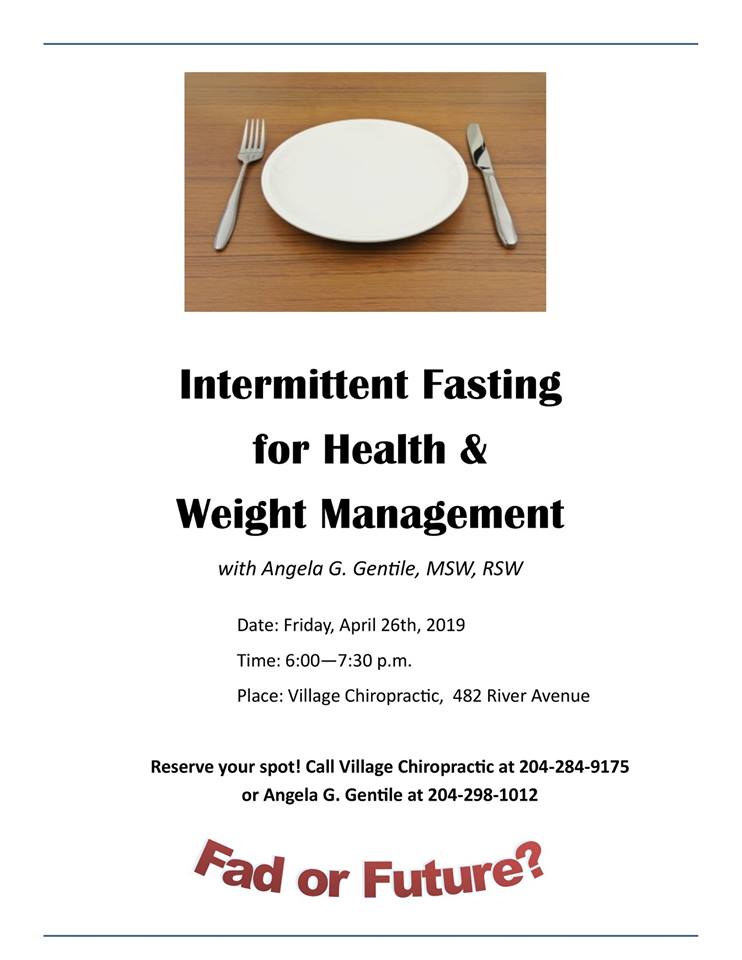
Please join me (Angela G. Gentile) at Village Chiropractic in Winnipeg (482 River Avenue) on Friday, April 26, 2019; 6:00 pm – 7:30 pm. I will be presenting an education session on “Intermittent Fasting for Health & Weight Management.” I’ve been practicing an IF lifestyle since December 26, 2018 and I haven’t looked back. I am excited to share what I have learned and I am looking forward to answering any questions you may have.

Please register soon – it’s FREE and spots are limited!


Angela G. Gentile, MSW, RSW

12 Tips for Making Healthy Nutrition Choices on an Intermittent Fasting Program

ID-100644350

Image courtesy of kerdkanno at FreeDigitalPhotos.net

Nutrition is an essential aspect of our overall health and well-being, no matter what our age. What we consume can make us gain weight, lose weight, or cause (or prevent) many health problems. I had lost 30 pounds during my cancer ordeal in 2017, and the weight started to creep back up. I realized that if I didn’t change my diet, I would probably gain the weight back and some. Scientific studies show a link between obesity and medical problems like cancer, high cholesterol, and diabetes. As I age, I want to be as healthy as I can and prevent any further medical problems – or recurrence of cancer.

After talking to my doctor about my concerns, I went to a dietician she had recommended. I told her I was following an intermittent fasting lifestyle, and the dietician was good with that as long as it’s working for me. In the hour I was with Marni, she listened to my concerns and gave me some great tips. She wants to help me make healthy choices during my “eating window.” She says my dietary habits need some “tweaking.”

Following are the words of advice that stand out for me. Keep in mind that each person’s situation will be different, and dietary recommendations given here are tailored to me, my situation and my overall goals. You may find some of these tidbits helpful, or you may want to see a dietician for your own personal advice.

#1. Consider the 80/20 Rule. For 80% of the make “healthy choices.” She said it’s okay sometimes (about 20% of the time) to eat or drink what we consider “fun foods.” We all need to satisfy our indulgences or treat ourselves once in a while. “Cheat days” are not encouraged. Instead, follow the 80/20 rule and you won’t feel guilty. FYI – 20% of equals 1½ days per week or about four meals in seven days. Read more about the 80-20 Rule.

#2. The 50/25/25 Plate. When filling up your plate, half should be vegetables, one-quarter protein, and one-quarter carbohydrates/starch. For some people, the carbohydrates can be reduced or eliminated. My doctor also told me to reduce the amount of carbs. For example, if I was having a piece of bread, cut it in half. Pasta, rice and other starches should also be consumed in smaller amounts. Here’s more info on the healthy portion plate. 

#3. Focus on Healthy Choices and Lifestyle (Not Weight Loss). Psychologists, dieticians, and obesity specialists are realising that they have to stop focusing less on weight loss as this does not help people keep weight off in the end. The focus has to be more on healthy choices and lifestyle. Also, the “set point” theory states our body is going to try and get to a certain weight, no matter what we do. If we weigh less than our set point, then our body is going to do whatever it can do to get to that weight. Case in point, on the TV sensation, “The Biggest Loser,” the contestants may have lost a lot, and I mean A LOT of weight. When some of these people were followed up six years later, they had gained most of the weight back, except for one contestant. This is a testament to the set point theory, and it is related to metabolism. All we can do is focus on healthy nutrition choices and lifestyle, and go by what our body is telling us. If it feels healthier with the choices we are making, then we can say that’s a win! The dietician told me, “Things have their way of coming together.” For example, if you are a runner, you may eat differently to fulfill your caloric needs.

#4. Know Your Why for Wanting to Lose Weight. I had to think about the reason why I wanted to lose weight. Was it because society tells me I “should” weigh less? Is it societal pressures on me as a woman? Is it because I want to “look” better? Or is it because I want to be healthier? For me, I know there are many reasons why. And what I do know for sure is that I don’t want to be overweight or obese.

#5. Keep Unhealthy Junk Food Temptations Out of the House. If you don’t have those unhealthy choices around you all the time, it’s a lot easier to avoid them. Instead of opening up the cupboard to find that unhealthy snack, you would have to drive to the store to get it. That little deterrent can help a lot. Having a supportive environment can help support healthy choice goals.

#6. Listen to Your Body – Eat When Hungry, Stop When Full. Some people don’t know what hunger feels like. If you are not hungry, don’t eat. When you do it, make sure you eat until you feel full. Eating more of the “healthy choices” will help prevent you from snacking and eating things you consider unhealthy — more quality AND quantity.

#7. Eat 1-3 Servings of Fruit a Day. Fruits are a good source of vitamins and minerals, and play a role in preventing vitamin C and A deficiencies. Read more about why fruit is so good for us. 

#8. Practice Mindful Eating. The first bite or sip of anything is the most satisfying and rewarding. We usually don’t need to eat much more than a bite or two to satisfy a craving. If what you desire is considered an unhealthy or “fun food” choice, try one or two bites, or a small amount. That’s probably all you need. We usually continue to eat something because we want that feeling to stay. But that’s usually not the case (e.g., potato chips and chocolate.)

#9. Follow the 2019 Canada Food Guide. There are lots of great tips and advice there. For example, water is recommended as the beverage of choice. Mindful eating is encouraged.

#10. Nuts and Legumes are Healthy Choices. These are considered good sources of protein and healthy fat.

#11. Dietary Fiber is Important. Beans, whole grains and brown rice are all good choices. Here’s the top 10 according to WebMD. 

#12. End Your Meal by Brushing Your Teeth. I like to end my meal with something sweet or fresh-tasting as I don’t like the food after-taste. I used to chew gum after, but in the evenings that cuts into my “fasting window” time. I was in the habit of eating chocolate or something else that was sweet (even marshmallows!). Options would be to brush my teeth, chew gum for a bit, or have a mint. A breath mint spray may also work.

The dietician was pleased that I have found something that works for me (intermittent fasting) and she is going to help me tweak it. She says regimens like WW (Weight Watchers) works for some people, and there are other programs that can help with making healthier choices. A good friend of mine has lost 20 pounds on WW! We are all different and it’s good to have choices on what works for us and complements our lifestyles. What works for one person may not work for the next.

I will consider all these tips and see what works for me. I know there are plenty more tips and you may want to add some of your own in the comments below. The dietician wants to see me again in April, and she has registered me for the Well 4 U exercise and education program. There is also a Fit 4 U program this fall that she recommends I attend.

By the way, she said I could have a little bit of dark chocolate every day! 1-2 squares daily is okay – even more if my body says I need it. But as it turns out, I gave up chocolate for Lent. No chocolate for me until Easter!

Angela G. Gentile, MSW, RSW

The ​Long Road to Recovery

IMG_7093

Anyone who has had or has cancer or any other chronic illness or disease knows there is a certain amount of time when they feel they are truly on the road to recovery, recovered, or have discovered their “new normal.” I am one of those people.

I was diagnosed with anal cancer in April 2017. I finished treatment in August 2017. One and a half years later, I can say I am starting to feel “recovered” for the most part – “still recovering” in other areas –– and have discovered my new normal.

My new normal includes ongoing and long-term physical rehabilitation as a result of pelvic radiation damage. I am not complaining (radiation saved my life!), I am just sharing that although some people look great after a big ordeal like cancer, there could be ongoing battles that you may know nothing about. Invisible wounds and scars are very common for people who have experienced cancer.

Recently I attended an art show, and I received a few compliments on my appearance (the picture above was taken at the end of a Hawaiian vacation last month). I know I am feeling much better physically, and my self-image is shaping up. My hair is almost all grown back and highlighted again; I am back to yoga once weekly, and I have started back on my elliptical and doing stretches and weights. I even started wearing my FitBit again. My modest goal of 6,000 steps daily is still a ways away, but at least I am working towards it.

I have also been enjoying my new “intermittent fasting” lifestyle and my relationship with food. I am feeling in control of my life and my body. It’s taken almost two years, but I finally feel like each day I feel better and better.

I am enjoying moderating and managing support groups on Facebook. The “Anal_Cancer Support” group on Facebook is doing amazingly well and has recently achieved the 10-year milestone and the 300th member. Having cancer has expanded my social network by leaps and bounds. A profound and harrowing experience can bring more people into your life – if you want it. You just have to open up and ask for it.

The “Dementia Caregiver Solutions Support Group” is also growing and the admin team recently expanded to include two new moderators who are actual caregivers. They join three professionals to moderate and keep things on track. I find comfort in knowing I have given caregivers this safe forum to share, vent, and get advice for such a difficult time in their lives.

I am also pursuing other volunteer opportunities to help me reach more people who may benefit from my experience, passion, and support. I seem to have an infinite amount of “help” to give, and I am looking for ways to do so –– in a way that will keep me balanced and not over-taxed.

I continue to write for a company called Trualta. I am enjoying my writing projects and look forward to writing for more companies and individuals as the opportunities present themselves.

I am also helping people get married, sort out their problems, write books, develop websites and more. I am starting to consider finishing up my book on aging well (this will be my fifth book!).  Where all this will take me? Who knows. The long road to recovery takes us places that we never dreamed of. I am looking forward to continuing on this journey.

Angela G. Gentile, MSW, RSW


My 72-Hour Fasting Experience, Part 4

images


During the day yesterday, I did really well. I was busy with work, and I was taking my water, S. Pellegrino mineral water, plain tea and salt. I got a little tired around 11:00 am (40 hours into my fast), and I figured it was because I hadn’t had my second cup of tea. I perked up in the afternoon, but work created some brain drain (intensive clinical work), so I was looking forward to going home and just resting on the couch in front of the TV.


My husband Cupp made some sausages and reheated some other food for himself for supper. The food odours were driving me crazy! I was very hungry. The site, smell or talk of food was very tempting and made me want to end my fast.


I managed to get through the evening unscathed, but I noticed when I got to bed, my heart was pounding and racing. I’ve had some heart issues since chemo-radiation in 2017 (checked out as “normal”) so I was thinking it’s just a little “blip” as I’ve had this before.


I had a restless sleep, mainly due to the racing heart. When I woke up, I felt like I had got enough sleep, in order to carry on for the remainder of my fast (another 12 hours or so) and the rest of the day. My heart was still pounding when I got up. So, I drank some water, and headed for the shower. I weighed myself, I was 158 pounds. I lost two pounds in one day. The total was now five pounds in 2.5 days of fasting.


In the bathroom, I started to feel a bit woozy, but I decided to get into the shower to help start my day. As I got into the shower and started running the water, I started feeling a bit weird. I was a bit shaky and weak. I looked down at my toenails and they looked a bit bluish. My heart starting pounding harder. I thought to myself, “This isn’t right.” The doctor had said if I feel faint or lightheaded, to stop my fast and eat something.


I cut my shower short, and went to check my heart rate. The effort it took to take a shower pushed my heart rate to 112 beats per minute (BPM). I knew I needed to eat something. But – I had come so far in my fast. I was disappointed. How far had I come? Maybe checking my Life app would help me decide what to to.

I opened up the app and it said I was 60 hours into my fast. “Wow!” I thought. I was actually satisfied with that number (I am sure I would have been satisfied with anything at this point!) I couldn’t see myself functioning the rest of the day without eating — waiting another 12 hours? I think my heart would have conked out!

I ended my fast at 7:15 am, 60 hours into my fast. I HAD to eat. The quickest thing I could think of was my favourite cereal with milk. It went down pretty good. I also made tea with milk. After I finished my cereal, I was still hungry. I figured I should have some protein, so I made an egg. I still wasn’t satiated, so I had some more cereal. My heart was still pounding. I was hoping my heart would settle down. I was eating more than my usual breakfast, that’s for sure!


At 8:15 am, I was feeling stronger. I wasn’t hungry, just thirsty. Drank some more water. I checked my heart rate, still at 112 BPM, but not as distressing. No more pounding. I drove to work for a staff meeting.


At 10:30 am, I was on break. During our staff meeting, we were celebrating a co-worker’s birthday. There was chocolate cake and other treats. I had some. I was feeling stronger as time went on. I walked down to the cafeteria to buy a tea. With the walking, my heart started working really hard! 122 BPM. I was hoping it wouldn’t get any worse!


At 12:00 noon our meeting had ended and I was driving back to the office. I was feeling good still. Had a chicken bacon ranch wrap with extra veggies.


At 12:45 pm I checked my heart rate again. Now it was at 97 BPM. Starting to slow down. Whew! Thank God!


So, although I didn’t make it to 72 hours, I am pleased with my results. 60 hours is no small feat! I hope that anyone who tries this does it with a doctor’s approval. I will be going back to my intermittent fasting routine of 17:7 on Friday. If I were to do another prolonged fast, I think I would keep it to 36 hours. Next steps is to go get my blood work done to see if it has helped rejuvenate my white blood cell count. I will post the results when I get them. I will also share my elevated heart rate experience with my doctor at the next visit.


Angela G. Gentile, MSW, RSW

My 72-Hour Fasting Experience, Part 3

fullsizeoutput_87

7:30 am. Half-way (36 hours) into my fast, I woke up after having a bad dream. I dreamed I was being chased by a large, vicious, hungry lion! I haven’t remembered my dreams that vividly for a long time. I was in some sort of building, a school perhaps, and I heard a loud rustling noise. My intuition told me danger was lurking. As the noise got closer, I saw the lion coming around the corner! I ran into a room and locked the door. That’s when I woke up. (Maybe it was all that thinking about hungry animals yesterday that brought it on!)

img_2474

I felt noticeably “lighter” this morning, so I stepped on the scale. I lost three pounds! Now going from 163 to 160 isn’t a lot when you look at the bigger picture, but wow, it’s interesting how lighter one can feel after not eating for 36 hours!

My energy is still good. I have a slight little nagging headache, but that will soon pass once I have my green tea and some Himalayan pink salts (I hope!). (See the screenshot above of the app I am using, it’s called LIFE.)

I will be working today so I will be kept busy.

Angela G. Gentile, MSW, RSW


My 72-Hour Fasting Experience, Part 2

img_2468

I am 24 hours into my fast (48 to go!), and the first day went pretty well. I have been drinking water, green tea, San Pellegrino and taking some Himalayan pink salt every once in a while. I worked today, so I have been keeping busy and distracted.

At 1:20 pm (“Lunch break” – 18 hours into my fast) I noted I hadn’t really felt hungry at all, and I had lots of energy still.

It was a bit difficult when I got home, as my husband and daughter were making dinner. The smell of food makes me want to eat! But, I am proud to say I was able to sit at the table with them while they ate. I had my black tea and I was fine!

Watching TV is torturous! Every second commercial is about food!

I was thinking about the idea of energy and alertness. When wild animals are hungry, they are super alert and on the lookout for their next meal. Hunting takes a lot of energy. I guess that’s kind of how I feel. I am mentally alert and feel I can keep going until Thursday at 7:15pm. At least that’s how I feel right now.

I decided to take my magnesium citrate supplement. I passed on the others.

I found this video on a three-day water fast and Dr. Zyrowski answered some of my questions about how to break the fast. He suggests steamed veggies and bone broth, but I am already dreaming of bacon and eggs! I guess time will tell.

Watch: 3 Day Water Fast – A How To Guide

with Dr. Nick Zyrowski

I also watched another video where two younger guys, who had practically no body fat and lots of muscle, challenged themselves to a 72-hour fast. They only got to 50 hours.

Let’s see how I do. I have more body fat so maybe I’ll be okay.

Angela G. Gentile, MSW, RSW


My 72-Hour Fasting Experience, Part 1

72-hour fastthat's three days!

On 14 Jan 2019, I saw my doctor and discussed my interest in trying a 72-hour fast. I explained that I have been doing intermittent fasting for the last 20 days and I also experienced one 24-hour fast already. I am feeling great, and I wanted to explore the possibility of a prolonged fast that could also help boost my immune system.

I had chemoradiation 17 months ago, and my white blood cell count has been running at a moderately-low level for a few months now. I was told that if I got a fever, I would have to go to the hospital, as “leukopenia” can make it difficult for my body to fight off infection. Also, whenever I get a little cut or something, I am very diligent at making sure I keep it clean and put Polysporin on it.

My doctor explained to me that a prolonged fast will make the liver work harder and my body may experience “starvation” mode. She explained that there are many people who fast for religious reasons, and in fact, her mom has done 72-hour fasts (she would drink only water and black tea or coffee.) She told me that she, herself, couldn’t do it. She also said she can’t “promote fasting” and suggested I speak to a dietician (as it is provided by our provincial healthcare services). I was quite convinced that I can do it without the dietician’s involvement, and I am motivated to see if it can help improve my immune system (as there are studies that show it can help).

Watch: Fasting: Awakening the Rejuvenation from Within

TedXEchoPark with Dr. Valter Longo

My doctor cautioned that if I feel faint or lightheaded, that I should stop the fast and eat something. I told her I will make sure I stay safe and I will always have water and something to eat with me. She gave me a requisition for lab work – including blood glucose and white blood cell counts. She said to get my blood tested in a fasting state and about one month after my prolonged fast has ended.

I plan to do my 72-hour fast starting tonight, after dinner. I will document how it goes in a subsequent post. Wish me luck!

Warm regards,

Angela G. Gentile, MSW, RSW