
Creative Retirement Manitoba – Memory and Aging Program™
I first heard Dr. Ronak Patel, clinical neuropsychologist, speak about the Memory and Aging Program™ last fall here in Winnipeg. This is an evidence-based program that comes out of Baycrest Centre for Geriatric Care in Toronto, Ontario. Many of us fear developing dementia in our older years, and many of us start to get worried when we have memory problems. Now there is a program to help enhance memory skills that works. (It doesn’t prevent Alzheimer’s or related dementias, however.)
I met up with a friend, Sherry Cels, a retired social worker, who completed the Memory and Aging Program™. She says it is a very popular program, and there is a wait list for people who want to go. It’s very popular with those 60 and over who are experiencing memory problems.
For Sherry, at 70, she was worried about her own cognitive health and memory skills. One of her parents had Lewy Body dementia, and she was concerned she may have inherited the condition.
I asked her, if after taking the course, was she still worried about developing Lewy Body dementia and she replied,
“There is no predicting that. But for now, I believe my memory problems are very normal for my age group. Sharing with others in the class helped me see that.”
Not everyone has problems in this area, but she learned it is quite normal to experience changes and there are things that can be done to combat these memory problems. I asked her to tell me about the Memory and Aging Program™ she attended.

The workshop was $150.00 and it is held at the classroom at 1075 Portage Avenue in Winnipeg (The Creative Retirement Manitoba office). Free parking is available. The building has an elevator, but unfortunately it isn’t reliable. Space is limited to 25 participants. They met once weekly for five sessions, of two-hours duration (1:30-3:30pm). She said everyone, except for one man, attended every session. No one stayed home!
They are given a 74-page participant workbook, “A Practical Guide to Managing your Memory: Memory and Aging Program™.” It has “Baycrest” on the cover, and it is authored by Dr. Angela K. Troyer and Dr. Susan Vandermorris. It’s unfortunate that the binding is already falling apart, but the content is very useful (it’s well-used!). This was the book that Dr. Patel used during the course. It includes worksheets and space for notes. Each participant had “at home” activities to complete between sessions.
The content includes three sections:
- The Science of Memory
- Memory Strategies
- Putting your Skills to Practice
The main focus of the course was on the Memory Strategies portion. The acronym SHARP is used, which stands for:
SHARP:
-
Seeing and Saying
-
Habits
-
Associations
-
Records
-
Practice Retrieval

Sherry learned about associations, and how it can help her learn names. For example, she has a beautiful garden in her backyard. In order to remember the names of flowers, she makes an association with them. She doesn’t forget the name of the “climbing” Clematis anymore. She is able to remember her license plate by giving each letter a name of the people she knows or knew. I was impressed when she told me the names of the new neighbours, including their kids names, based on association!
She uses the same purse she’s had for years because it helps with remembering where everything is. This is an example of the the “Habit” strategy she learned about. This made me well aware of the fact that I need to decide what purse pocket to put my keys in because I can never remember which pocket I put my keys in! Sherry learned we can develop new habits to help us remember things more easily.
Sometimes habit can backfire though. We laughed as we could both relate to our forgetfulness in the shower. For example, we both use shampoo and conditioner. We sometimes forget if we’ve used the conditioner or not!
“Hmm, let me think? Does my hair feel like it was conditioned? Did I use conditioner?”
To help correct this memory issue, we are to pay attention to what we are doing, instead of doing activities on autopilot. At least if we put our seat belt on without thinking about it, we can easily check to make sure it’s fastened. This reminded me of the term “mindfulness” and how we can be more in tune with our actions if we pay more attention and be mindful of what we are doing.

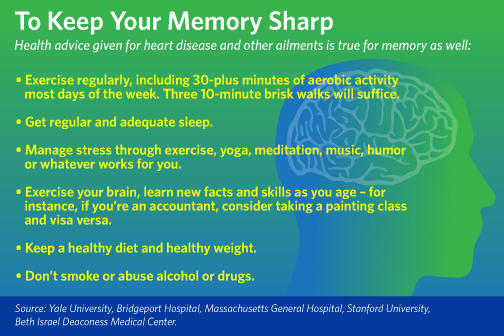
Deep breathing and visualization (such as meditation) is recommended for managing stress and promoting relaxation.
An important part of the program is keeping a log of your activities. The program recommends at least 100 minutes a week of physical activity (to get the blood flowing to the brain for good brain health) and cognitive activity which includes brain exercises and socializing with others. Good nutrition is also an important part of nurturing our bodies and brains for good brain health. Canada’s Food Guide can also be helpful.
Sherry and I were also discussing the different ways we prefer to learn and remember things. I like to write things down, as doing this can help me remember. How many of us write our shopping list out, then can still remember the items on the list although we forgot the list at home? When receiving and retaining information, some of us need to see it, others need to hear it. Some of us may also say it out loud to ourselves to help remember. Others like to do or act it out. The four main learning styles are: Visual, Auditory, Kinesthetic (movement) and Tactile (touch). Exploring what your preference is and implementing it can make a big difference in remembering.
The main takeaway for Sherry was the emphasis on lifestyle and memory strategies. She felt very uplifted. The group discussions among the participants were quite helpful. She says with the cocooning phase of a Winnipeg winter, she found her “memory slipping,” and this course has motivated her to make lifestyle changes, such as “more physical and cognitive activity.” Adding to this, several new strategies practiced in the five weeks of the course has resulted in an improved memory and more positive attitude. She would highly recommend it anyone 60 or older who is experiencing mild memory problems.
Angela G. Gentile, MSW, RSW
http://www.AngelaGGentile.com





 Angela G. Gentile